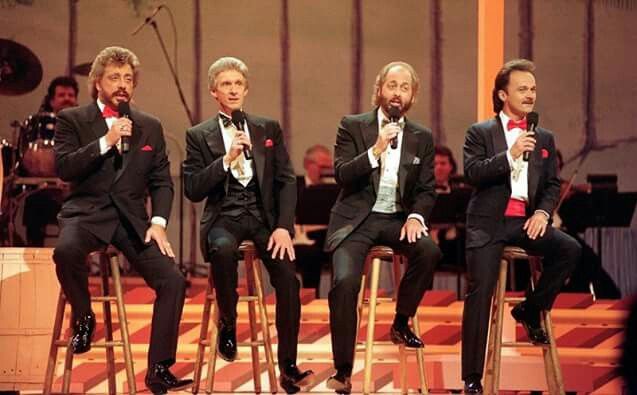
A country-gospel quartet found the pop doorway by making loneliness sound sly, precise, and almost cheerful.
In 1965, The Statler Brothers released Flowers on the Wall, the Lew DeWitt composition that carried their four-part harmony from a country and gospel foundation into the center of mainstream pop attention. The record became their first major crossover success, reaching both country listeners and the wider pop audience without disguising what the group was: a vocal quartet built on balance, character, and the pleasure of voices locking together with exactness.
The group’s sound came from a lineage older than the pop moment that received them. Don Reid, Harold Reid, Phil Balsley, and Lew DeWitt had the architecture of gospel quartet singing in their blend: a low voice that could give the harmony weight, inner parts that kept the chord standing, and upper lines that added brightness without becoming showy. By the mid-1960s they were also connected to the touring world of Johnny Cash, a setting where country storytelling, gospel feeling, humor, and plainspoken performance could live side by side. Flowers on the Wall drew from that mixture but moved with its own peculiar stride.
What makes the single so clever is the way it refuses to announce its sadness. The narrator insists that everything is fine, then offers evidence that quietly argues against him: counting flowers on the wall, playing solitaire with a deck missing a card, watching television, filling the hours with small routines that seem comic until their emptiness begins to show. The song does not ask for pity. It lets the joke do the exposing. That restraint is part of its emotional power. Instead of presenting loneliness as a dramatic wound, it shows loneliness as maintenance, as habit, as the work of convincing oneself that a room is not too silent.
The arrangement understands that tension. The rhythm is brisk, almost jaunty, and the vocal attack is clean enough to make every line feel deliberate. Nothing drags. The record smiles at the surface, and the harmonies help keep that smile in place. Yet the four voices also create a strange little room around the lead line, as if the narrator’s own thoughts have learned how to answer him in perfect chordal agreement. The precision is not merely decorative. It becomes part of the character: orderly voices describing an inner life that may not be orderly at all.
That was the Statlers’ gift in miniature. They could make a song sound friendly without making it simple. Their harmony was approachable, but it had personality in every part. Harold Reid’s bass presence gave the group a grounded comic edge, while the upper and middle voices kept the blend nimble. The result on Flowers on the Wall is not just a novelty mood, though the song certainly uses wit. It is a portrait of denial delivered with such polish that the listener may laugh first and understand later.
As a 1965 crossover record, it arrived in a pop landscape full of competing sounds: British Invasion bands, folk-rock, soul, Nashville productions, and vocal groups of many kinds. The Statlers did not cross over by chasing the loudest trend. They crossed over by letting their roots become the unusual feature. A country-rooted quartet with gospel discipline and comic timing sounded distinctive on pop radio precisely because it did not flatten itself into the expected shape. The song’s success showed that a group could reach beyond its home audience while keeping its accent, its humor, and its formal craft intact.
The record also helped define the public identity the group would continue to develop: literate, wry, harmony-centered, and alert to the ordinary strangeness of American life. The Statlers often found drama not in grand confession but in familiar rooms, remembered names, family language, and the ceremonies of everyday people. Flowers on the Wall pointed the way by making a small domestic scene feel theatrically alive. Its narrator is not a hero or a tragic figure. He is someone trying to sound convincing while the song gently lets the truth slip out between the rhymes.
Part of the reason the performance still feels sharp is that it trusts the listener. It does not over-explain the loneliness, nor does it turn the humor into a shield too thick to see through. The Statlers keep both elements in motion. The record is funny enough to be memorable and disciplined enough to be musically satisfying, but its deeper ache comes from the gap between what the voice claims and what the details reveal. In that gap, the harmony becomes almost compassionate. It surrounds the narrator without correcting him.
For a mainstream audience meeting The Statler Brothers through this single, Flowers on the Wall offered something unusually complete: a hook, a character, a sound, and a point of view. It did not need to announce the arrival of a serious vocal group. It simply let the voices do their work. The lesson of the recording is quiet but durable: sometimes artistic reach comes not from smoothing away the odd corners, but from trusting them until other people can hear their shape.
