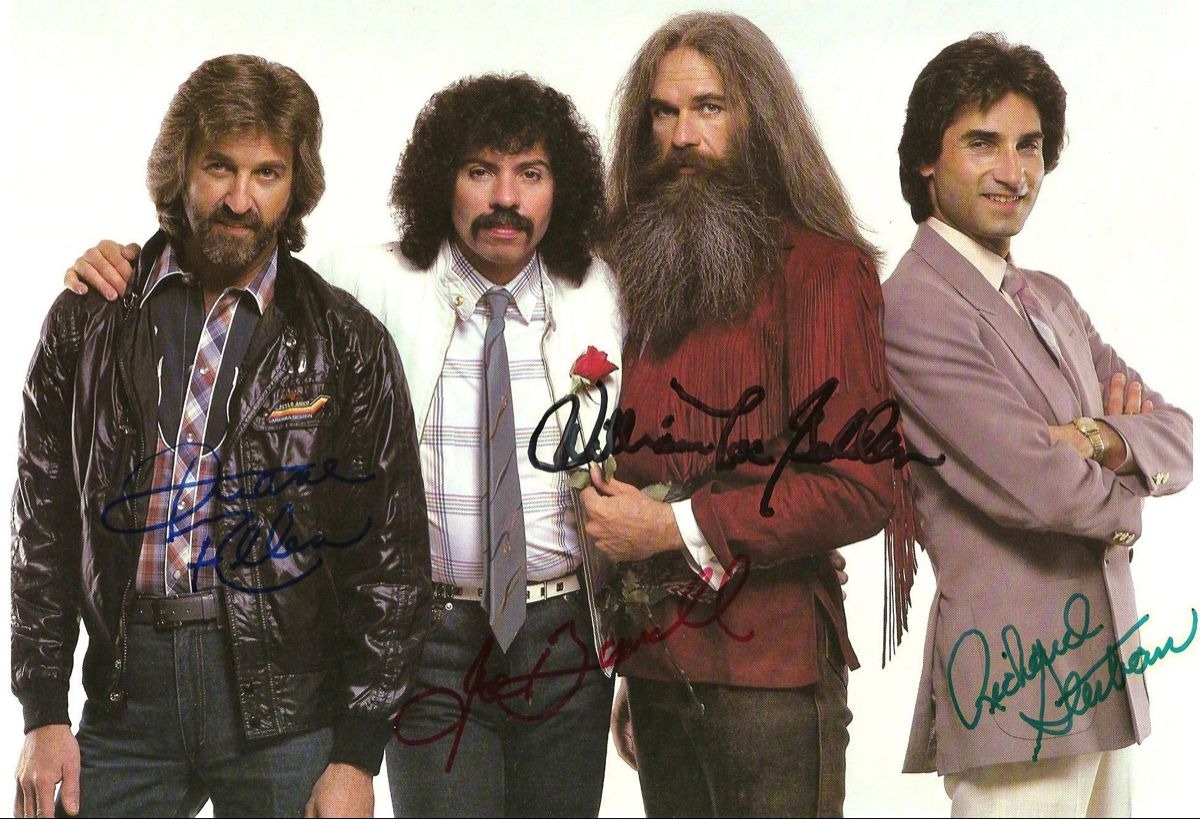
The Oak Ridge Boys turned a child’s wonder into one of country radio’s gentlest adult reflections.
In 1982, The Oak Ridge Boys recorded Thank God for Kids, a song written by Eddy Raven and released as a single from the group’s album Christmas. It fit naturally beside holiday music, but it was not simply a Christmas record. Its world was the family home: Santa Claus in the imagination, television characters in the living room, questions asked with complete seriousness, stains on the couch, and the sudden recognition that children make ordinary rooms feel morally larger.
By that moment, The Oak Ridge Boys had become one of country music’s most recognizable vocal groups. Their background in gospel harmony gave them a disciplined blend, while their late-seventies and early-eighties country success had brought them to a wide mainstream audience. After the brightness and drive of songs such as Elvira and Bobbie Sue, Thank God for Kids revealed a softer public face. It did not depend on novelty, flash, or rhythmic swagger. It depended on tone.
The recording understands that a sentimental subject can easily become too heavy if the performance presses too hard. The arrangement leaves room around the words. The pace is unhurried, the production rounded in the early-eighties country style, and the group’s harmonies enter like family members gathering around a shared memory. Rather than treating the lyric as a sermon, the voices carry it as a conversation overheard in a home after the day has slowed down.
That restraint matters because Thank God for Kids is built from small, domestic images. It does not speak in grand declarations at first. It begins with the playful evidence of childhood: Santa Claus, Mickey Mouse, Big Bird, Kool-Aid on the couch. These details are simple, but they are not trivial. They locate wonder inside inconvenience. The song’s gratitude is not for an idealized childhood kept safely in a frame; it is for the real presence of children, with their mess, noise, questions, and trust.
As a vocal-group performance, the song gains an emotional shape that a lone narrator might not have given it. The blended voices make the reflection feel communal rather than private. One singer may carry a line, but the surrounding harmony suggests a larger circle of witness: parents, grandparents, neighbors, and listeners who recognize the same ordinary scenes from their own lives. Country music has often been strongest when it turns everyday language toward moral attention, and here the group’s sound gives the lyric that exact kind of lift.
Eddy Raven’s writing gives the song its plainspoken center. The lyric moves from household clutter toward a more serious adult realization: children do not merely decorate life; they reveal responsibility. Their questions require patience. Their trust asks for steadiness. Their presence interrupts self-importance. In the hands of The Oak Ridge Boys, those ideas arrive without harshness. The recording lets gratitude feel like something learned slowly, through repetition, care, and the daily work of being needed.
This is one reason the 1982 recording found such a lasting place on classic country radio. It carries the atmosphere of its era without being trapped inside it. The warm studio finish, the clean vocal blend, and the family-centered lyric all belong recognizably to early-eighties country, a time when polished productions could still keep close ties to home, faith, and rural memory. Yet the heart of the song is not nostalgia for a particular decade. It is nostalgia for a state of attention adults often lose.
The title itself sounds simple enough to risk being overlooked. But in performance, Thank God for Kids becomes less about childhood as a theme and more about humility as an adult condition. The song asks the listener to see spilled drinks, cartoons, bedtime questions, and holiday myths not as background noise, but as signs of a life being asked to love beyond convenience. That is a quiet kind of inspiration: not a command to become better, but a reminder that tenderness often begins with noticing what is already in the room.
What remains most affecting is how little the record needs to prove. The Oak Ridge Boys do not turn the song into spectacle. They keep faith with its scale. The performance honors the family table, the living room, the child’s question, the tired adult who tries to answer. In doing so, their 1982 version of Thank God for Kids preserves a modest but durable truth: sometimes the deepest gratitude is not found in silence, but in the beautiful disorder that teaches a heart to listen.
