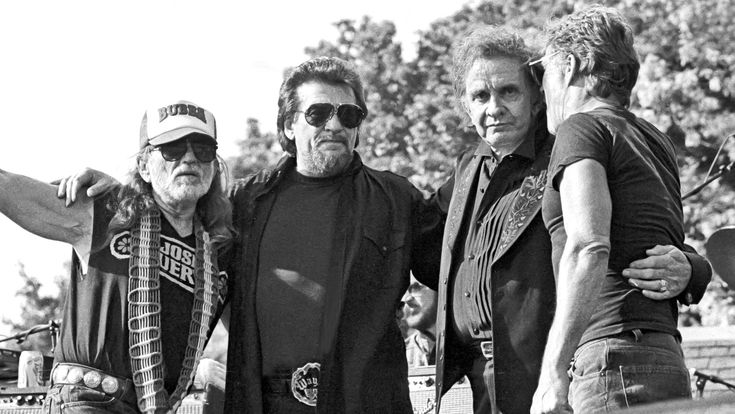
In 1985, four country voices became one traveling myth without losing their rough individual edges.
“Highwayman”, released in 1985 by Johnny Cash, Waylon Jennings, Willie Nelson, and Kris Kristofferson, did more than introduce a country supergroup. It gave that group its identity. Written by Jimmy Webb, the song became the title track of the album Highwayman and the first great statement from the partnership later known simply as The Highwaymen. Its power came from a rare alignment: four unmistakable singers, each already carrying a long public story, stepping into a song about death, return, labor, danger, and endurance.
By the mid-1980s, each man had already helped redraw the map of country music. Cash brought the grave authority of folk balladry, prison songs, gospel memory, and American shadow. Jennings carried the defiant pulse of outlaw country, a sound toughened by rhythm and refusal. Nelson’s voice moved with conversational looseness, bending time as if melody were something he could lean against rather than obey. Kristofferson brought the songwriter’s weathered intelligence, a plainspoken poetic quality that made hard lives sound witnessed rather than judged. In lesser hands, gathering four such presences might have produced only a display of fame. “Highwayman” works because it gives each one a role that feels both theatrical and strangely personal.
The structure is simple and decisive. Rather than asking the four singers to merge immediately into harmony, the song lets them appear one at a time, as if each voice were arriving from a different century. Nelson opens as the highwayman, a figure of danger and motion, riding through an older world of roads, robbery, and consequence. Kristofferson follows as a sailor, lost to the sea but not erased by it. Jennings takes the verse of the dam builder, a worker sacrificed to modern progress, buried in the concrete and machinery of the new world. Cash closes the sequence as a starship pilot, carrying the song out of history and into the imagined future. The movement is astonishingly broad: from horse roads to ocean, from public works to outer space. Yet the refrain holds it together with a calm insistence that the singer will return.
That idea of return is central to the recording’s emotional force. Jimmy Webb wrote a song of reincarnation, but the 1985 version turns the concept into something larger than a mystical premise. Sung by these four men, it becomes a meditation on artistic survival. Their voices were not polished into anonymity. They retained grain, age, breath, and personality. You hear Nelson’s supple phrasing, Kristofferson’s rugged plainness, Jennings’s grounded strength, and Cash’s deep finality. The arrangement supports them without crowding them, leaving space for the verses to feel like separate lives joined by one recurring spirit.
The casting of the verses is one of the reasons the recording feels so inevitable. Nelson’s opener has the ease of a wanderer who understands the road not as scenery but as fate. Kristofferson’s sailor verse carries the fatalism of a writer who knows how quickly romance can turn into reckoning. Jennings, singing of the dam, brings a workingman’s solidity; his voice makes the verse feel physical, weighted by stone, water, and machinery. Cash’s final verse is the boldest turn, because it could have become novelty. Instead, his voice gives the starship image a solemn credibility. When Cash sings of flying across the universe, the futuristic setting feels less like science fiction than another frontier ballad.
The song also arrived at a moment when the idea of the country “outlaw” was changing. In the 1970s, the label had suggested rebellion against Nashville polish, a demand for rougher textures, personal control, and a more adult emotional range. By 1985, these men were not newcomers fighting for permission. They were established artists with histories behind them, and that altered the meaning of their collaboration. “Highwayman” does not sound like youthful revolt. It sounds like veterans recognizing one another across different kinds of miles. The legacy angle is built into the performance: not a passing of the torch, exactly, but a gathering around a shared flame.
There is also restraint in the record that deserves attention. A project involving four major figures could easily have leaned on spectacle, but “Highwayman” trusts the song’s architecture. The drama comes from sequence, contrast, and inevitability. No singer needs to overstate the emotion, because the lyric itself keeps widening. Each death is followed by another life. Each ending becomes a doorway. By the time the voices converge, the song has traveled through several forms of American myth: outlaw, sailor, builder, explorer. The group legacy is not built on sameness, but on the dignity of difference held in common purpose.
As a signature track, “Highwayman” gave Johnny Cash, Waylon Jennings, Willie Nelson, and Kris Kristofferson a shared emblem strong enough to define their collaboration. It did not erase their solo identities; it arranged them into a larger pattern. That is why the recording still feels so balanced. It lets each artist remain fully himself while suggesting that some songs are spacious enough to hold more than one lifetime.
Its lasting appeal lies in that rare combination of myth and humility. The song imagines endless return, but the performance is grounded in human texture: four voices marked by experience, meeting inside a melody that understands disappearance without surrendering to it. In “Highwayman”, legacy is not treated as a monument. It moves, changes shape, takes another road, and keeps singing from somewhere just ahead.
