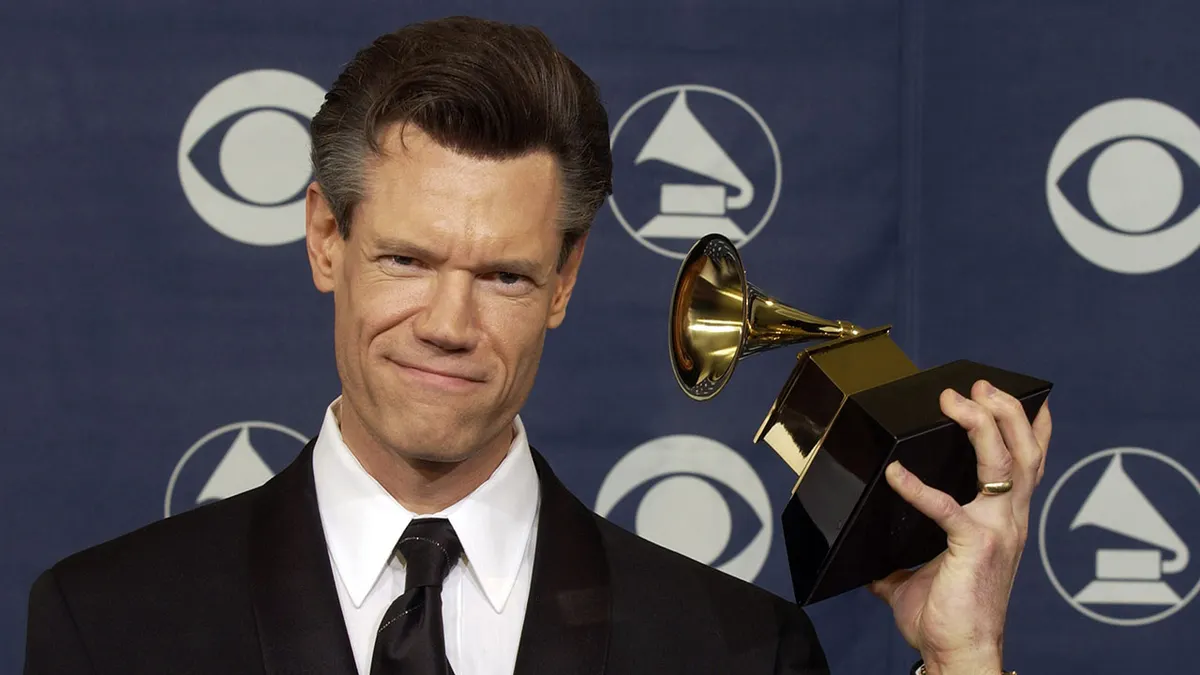
A traditional country song needed a second chance before it opened the first great door for Randy Travis.
In 1986, the reissue of “On the Other Hand” gave Randy Travis his first number-one country hit, turning a once-overlooked single into one of the defining moments of his debut album, Storms of Life. The song had first appeared as an earlier Warner Bros. single before the album fully announced him to country radio, but its return mattered. After “1982” had brought Travis wider attention, “On the Other Hand” came back with a clearer audience waiting for it. What had sounded almost too plain for the moment suddenly felt exact.
The recording did not ask for attention by force. Written by Paul Overstreet and Don Schlitz, the song is built around a simple moral and emotional contrast: one hand carries the symbol of a marriage, while the other hand is tempted toward someone else. It is a lyric of hesitation rather than action, and that is where Travis’s performance finds its strength. He does not oversing the guilt. He lets the words sit in the lower reaches of his baritone, where the tension feels lived-in but never theatrical.
That restraint was crucial. In the mid-1980s, mainstream country music often made room for smooth crossover polish, and Travis arrived with a voice that seemed to lean backward without sounding like an imitation. His singing carried the weight of older country phrasing: rounded vowels, careful pauses, a deep sense of line. Yet the record was not a museum piece. Under the guidance of producer Kyle Lehning, the arrangement kept the frame clean enough for radio, giving the traditional center a contemporary clarity.
Listen to how the recording moves. The tempo is measured, not dragging. The instruments do not crowd the vocal. Steel guitar and understated country textures create a room around the story, while Travis remains steady at the center. The effect is not confession shouted from a stage; it is a private argument rendered in public form. The narrator knows the pull of desire, but the song’s drama comes from the decision to recognize a boundary before crossing it. In Travis’s hands, that choice sounds less like moralizing than like discipline under pressure.
That was part of the larger force of Storms of Life, released in 1986. The album did not introduce Travis as a flamboyant new star chasing the sound of the day. It presented him as a singer deeply aligned with country music’s older grammar: heartbreak, loyalty, domestic strain, ordinary temptation, consequences that arrive quietly. “On the Other Hand” fit that world perfectly. Its success showed that a spare, traditional country recording could still cut through when delivered with conviction and precision.
The fact that the song needed a reissue gives the breakthrough a particular emotional shape. Some records arrive before the audience has learned how to hear the artist. The first release of “On the Other Hand” did not become the career-making hit it later became, but the song itself did not change into something louder or easier. The context changed. By the time it returned, Travis had begun to establish an identity, and country listeners were ready to meet the song on its own terms. The number-one success was not a reinvention of the recording so much as a recognition of what had been there all along.
There is a quiet lesson in that timing, though the song itself never turns into a slogan. Breakthroughs in music are often described as sudden, but they can also be cumulative: a voice finding the right song, a label giving a track another chance, radio responding after one door has already opened. Randy Travis did not need to make “On the Other Hand” bigger to make it work. He needed the space for its stillness to be understood.
That stillness remains the reason the recording feels so central to his early career. It introduced not only a singer with a remarkable baritone, but an artistic posture: trust the song, honor the line, do not decorate the feeling beyond recognition. In a career filled with later signature recordings, the 1986 reissue of “On the Other Hand” stands as the moment when restraint became momentum. It proved that a country song could turn on a small symbol, a wedding ring, a pause, a hand withheld, and still carry enough force to open a lifetime’s path.
The breakthrough was not loud. It was steady, measured, and deeply country. That is why it endures in memory as more than a first number one: it is the sound of an artist being heard clearly, after the world had taken just long enough to catch up.
