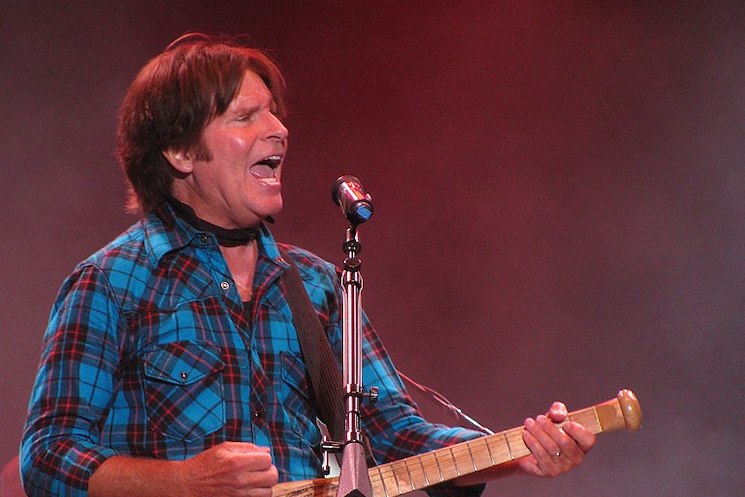
John Fogerty turned the wounds of 2020 into a gospel protest that sounded like a public lament.
In early 2021, John Fogerty released Weeping in the Promised Land, a standalone single shaped by the pandemic, public grief, and the fierce divisions that had marked the previous year. The song arrived with the weight of an American season that had not truly ended: hospitals strained by COVID-19, families separated, streets filled with argument and mourning, and a national conversation often too loud to hear itself clearly. Fogerty did not answer that atmosphere with escape. He answered it with a protest song built like a lament.
That choice matters because Fogerty has long understood protest not only as accusation, but as sound. In Creedence Clearwater Revival, he gave the late 1960s and early 1970s some of their most direct musical reckonings, from Fortunate Son to Who’ll Stop the Rain. Those songs were compact, earthy, and plainspoken, carried by a voice that could make civic anger feel physical. Weeping in the Promised Land belongs to that lineage, but it does not simply attempt to recreate it. It is the work of an older songwriter looking at a different kind of national emergency and choosing a slower, more openly wounded language.
The title itself holds the song’s central tension. The phrase Promised Land carries biblical resonance, but in Fogerty’s hands it also points toward the American promise: safety, fairness, dignity, community, the belief that a country can do better than its worst reflexes. To place weeping inside that promise is to expose the distance between aspiration and daily reality. The protest energy of the song comes from that gap. Fogerty does not need to overstate it. The image is already severe enough: a place imagined as deliverance, filled instead with mourning.
Musically, the single leans into gospel-tinged colors rather than the swamp-rock drive most closely associated with Fogerty’s classic era. The arrangement feels less like a sprint than a procession. Piano and organ-like textures suggest a room where grief has gathered and is trying to become witness. The rhythm gives the song a steady forward motion, but the emotional center is not triumph. It is endurance. Fogerty’s voice, weathered and unmistakable, carries the lyric with a rough moral urgency. He sounds less interested in polish than in making the words land.
That restraint gives the recording much of its force. A protest song can easily become a set of slogans, especially when written close to the events that provoked it. Weeping in the Promised Land avoids that by letting lament do some of the work anger usually does. The gospel feeling is not decorative; it changes the scale of the complaint. It turns political fracture into something closer to a collective reckoning, a moment in which the singer is not standing outside the damage, but speaking from inside it. The song’s spiritual vocabulary widens the frame without making the crisis abstract.
The timing also sharpened its meaning. After a year when live music had largely been interrupted, many artists were searching for ways to respond to distance and uncertainty. Fogerty had been visible during the pandemic through family performances and home-recorded music, a setting that often brought warmth and familiarity. Weeping in the Promised Land stepped away from that comfort. It placed him back in the role of public witness, not as a nostalgic return to the protest era, but as a reminder that protest music belongs to any moment when language fails and song has to carry moral pressure.
There is a particular gravity in hearing Fogerty address 2020 from the far side of his own long career. He had already written songs that became shorthand for disillusionment, class resentment, and rain-soaked uncertainty. By 2021, he did not need to prove that he could write a protest anthem. Instead, he used his authority with restraint. The song does not pretend that experience grants easy answers. If anything, it suggests the opposite: that the longer one watches history repeat its patterns, the more necessary it becomes to speak plainly, even when the speaking cannot fix what is broken.
The gospel influence gives the single a sense of communal space. Even when heard alone, it seems to imagine other voices nearby, not as a crowd cheering, but as people bearing witness together. That is where the song’s energy lives. It is not only in outrage, but in refusal: refusal to let suffering become background noise, refusal to let division be treated as weather, refusal to let the language of promise go unchallenged when the evidence of grief is everywhere. Fogerty’s protest is not polished into comfort. It keeps its edges.
What makes Weeping in the Promised Land quietly inspiring is not optimism in the simple sense. The song does not decorate a painful year with easy hope. Its strength lies in the older, harder act of looking directly at a wounded public moment and giving it a form that can be sung. Fogerty reminds us that protest music is not only a shout from the street; it can also be a lament strong enough to stand upright. In that space between sorrow and resolve, the promised land becomes not a possession, but a task still waiting to be honored.
