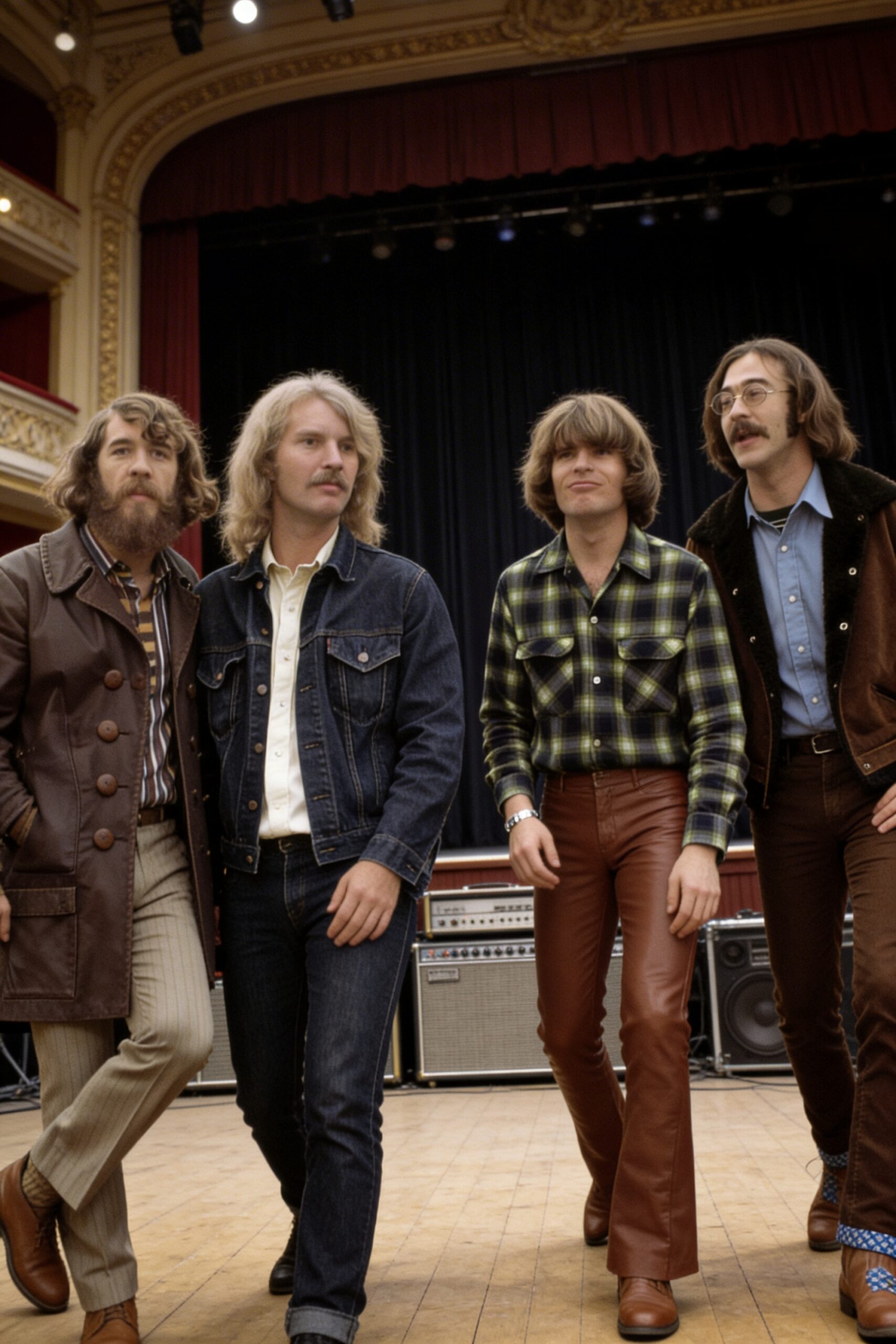
Before the hits on Cosmo’s Factory unfold, Ramble Tamble opens the door with speed, discipline, and a sudden widening of the road.
Released in 1970 as the opening track of Creedence Clearwater Revival’s fifth studio album, Cosmo’s Factory, Ramble Tamble is one of the band’s most revealing studio constructions. Written by John Fogerty, who also produced the album, the song runs a little over seven minutes, an unusual length for a group so often remembered for concise, hard-driving singles. Its importance is not simply that it is long. It matters because of how it uses length: as a test of tension, tempo, and control.
Cosmo’s Factory arrived during a remarkably productive period for the band. Recorded around 1969 and 1970 at Wally Heider’s Studio in San Francisco, the album gathered original songs and covers into a record that sounded direct even when it stretched out. The title itself came from the band’s nickname for its rehearsal space, connected to drummer Doug Clifford’s nickname, Cosmo, and to the workmanlike routine that shaped the group’s sound. That background fits Ramble Tamble especially well. It does not feel like a decorative experiment. It feels like a machine being pushed to see how much pressure it can carry.
The opening section arrives fast, bright, and almost impatient. The rhythm has the snap of early rock and roll, with a country-edged guitar attack and a rhythm section that refuses to loosen its grip. John Fogerty sings with clipped force, driving through images of disorder that feel domestic and social at once: trouble in the house, trouble in the streets, trouble in the water. The language is not elaborate, but it is crowded with irritants. The song begins as if everyday life has become too full of noise to ignore.
Then the track does something that still feels startling. Instead of staying in that compact burst of rockabilly energy, it downshifts into a long instrumental passage, slower and heavier, built around a persistent guitar figure and a steady pulse from Stu Cook and Doug Clifford. The tempo change is not a simple break for a solo. It changes the geography of the song. What began as a complaint becomes a road, a landscape, a stretch of time in which the band holds back the urge to resolve too quickly.
This middle section is where Ramble Tamble most clearly separates itself from the more familiar image of Creedence Clearwater Revival as a singles band. There is no orchestral expansion, no psychedelic haze, no elaborate studio trick presented as spectacle. The exploration is physical and rhythmic. The guitars keep circling, the drums keep the frame steady, and the bass gives the music a grounded insistence. The arrangement does not wander; it bears down. In that restraint, the track finds its intensity.
The tempo shifts matter because they reveal how disciplined the band’s looseness could be. Many extended rock recordings of the era leaned toward virtuoso display, but Ramble Tamble remains stubbornly ensemble-minded. The long passage works because nobody steps outside the song’s weather. Tom Fogerty’s rhythm guitar, John Fogerty’s lead lines, the bass, and the drums all serve the same forward pressure. Even when the track expands, it keeps the dry, unvarnished character that made Creedence sound unlike the more ornate bands around them.
When the faster section returns, it does not feel like a repeat so much as a release. The opening’s agitation has passed through the instrumental stretch and come back sharpened. That is the hidden architecture of the piece: rush, widen, endure, rush again. The song’s seven minutes are not there to inflate a simple idea. They allow the band to dramatize momentum itself, to make the listener feel the difference between speed and force.
Placed at the start of Cosmo’s Factory, Ramble Tamble also frames the album’s larger identity. This is the same record that contains compact radio-ready songs and a long reading of I Heard It Through the Grapevine. By beginning with an original that stretches its shape without abandoning its roots, the album announces a band confident enough to be both plainspoken and ambitious. Creedence did not need to disguise the studio as fantasy. They could make a room, four players, and a hard pulse feel expansive.
That is why Ramble Tamble continues to carry such force. It captures a group at full working temperature, trusting repetition, tempo, and pressure instead of ornament. Its intensity is not chaotic; it is measured. Its length is not indulgent; it is earned. In the first seven minutes of Cosmo’s Factory, Creedence Clearwater Revival showed that a band built on directness could still open a door into something vast, provided it kept both hands on the wheel.
