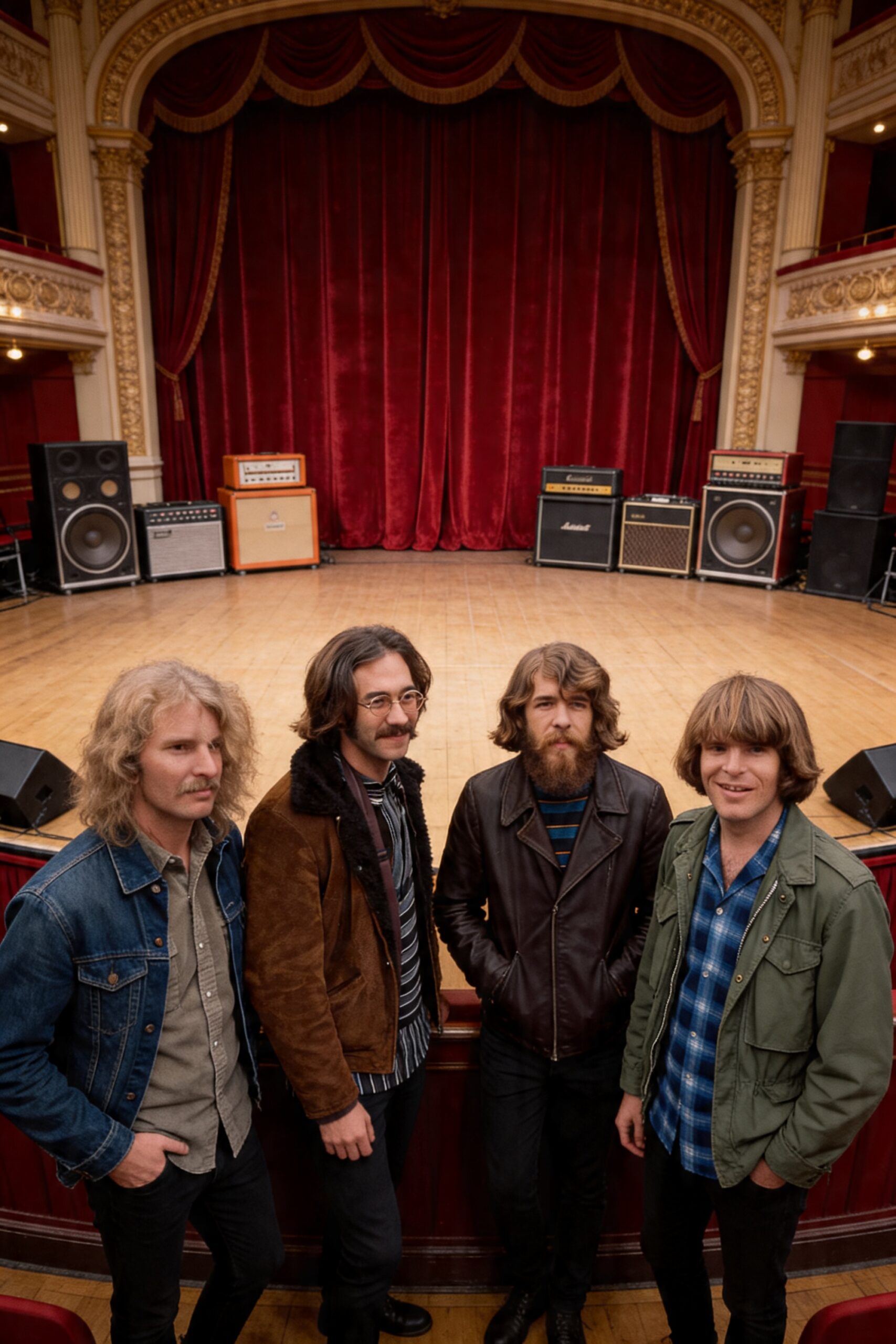
Before Creedence Clearwater Revival sounded inevitable, “Walk on the Water” showed how an early Golliwogs idea could be made leaner, darker, and more sure-footed.
In 1968, Creedence Clearwater Revival closed their self-titled debut album with “Walk on the Water”, a re-recording of a song from their earlier life as The Golliwogs. The first version had appeared in 1966 under the title “Walking on the Water”, credited to John Fogerty and Tom Fogerty, when the same four musicians were still working toward the identity that would soon define them. By returning to the piece for the Fantasy Records debut LP, the band did not simply carry over an old item from the shelf. They tested an earlier idea against the sound they were becoming.
That placement matters. The 1968 album was not yet the fully distilled Creedence Clearwater Revival of the following year, when their swamp-rock language would arrive with remarkable force. It was a first statement built from covers, originals, and remnants of the band’s pre-Creedence past. “Suzie Q” gave them space to stretch. “I Put a Spell on You” showed their taste for menace and drama. “Porterville”, another song connected to the late Golliwogs period, pointed toward sharper storytelling. Then “Walk on the Water” ended the album like a door left open to a darker room.
The track’s power comes from its refusal to dress itself up. The rhythm section of Stu Cook and Doug Clifford gives the performance a plain, physical certainty, the kind of pulse that would become one of Creedence’s great strengths. The guitars do not float above the song so much as press into it, circling the mood with a garage-rock edge that still carries the imprint of the mid-1960s. John Fogerty sings with the clipped intensity that would soon become unmistakable, but here it still feels close to the band’s roots: rough, direct, slightly shadowed, and more concerned with pressure than polish.
Compared with the idea of a youthful single, the album version feels less like a novelty and more like a statement of method. Creedence were learning how to make spareness feel large. The arrangement leaves room for repetition and tension, and the song’s imagery gains force because the band does not overexplain it. Water, danger, motion, and belief gather around the title without turning into a sermon or a theatrical set piece. The effect is not gothic in an ornate way; it is practical and stripped down, as if the band had found that a small amount of darkness could travel farther when played with discipline.
The re-recording also reveals something important about Creedence Clearwater Revival’s early roots. Their music would soon be associated with bayous, riverboats, back roads, and Southern myth, yet the musicians themselves came out of the East Bay in Northern California. “Walk on the Water” sits at that intersection. It is not documentary Southern music, and it is not simply British-influenced garage rock either. It is a band from one place imagining a larger American sound from records, radio, blues, country, R&B, and their own hardening instincts. The song shows the construction before the silhouette became famous.
There is also a quiet artistic lesson in the decision to revisit it. Many bands leave early material behind when they change names or sharpen direction. Creedence did the opposite here. They treated the Golliwogs past not as an embarrassment to erase, but as raw material that could be cut closer to the bone. In that sense, the 1968 “Walk on the Water” is not merely a re-recording; it is evidence of refinement. The same composition, placed in a new frame, begins to carry a different authority.
Listening to it now, the track has the fascination of an origin point that has not yet become a monument. It does not ask to be heard as a finished map of everything Creedence Clearwater Revival would do. Its value lies in the opposite quality: the sound of a band discovering which parts of its past could survive the transformation. At the close of the debut album, “Walk on the Water” suggests that artistic identity is not always born in one clean break. Sometimes it arrives when musicians return to something unfinished and finally hear the shape waiting inside it.
