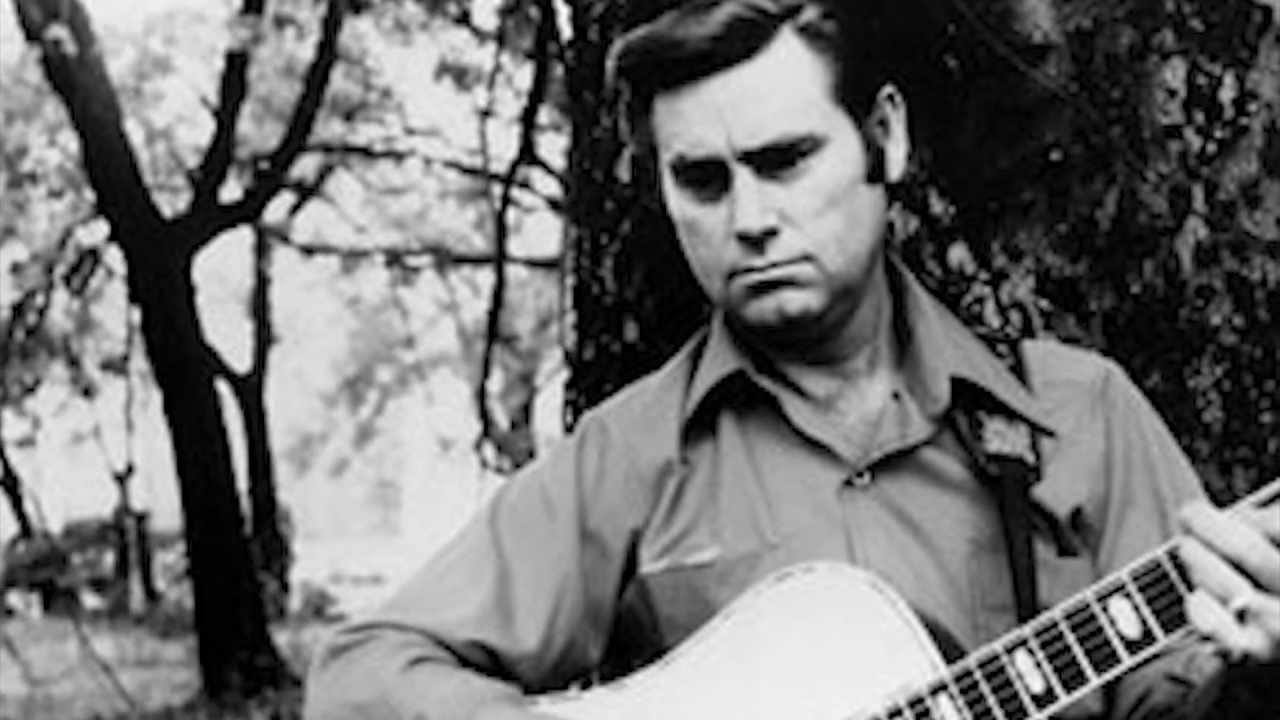
A country voice returned to the center by singing love as something final, patient, and devastatingly plain.
In 1980, George Jones released He Stopped Loving Her Today, a ballad written by Bobby Braddock and Curly Putman and produced by Billy Sherrill. It appeared on the album I Am What I Am and quickly became the recording most closely associated with Jones. The song reached No. 1 on the country chart, gave him his first country chart-topper in several years, and earned him a Grammy Award for Best Male Country Vocal Performance. Those facts matter because they mark a public return. But the deeper force of the record lies in how little it seems to chase a comeback. It does not announce renewal. It walks slowly toward an ending.
The premise is stark even by country music standards. A man loves a woman long after she has gone from his life, keeps her letters, and holds on to the promise that he will love her until death. The title delivers the turn with chilling simplicity: he stopped loving her today because he has died. In lesser hands, that idea could have become melodrama. In Jones’s recording, it becomes something quieter and more severe. The performance asks the listener to sit with endurance, obsession, memory, and the strange dignity that country music can give to heartbreak when it refuses to hurry past it.
Jones was already one of country music’s most admired singers by the time he recorded it. His voice had shaped honky-tonk music with a blend of ache, precision, and conversational phrasing that few singers could approach. Yet by the late 1970s, his career was no longer moving with the same commercial force. He Stopped Loving Her Today arrived not as a reinvention in style, but as a reminder of what his greatest gift could do when matched with the right song and arrangement. It restored attention not by making Jones sound new, but by allowing him to sound unmistakably himself.
Part of the recording’s power comes from its pacing. Sherrill’s production surrounds Jones with a formal, almost ceremonial setting: strings, piano, background voices, and the measured atmosphere of a funeral procession. Nothing feels rushed. The arrangement gives the story space to unfold in small revelations rather than dramatic bursts. The spoken section, a familiar device in classic country, could have broken the spell. Instead, it deepens the sense of witness. Jones does not merely sing about the man in the song; for a moment he seems to stand beside the room where people have gathered, observing the final proof of a love that outlasted ordinary reason.
His vocal phrasing is where the record becomes singular. Jones had a way of bending a syllable without making it decorative, letting a line lean forward and then fall back as though the emotion itself had lost its balance. On He Stopped Loving Her Today, that skill is restrained. He does not oversing the tragedy. He allows the melody to carry grief in plain language, with small catches and turns that suggest a man telling a story he cannot soften. The famous title line lands not as a punchline, but as a verdict. The voice understands the terrible economy of it: a lifetime of feeling reduced to one day on a calendar.
The song also belongs to a particular country tradition, one in which death is not used for shock but for moral weight. Classic country often returned to gravesides, empty rooms, letters, photographs, and promises because those images made private loss visible. He Stopped Loving Her Today draws from that tradition, yet it avoids sounding merely old-fashioned because Jones’s performance keeps the emotional stakes immediate. The lyric’s details are simple enough to be almost severe. The production is grand, but the center remains human-scale: a man, a memory, a love that has become indistinguishable from habit and faith.
As a signature song, it is unusual because it is not triumphant in the obvious sense. Many artists become linked to songs that celebrate desire, independence, escape, or victory. Jones became permanently linked to a song about surrendering only at death. That association says something about the kind of singer he was. His greatness did not depend on brightness. It lived in the way he could make sorrow articulate, how he could turn a carefully written country ballad into a lived emotional document without pretending it was autobiography. The listener does not need to know the details of his life to hear authority in the performance. The authority is in the control, the grain of the voice, the refusal to look away from the last line.
The public response to He Stopped Loving Her Today gave Jones more than another hit. It re-centered him at a moment when country music was changing and when an artist from an earlier era might easily have been treated as a revered figure from the past. The success of the single and the recognition that followed showed that traditional country singing still had the power to command attention when the song, singer, and production met with such clarity. It was not a museum piece. It was a contemporary record in 1980, carrying old country virtues into a new decade with force and patience.
What makes the recording endure is not only its sadness, but its discipline. Every element serves the story. The strings do not decorate the pain; they frame it. The vocal does not beg for sympathy; it earns silence. The lyric does not explain love; it shows what can happen when love becomes the measure of an entire life. In that discipline, there is a kind of artistic courage. Jones trusted the song’s slow pace, its bleak turn, and its emotional restraint. He trusted that a country audience would follow him into a room where the conclusion was already waiting.
That is why He Stopped Loving Her Today remains inseparable from George Jones. It revived his commercial standing, won major recognition, and became the recording many listeners name first when they speak of him. But beyond the awards and chart return, it captured the rare moment when a singer’s known gifts, a beautifully shaped song, and a perfectly judged production all point in the same direction. The comeback was real, yet the record’s lasting meaning is quieter than comeback language can hold. George Jones returned to the center of country music by singing a song about an ending, and in that paradox his voice found one of its most enduring forms.
