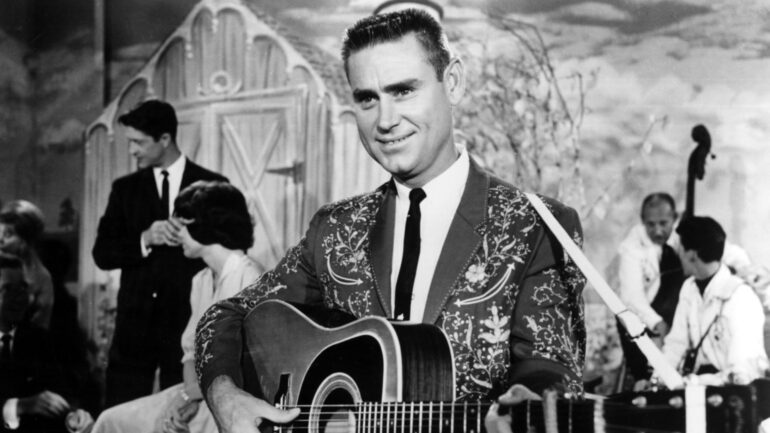
In George Jones’ 1974 “The Grand Tour,” heartbreak becomes a house you can walk through.
In 1974, George Jones released “The Grand Tour” as the title track and lead single from his album The Grand Tour. Written by Norro Wilson, Carmol Taylor, and George Richey, and recorded with producer Billy Sherrill, the song reached No. 1 on the country singles chart and became one of the performances most closely identified with Jones. But its force has never depended only on success. Its power lies in how patiently it lets ruin take shape: not as a confession shouted into the night, but as a guided walk through rooms where ordinary objects have become evidence.
The opening gesture is almost theatrical. The narrator invites someone inside and offers a “grand tour” of a lonely house. That phrase usually suggests pride, hospitality, maybe even a showplace. Here it is used with devastating irony. There is nothing grand in the usual sense. The grandeur belongs to the scale of the loss, and to the discipline with which the song reveals it. Country music has long understood the emotional weight of plain language, and “The Grand Tour” is one of its clearest examples: a man does not need to explain that his life has collapsed when the chair, the bed, the closet, and the nursery can do it for him.
Jones’ vocal is the center of that design. He does not rush toward the song’s final blow. He moves through the lyric with the controlled pace of someone trying to remain civil while standing inside devastation. His phrasing stretches certain words just enough to expose the ache underneath them, then tightens again before the emotion becomes theatrical. That balance mattered. In a lesser performance, the lyric could have turned melodramatic. Jones gives it dignity by treating the narrator’s pain as something too large to be performed openly, yet too present to hide.
Billy Sherrill’s production frames the vocal with care. The arrangement carries the polish associated with 1970s Nashville, but it does not smother the song’s country core. The tempo is slow and deliberate, allowing each room to appear before the listener. The accompaniment rises in measured waves, giving Jones space to lean into a phrase and then pull back. What emerges is not simply sadness, but architecture: the music creates hallways, pauses, doorways, and thresholds. The listener is not told about absence from a distance. The listener is brought inside it.
The genius of the lyric is its sequence. First comes the social mask of invitation. Then come the relics of domestic life: the chair where intimacy once rested, the bed where love had been familiar, the picture that preserves a presence the house no longer holds. Each image is simple, but none is decorative. The song understands that heartbreak often announces itself through objects that have not changed. The room is still there. The furniture is still there. The clothes are still hanging. What has vanished is the living connection that made those objects ordinary.
That is why the final turn lands with such quiet severity. The tour ends at the nursery, and the listener understands that the loss is not limited to romance. The woman has left, taking the baby and the narrator’s heart. The song does not need to describe the departure in detail. It gives no scene of argument, no explanation of blame, no courtroom of competing stories. Its restraint is part of its moral force. It stays with the person left behind, not to prove his innocence or condemn anyone else, but to show how absence can reorganize an entire home.
As a signature song for George Jones, “The Grand Tour” also reveals the depth of his interpretive gift. Jones was often praised for the ache in his voice, but ache alone is not enough to carry a song like this. What makes the recording endure is his precision. He knows when to bend a note, when to let a syllable tremble, when to leave a line nearly plain. The performance feels emotionally exposed because it is musically controlled. That discipline allows the listener to feel the break without being pushed toward it.
The song arrived during a decade when country music was negotiating between traditional forms and smoother Nashville production. “The Grand Tour” belongs to both worlds. Its story is built from old country materials: home, separation, memory, the terrible eloquence of everyday things. Its sound, shaped in the studio era of Sherrill’s productions, gives that story a formal sweep. Instead of weakening the old style, the polish sharpens it. The result is a recording that feels carefully made and deeply human at the same time.
What remains most affecting is the way “The Grand Tour” trusts the listener. It does not hurry to explain why the house matters. It simply opens the door and lets the rooms speak in order. In doing so, George Jones turned a country ballad into a map of emotional aftermath, where every familiar place has been altered by what is missing. The song’s heartbreak is absolute because it is specific: not an idea of loss, but a chair, a bed, a closet, a nursery, and a voice steady enough to show how much has been taken.
