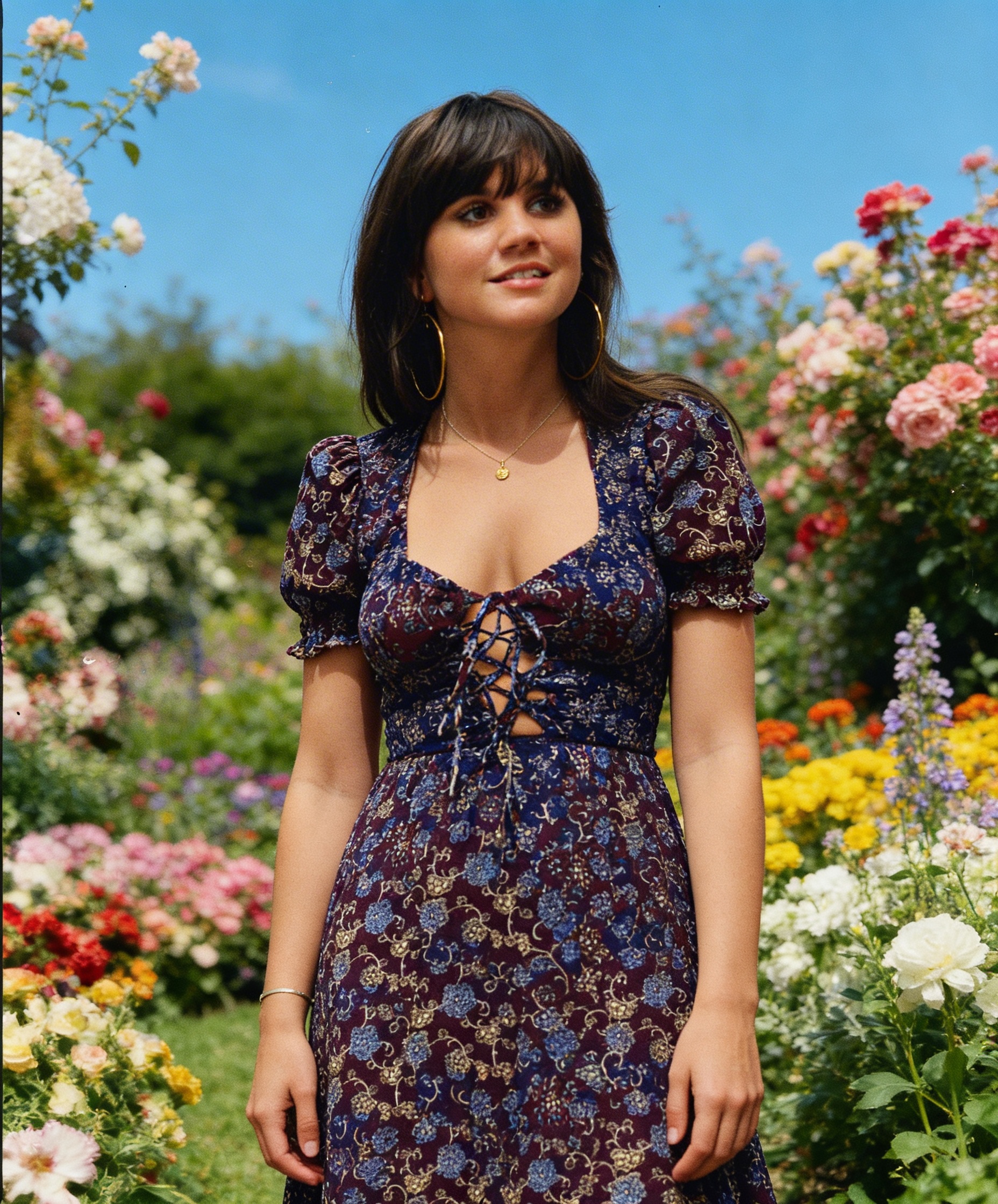
On “Crazy He Calls Me”, Linda Ronstadt did not imitate the old torch singers; she entered their language and let every breath reveal how daring restraint could be.
When Linda Ronstadt released What’s New in 1983, the move startled anyone who knew her mainly as the commanding voice of country-rock radio, Los Angeles harmonies, and polished pop confessionals. The album was not a casual detour into old songs. It was a full collaboration with Nelson Riddle, the arranger and conductor whose elegant orchestral work had shaped some of the most refined vocal pop recordings of the mid-20th century. Within that setting, her version of “Crazy He Calls Me” became one of the album’s most revealing moments: intimate, poised, and quietly fearless.
“Crazy He Calls Me” was already carrying a long emotional memory before Ronstadt ever sang it. Written by Carl Sigman and Bob Russell, the song became closely associated with Billie Holiday, whose 1949 recording gave it a weary, suspended kind of tenderness. That history could have intimidated a singer. A lesser reading might have leaned too hard into imitation, borrowing the surface of jazz melancholy without finding its pulse. Ronstadt took another path. She respected the standard’s lineage while refusing to disappear inside it.
What makes her 1983 performance so compelling is not vocal display in the obvious sense. Ronstadt had already proved, many times over, that she possessed power, range, and a remarkable ability to carry emotion across genres. But on What’s New, and especially on “Crazy He Calls Me”, her mastery comes through subtraction. She does not attack the lyric. She allows it to hover. The song’s declaration of devotion could sound reckless on the page: the singer is willing to do impossible things for love, to move mountains, to turn the world around if asked. In Ronstadt’s hands, those words are not melodrama. They become a study in surrender, sung by someone who understands the difference between romance and self-erasure, between promise and peril.
Riddle’s arrangement gives her the room to make those distinctions. The orchestra does not crowd the vocal. It creates an atmosphere of polished dusk: strings rising like a private thought, horns lending warmth without smothering the line, rhythm moving with a careful, unhurried pulse. Ronstadt meets that space with a voice that is clear but softened at the edges. She shapes consonants delicately, lets vowels open without spilling over, and places phrases as if each one has to be weighed before it can be trusted. The result is not a rock singer trying on sophistication. It is a singer discovering that sophistication can be emotionally dangerous when it is done honestly.
The larger importance of What’s New lies partly in its timing. In the early 1980s, the pop world was shifting toward synthesizers, glossy production, and a faster visual culture. Ronstadt’s decision to record a collection of standards with a large orchestra was, commercially speaking, far from predictable. Yet the album found a wide audience and helped introduce the Great American Songbook to listeners who may not have been living with those songs every day. It also opened a new chapter in Ronstadt’s career, followed by further Riddle collaborations including Lush Life and For Sentimental Reasons. The project did not shrink her identity; it expanded it.
That expansion is audible in “Crazy He Calls Me”. Ronstadt does not abandon the emotional directness that made her famous. Instead, she refines it until it can move through a quieter room. The vocal line carries traces of everything she had been: the country singer’s respect for lyric, the rock singer’s instinct for emotional lift, the pop singer’s command of tone. But those qualities are folded into a standards-era vocabulary, where a slight delay before a word can matter as much as a high note, and where the most intense feeling may arrive in a phrase that barely rises above a murmur.
There is also a subtle tension in hearing Ronstadt sing a song so closely linked with earlier interpreters. She approaches the material not as museum glass, but as living conversation. The lyric’s devotion feels both old-fashioned and startlingly present. When she sings of being called crazy, the word does not land as a joke or a simple romantic compliment. It lingers as a question: what does love ask of a person, and how much of the self can be offered before the offering becomes dangerous? Ronstadt never answers directly. Her achievement is that she lets the song hold the question.
More than four decades after What’s New arrived, Linda Ronstadt’s “Crazy He Calls Me” still feels like a lesson in controlled intensity. It reminds us that vocal mastery is not only about grandeur. Sometimes it is the courage to sing less, to trust silence, to let an orchestra breathe around you, and to make an old standard sound as if its confession has just been spoken for the first time.
