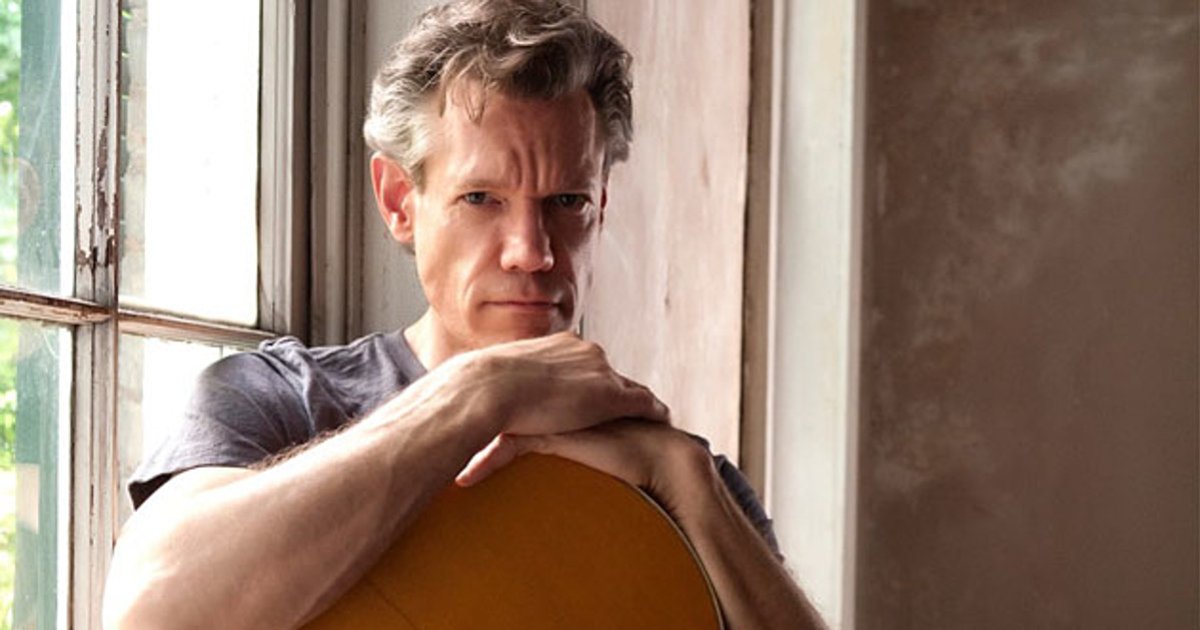
With a childlike dare and a grown man’s calm, Randy Travis turned Look Heart, No Hands into a chart-topping love song about trust.
Released in 1992 as new material on Greatest Hits, Volume Two, Randy Travis’s Look Heart, No Hands did more than decorate a retrospective. The single climbed to number one on the country charts, giving a hits collection the rare feeling of a living chapter rather than a sealed scrapbook. Written by Trey Bruce and Russell Smith, the song arrived during Travis’s Warner Bros. years, when his voice had already become one of the defining sounds of modern traditional country. By then, his first great run was established enough to be gathered into compilations, but Look Heart, No Hands proved he was not merely looking back. He was still capable of sending a new song all the way to the top.
That chart milestone matters because of where the song sits in his story. A greatest-hits package usually asks an audience to remember: the early breakthrough, the familiar choruses, the radio years that made an artist part of ordinary life. But Greatest Hits, Volume Two was not only a museum case. It carried fresh material, and Look Heart, No Hands stepped out of that setting with the confidence of a single that did not need to apologize for arriving among proven favorites. Its success made the collection feel less like a closing statement and more like a bridge between the Randy Travis who had reshaped country in the 1980s and the artist still standing firmly in the conversation in the early 1990s.
The genius of the title is its simplicity. Look Heart, No Hands borrows the image of a child riding a bicycle with reckless pride, lifting both hands from the handlebars to prove courage, balance, and trust. In another voice, that metaphor might have turned cute or overly polished. Travis gives it weight. He sings as though the risk is not theatrical, but private: the quiet surrender of someone who knows love can throw a person off balance and chooses to ride forward anyway. The song is romantic, but it is not flimsy. Its warmth comes from the tension between innocence and adulthood, between the memory of showing off as a boy and the far more serious act of letting the heart move without defense.
Musically, the recording works because it leaves room for that feeling to breathe. The arrangement carries the clean country shape associated with Travis’s best work: steady rhythm, melodic ease, and instrumental colors that support the lyric rather than crowd it. There is no need for grand gestures. The song’s emotional lift comes from the way the melody rises with confidence while Travis remains grounded, his baritone calm enough to make vulnerability sound like strength. He had a gift for making plainspoken lines feel lived-in, and here that gift turns a playful phrase into something deeper. He does not oversell the image. He trusts it.
That trust was central to his appeal. When Randy Travis broke through with Storms of Life in 1986, he helped reopen mainstream country to a more traditional sound at a time when polish and pop influence had pushed parts of the genre in another direction. By 1992, country music was expanding into a larger commercial era, with new stars, bigger arenas, and a sharper media spotlight. Travis was no longer the newcomer restoring old values to the radio; he was part of the foundation on which that new boom was being built. A number one single from a hits collection showed that his style still had force. His restraint, far from sounding old-fashioned, remained persuasive.
What makes Look Heart, No Hands especially durable is that it does not confuse simplicity with smallness. It knows that the most frightening emotional acts often look ordinary from the outside. Falling in love, trusting someone, giving the heart permission to move without gripping every possible guardrail—these are not dramatic in the cinematic sense, but they are dramatic in a human sense. Travis’s performance understands that. He lets the song smile, but he also lets it tremble just enough beneath the surface.
He had recorded bigger statements and sterner songs, and his catalog contains moments of sorrow, faith, humor, and hard-earned reflection. But this 1992 single carries its own quiet importance. It shows an artist at a point when a retrospective could have encouraged nostalgia, choosing instead to add something fresh enough to become a chart-topper. It reminds us that a hits collection can sometimes reveal momentum rather than conclusion. And it captures Randy Travis doing what he did so well: taking a clear country idea, singing it without clutter, and leaving behind a feeling that seems simpler than it really is.
In the end, Look Heart, No Hands is not just a song about love’s first rush. It is a song about the nerve required to stop steering every second. That may be why its number one success still feels fitting. The record did not shout for its place. It coasted forward with balance, grace, and a voice steady enough to make letting go sound like the surest move of all.
