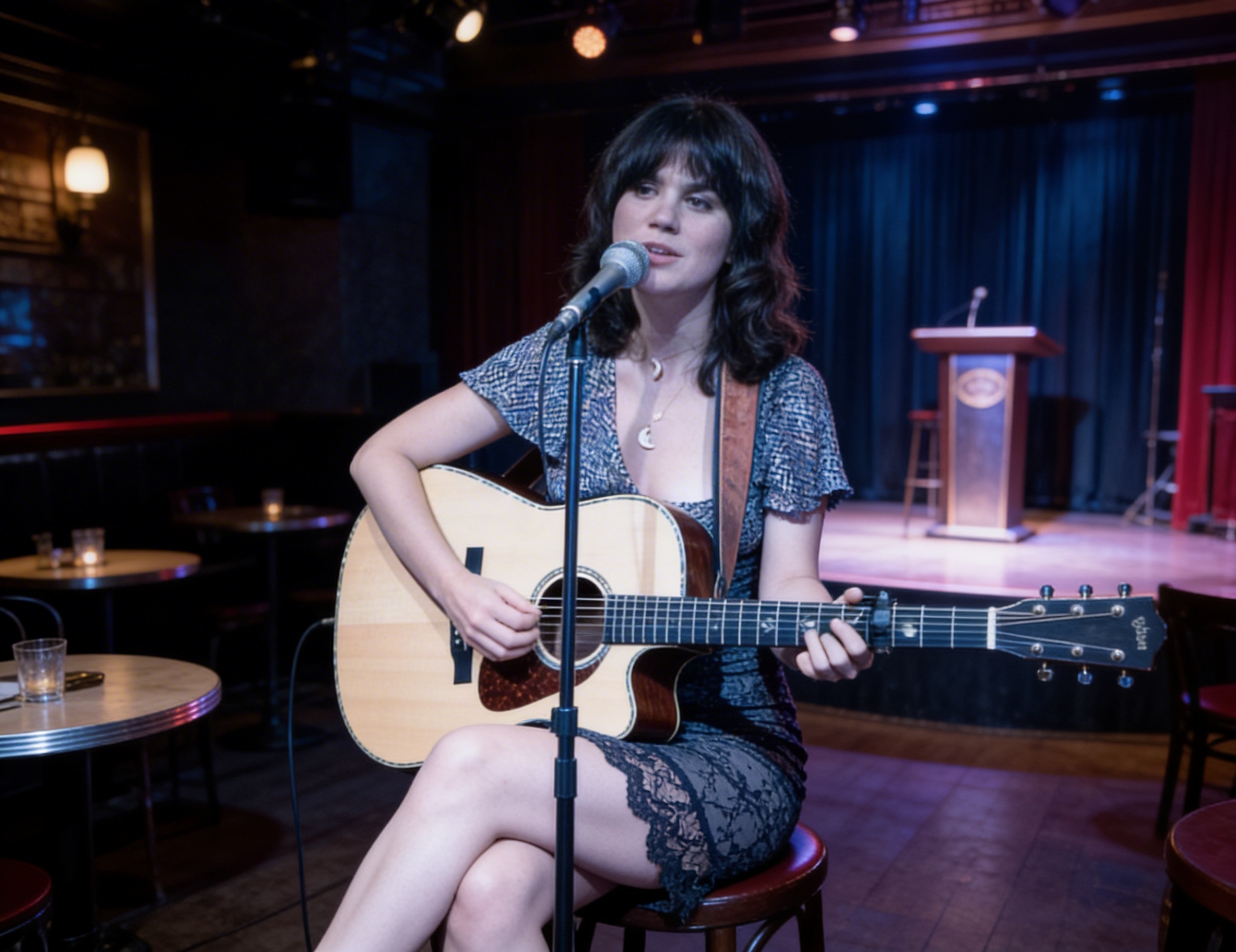
Before her Asylum years became a turning point, Linda Ronstadt opened Don’t Cry Now with a J.D. Souther song that sounded like trust, distance, and arrival all at once.
Linda Ronstadt began her 1973 Asylum Records debut, Don’t Cry Now, with I Can Almost See It, a song written by J.D. Souther. That placement matters. It was not simply the first track on an album. It was the first impression of a new label chapter, a new creative setting, and a new closeness between Ronstadt and the Southern California songwriters whose work would help define the next phase of her voice.
By 1973, Ronstadt was not a newcomer. She had already come through the Stone Poneys, carried Different Drum into the public ear, and made solo records that moved between folk, country, rock, and torch-song feeling without settling neatly into one category. But Don’t Cry Now arrived at a moment when her art was beginning to find its frame. The album followed her earlier Capitol recordings and marked her first album for Asylum, a label closely associated with the Los Angeles singer-songwriter world. Around her were musicians, producers, and writers who understood country music not as a museum piece, but as a living emotional language that could sit beside rock rhythm, folk intimacy, and pop directness.
Opening the record with J.D. Souther’s I Can Almost See It was a quiet but telling choice. Souther would become one of the central songwriters in Ronstadt’s orbit, with songs such as Faithless Love and Prisoner in Disguise later giving her some of the most finely drawn emotional material of her 1970s catalog. He was also woven into the same California country-rock circle that surrounded the Eagles, Jackson Browne, and the musicians who made heartbreak sound both intimate and wide open. But on I Can Almost See It, the connection feels less like music history and more like a singer leaning toward a writer whose emotional vocabulary already made sense to her.
The title itself carries a beautiful uncertainty. I Can Almost See It is not a phrase of triumph. It is not certainty, possession, or arrival. It is nearness. It suggests something just beyond focus: a future, a feeling, a person, a shape of life that cannot quite be held. That kind of emotional threshold suited Ronstadt unusually well. One of her great strengths was the ability to sing with power without flattening the doubt inside a lyric. She could open her voice fully and still leave a shadow in the room. In a lesser performance, a song like this might become merely pretty or merely wounded. Ronstadt gives it a forward motion, as if the ache is not the end of the story but the weather one has to travel through.
That is why the song works so effectively as the doorway into Don’t Cry Now. The album itself is full of crossings. It includes material associated with country tradition, contemporary songwriting, and the emerging Los Angeles rock landscape, including songs by artists such as Randy Newman and members of the Eagles circle. It also contains Ronstadt’s early reading of Desperado, a song that would later become inseparable from the era’s sense of weary romantic endurance. But before any of that, the listener is met with Souther’s composition and Ronstadt’s interpretation of it: not a dramatic curtain rising, but a door opening slowly.
There is also something revealing in the difference between writing and singing. Souther’s songs often live in the space between confession and restraint. They tend to know more than they say. Ronstadt, as an interpreter, had a gift for entering that restraint without overexplaining it. She did not need to make every line sound autobiographical for the emotion to feel real. Instead, she sang as if the song had passed through her long enough to leave a mark. That is the essence of a deep singer-songwriter connection: not ownership, not imitation, but recognition.
In hindsight, I Can Almost See It feels like a small map of what Ronstadt was about to become in the mid-1970s. The huge commercial breakthrough would arrive with Heart Like a Wheel in 1974, and her reputation as one of the most commanding interpretive singers of her generation would only grow from there. Yet the opening of Don’t Cry Now captures something before the full blaze of that success. It catches her at the edge of a new room, surrounded by songs that asked for emotional intelligence as much as vocal beauty.
That is why this album opener deserves to be heard as more than a track-list detail. Linda Ronstadt singing J.D. Souther’s I Can Almost See It is a moment of artistic alignment. A songwriter offered a phrase suspended between longing and vision; a singer stepped into it and gave that suspension a human pulse. Before the awards, before the arena scale, before the full public certainty of her 1970s ascent, Ronstadt began this Asylum chapter with a song about almost seeing. The tenderness is in that almost. The power is in how clearly she made us feel it.
