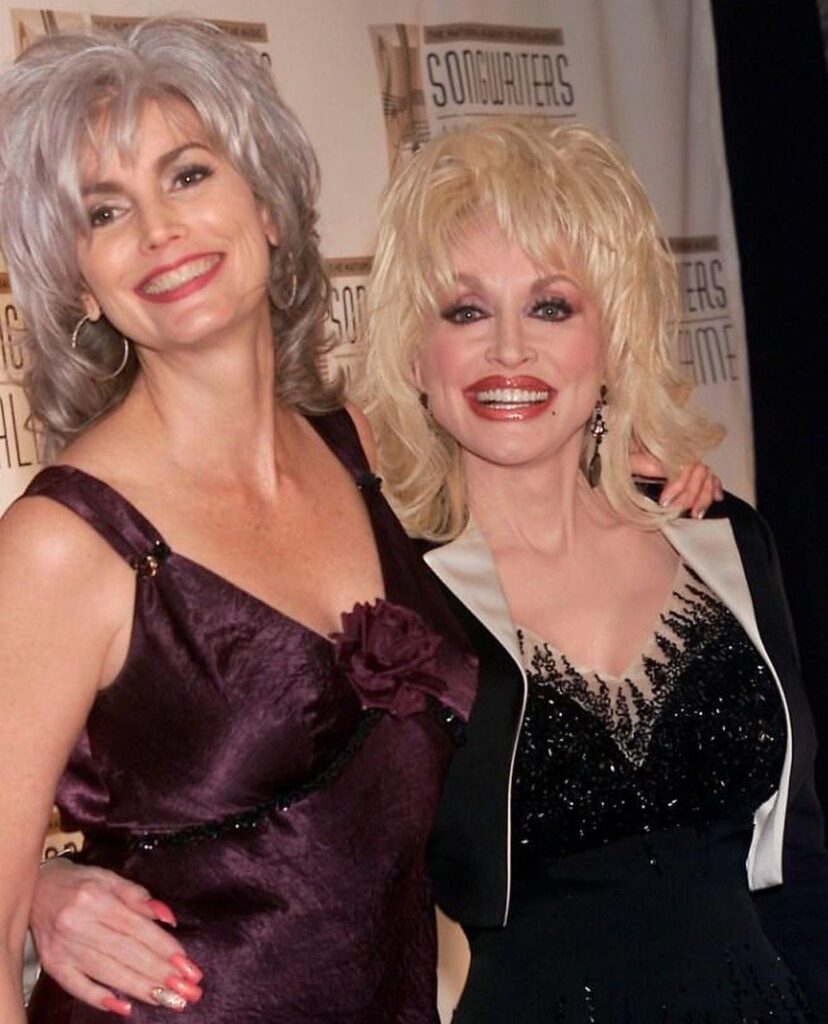
On Trio II, Emmylou Harris, Dolly Parton, and Linda Ronstadt turned “After the Gold Rush” into a hushed country vision, letting harmony carry the weight of Neil Young’s strange and tender warning.
When Trio II arrived in 1999, its version of “After the Gold Rush” stood out not because it tried to outdo Neil Young, but because it listened to him differently. Young had written and released the song on his 1970 album After the Gold Rush, giving listeners one of his most dreamlike early compositions: part folk hymn, part environmental unease, part private vision that never explains itself completely. Nearly three decades later, Emmylou Harris, Dolly Parton, and Linda Ronstadt approached it as a trio, and the result became one of the most quietly powerful reinventions in their shared catalog. Their recording earned the Grammy Award for Best Country Collaboration with Vocals, a fitting recognition for a performance built not on display, but on the rare discipline of three great voices becoming one shape.
The collaboration mattered because this was not simply a famous song passed through a country arrangement. By the time Trio II was released, Harris, Parton, and Ronstadt had already proved, with their 1987 album Trio, that their voices could meet in a place deeper than genre. Each woman brought a fully formed musical identity: Parton with mountain brightness and emotional directness, Ronstadt with a rounded, commanding warmth shaped by pop, rock, country, and Mexican song, and Harris with a silvery, high-lonesome sensitivity that had long made her one of American music’s most distinctive harmony singers. On “After the Gold Rush”, those identities do not compete. They gather around the song like light moving across the same wall.
Emmylou Harris is especially essential to the atmosphere of this version. Her gift has never been only the beauty of her own voice, but the way she can alter the emotional temperature of another voice beside her. In this trio setting, she often feels like the air between the notes: present, luminous, and impossible to separate from the whole. When her harmony rises through the blend, it does not push the recording toward grandeur. It makes it feel suspended. That is the key to the performance. The song’s images are already strange, filled with dreams, nature, flight, and warning, yet the trio refuses to dramatize them. Instead, they let the unease remain soft, almost domestic, as if the future were being sung about from a quiet room rather than proclaimed from a stage.
Neil Young’s original recording carried the fragile solitude of a young songwriter looking at the world through a cracked window. The Trio II version changes the emotional angle. Sung by three women with long histories in country, folk, pop, and rock, “After the Gold Rush” becomes less solitary and more communal. The warning in the song does not vanish, but it is held differently. A single voice can make the song feel like a vision. Three voices make it feel like memory, witness, and prayer all at once. The famous line about Mother Nature, already one of Young’s most resonant images, gains new force when carried by harmonies that sound both gentle and grave. The trio does not need to underline the lyric’s concern; the restraint does that work.
Part of the recording’s beauty lies in how little it seems to strain. A lesser version might have treated the song as a showcase, assigning each singer a moment to shine. Harris, Parton, and Ronstadt were all capable of that kind of commanding spotlight, but “After the Gold Rush” asks for something more delicate. It asks for listening. The arrangement leaves room for breath, for consonants to soften, for the vowels to join in that almost weightless way that only close harmony can create. Parton’s tone can cut through with clear Appalachian edges; Ronstadt gives the center a human warmth; Harris lifts the top line until the song seems to hover. The power is in the balance.
The Grammy recognition helped mark the recording as more than a respectful cover. It was a reminder that country harmony, at its finest, can transform familiar material without stripping away its mystery. “After the Gold Rush” had never been a conventional country song, but in the hands of Emmylou Harris, Dolly Parton, and Linda Ronstadt, it found a natural home near the oldest impulses of the genre: shared singing, moral weather, tenderness under pressure, and the feeling that a melody can carry what ordinary speech cannot.
What remains most striking is how the trio makes the song feel both older and newly alert. It reaches backward toward porch harmonies and churchlike stillness, yet it also keeps Young’s original sense of environmental anxiety and dreamlike displacement intact. Harris’s ethereal blend is central to that balance. She does not remake the song by standing apart from the others; she remakes it by disappearing into them, by helping create a sound where three separate lives become one listening body. That is why this Trio II performance still feels so quietly affecting. It does not solve the mystery of “After the Gold Rush”. It gives the mystery better company.
