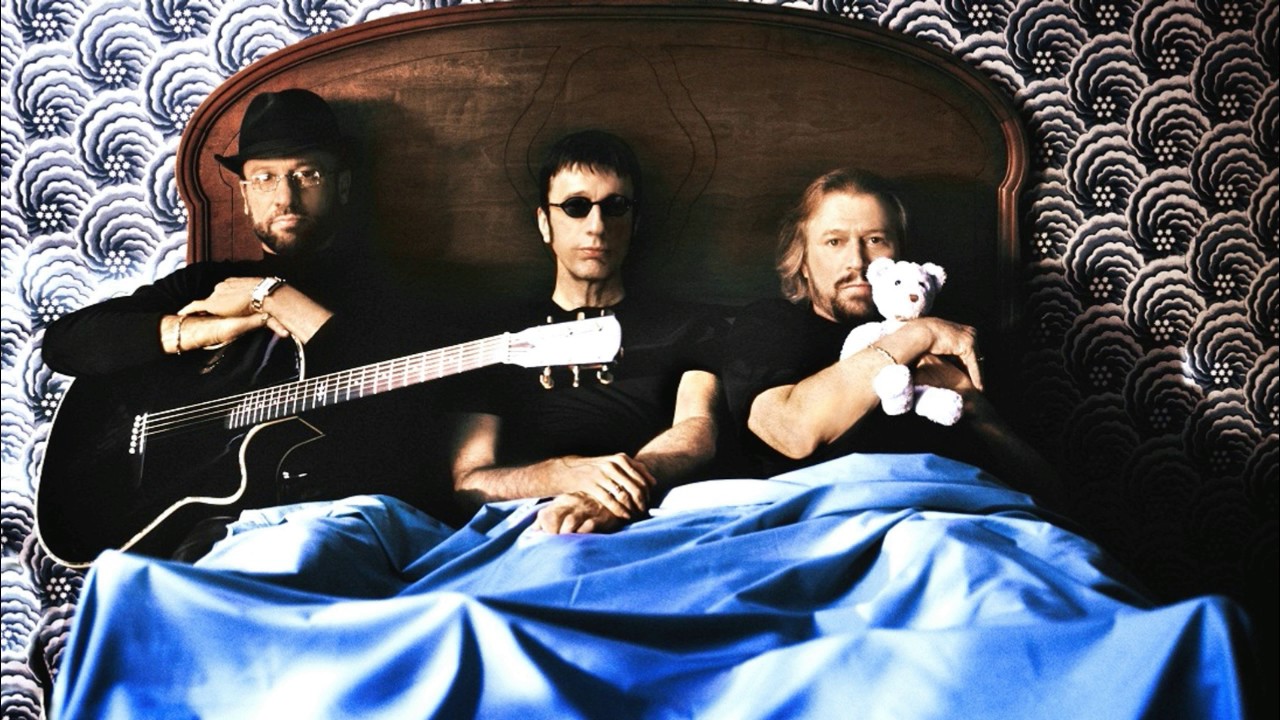
In their 1995 studio cover for Tapestry Revisited, the Bee Gees turned a famous question of trust into a brotherly harmony suspended between pop history and private doubt.
In 1995, the Bee Gees recorded Will You Love Me Tomorrow specifically for Tapestry Revisited: A Tribute to Carole King, a studio tribute album built around songs associated with one of the most personal and influential catalogs in modern popular music. That context matters. This was not simply the Gibb brothers choosing a beloved old standard from the shelf. It was their answer to a song already carrying several lives: written by Gerry Goffin and Carole King, first made famous by The Shirelles in 1960, and later reclaimed by King herself on her 1971 album Tapestry.
By the time the Bee Gees approached it, Will You Love Me Tomorrow had long since passed beyond the boundaries of a single era. In The Shirelles’ hands, it had the glow and anxiety of early girl-group pop, a question asked with youth, poise, and a fragile awareness of consequences. On Tapestry, Carole King made it quieter and more inward, as if the song had aged with its author and learned how much silence could live inside a simple melody. The Bee Gees’ 1995 version entered that lineage with a different kind of tenderness: not the solitary voice at the piano, not the polished innocence of a chart-era vocal group, but the unmistakable weave of three brothers whose harmonies had always sounded as though they were finishing one another’s thoughts.
That is what gives this cover its emotional identity. Barry, Robin, and Maurice Gibb were not visitors to the language of longing. From their 1960s ballads through the grand sweep of their late-1970s pop dominance and beyond, the Bee Gees understood how a melody could carry vulnerability without losing elegance. Their greatest gift was not merely singing in harmony, but making harmony feel like memory layered upon memory. On Will You Love Me Tomorrow, that gift softens the song’s central question. Instead of one person asking for reassurance, the recording seems to let the question echo from several emotional angles at once.
The song itself is built on a tension that never really dates. Its surface is graceful, almost conversational, but beneath it lies a deeply human uncertainty: whether affection spoken in the dark will still mean something in the morning. Goffin’s lyric and King’s melody do not need dramatic decoration. Their strength is in restraint. The words are direct, the tune is clear, and the ache comes from how carefully the singer refuses to accuse, beg, or collapse. The Bee Gees understood that kind of restraint. Their 1995 cover leans into the melodic shape rather than trying to overpower it, allowing the familiar question to remain intact while giving it the unmistakable color of their vocal blend.
Heard within Tapestry Revisited, the performance also becomes a conversation between songwriting traditions. Carole King emerged from the Brill Building world, where pop craftsmanship often had to be both concise and emotionally exact. The Bee Gees, though shaped by different geography and different decades of fame, shared that devotion to structure. They knew the value of a bridge, the weight of a title line, the way a chorus could rise without shouting. Their contribution to the tribute album therefore feels less like a celebrity cameo and more like one group of master songwriters saluting another songwriter’s architecture from the inside.
The mid-1990s setting adds another quiet layer. By 1995, the Bee Gees were no longer being heard only through the glare of the disco years, though that era still followed them in public memory. Their career had already shown far more range than the narrowest pop shorthand allowed: folk-tinged ballads, dramatic orchestral pop, aching adult contemporary work, and songs written for other voices. A Carole King tribute was a fitting place for them to remind listeners of something central to their art: beneath the recognizable sound was a deep respect for melody as emotional storytelling.
What makes their Will You Love Me Tomorrow linger is not that it tries to replace the earlier versions. It does something more modest and, in its way, more revealing. It places the song in the hands of singers who understood the ache of a question left unanswered. The harmonies do not solve the uncertainty; they surround it. They make the listener hear how many voices can live inside one doubt, and how a song written in one era can keep finding new rooms to inhabit.
In that sense, the Bee Gees’ 1995 studio cover is a small but meaningful chapter in the afterlife of Tapestry. It honors Carole King not by imitating her intimacy, but by meeting it with their own. The result is a recording that feels polished yet exposed, familiar yet gently reframed. The question at its center remains the same as it was in 1960 and 1971, but through the Gibb brothers’ harmonies, it seems to hover a little longer in the air, unanswered in the most musical way.
