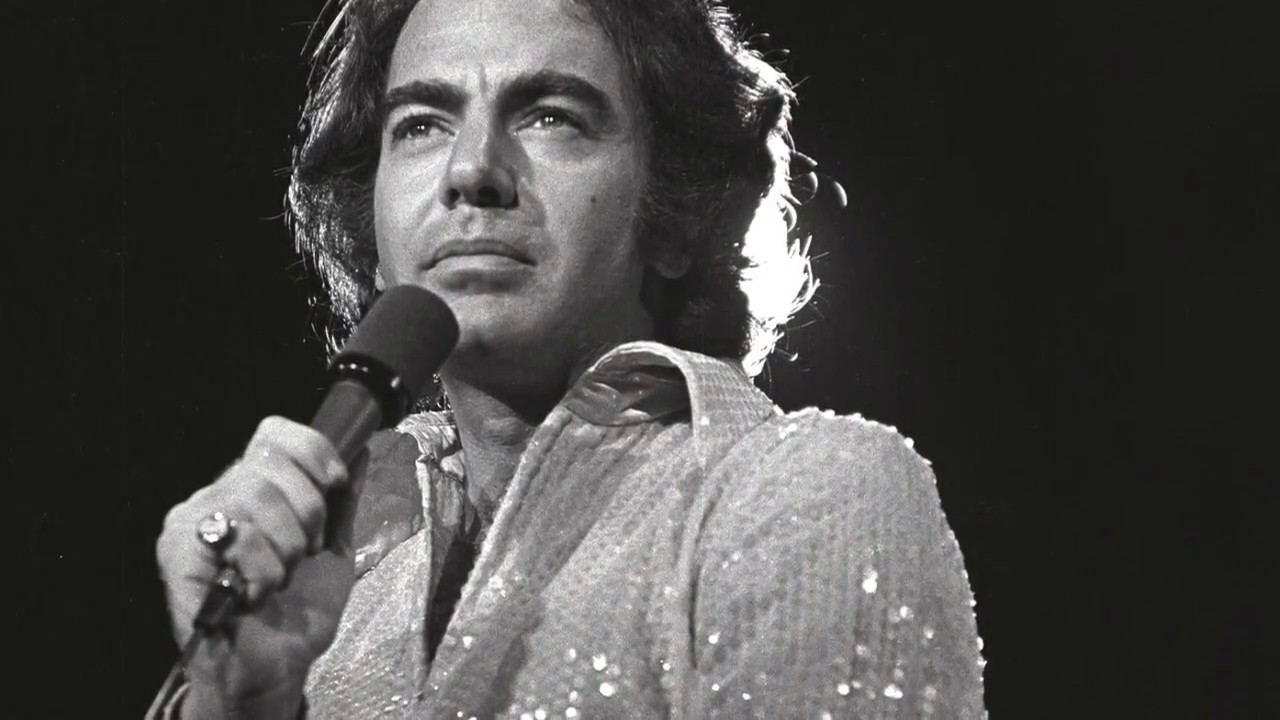
On 1971’s Stones, Neil Diamond turned a famous European plea into something quieter, more American, and painfully self-contained.
Neil Diamond recorded If You Go Away for his 1971 album Stones, placing an English-language version of Jacques Brel’s Ne me quitte pas inside one of the most introspective chapters of his early career. The song had already traveled a long road by the time Diamond reached it. Brel’s original, first written and recorded in French in 1959, was not simply a love song in the ordinary sense. It was a plea, a negotiation with absence, a piece of theater built from humility, fear, memory, and impossible bargaining. The English version most widely known as If You Go Away, with lyrics by Rod McKuen, did not translate Brel line for line so much as carry the emotional architecture into another language.
That distinction matters when hearing Diamond’s 1971 interpretation. If You Go Away on Stones is not merely a famous song borrowed for dramatic effect. It belongs to the album’s larger mood: searching, unsettled, full of voices trying to name loneliness without making it too neat. Released by Uni Records and produced during Diamond’s early-seventies rise as both a major songwriter and a serious album artist, Stones placed his own material beside songs associated with writers such as Leonard Cohen, Joni Mitchell, Randy Newman, Tom Paxton, and others. It was an album that showed Diamond not only as a writer of strong, memorable choruses, but as an interpreter with a taste for songs that carried emotional weather.
The best-known anchor of the album was I Am…I Said, Diamond’s great statement of displacement and self-questioning. Against that backdrop, If You Go Away feels almost like a companion room in the same house. One song asks where the self belongs; the other wonders what remains when another person leaves. Both are built around absence. Both depend on a singer willing to stand close to the edge of confession without falling into melodrama.
Diamond’s voice is central to why this cover works. Brel’s own performances of Ne me quitte pas could feel startlingly exposed, almost theatrical in the oldest and most human sense of the word. Brel sounded as though the song were happening to him in real time. Diamond approaches the material differently. He does not try to become Brel, and that restraint saves the performance from imitation. His reading comes from the American pop-ballad tradition, with a low, grounded vocal presence and a sense of controlled pressure. He lets the melody carry the ache rather than forcing the emotion into every syllable.
The arrangement around him gives the song room to breathe. In the early 1970s, Diamond’s records often carried a broad, cinematic sweep, but his best performances were rarely just about size. They were about contrast: the large musical frame against the private voice inside it. On If You Go Away, the drama is not in a sudden explosion; it is in the way the song keeps returning to the same impossible question. The singer imagines departure and staying, loss and reprieve, emptiness and devotion. The emotional force comes from the fact that none of these imagined futures feels entirely secure.
Rod McKuen’s English lyric also changes the listener’s relationship to the song. Where Brel’s French original can feel stark and direct in its desperation, If You Go Away creates a more spacious, almost cinematic emotional landscape. It gives the singer room to move between pleading and recollection, between the fear of abandonment and the fragile dream of being spared from it. Diamond understands that space. He does not overdecorate it. Instead, he lets his phrasing suggest a man measuring his words because he knows they may not be enough.
That is why this recording still feels significant within Diamond’s catalog. It reminds us that his artistry was not limited to songs he wrote himself. In the right material, he could locate a private corridor and walk through it with seriousness. If You Go Away gave him a song already heavy with history, but he did not treat that history as a museum piece. On Stones, he brought it into his own emotional weather: the same world of restless identity, long shadows, and rooms filled with words that cannot quite solve what the heart has already learned.
He was singing a cover, but not hiding behind one. He was standing inside a song made famous by another language and another kind of performer, then letting it speak in his own grain. The result is not the definitive version of Brel’s vision, nor does it need to be. It is a 1971 Neil Diamond moment: dignified, wounded, carefully shaped, and more revealing because it refuses to collapse. The farewell remains unfinished, and that is where the song keeps its power.
