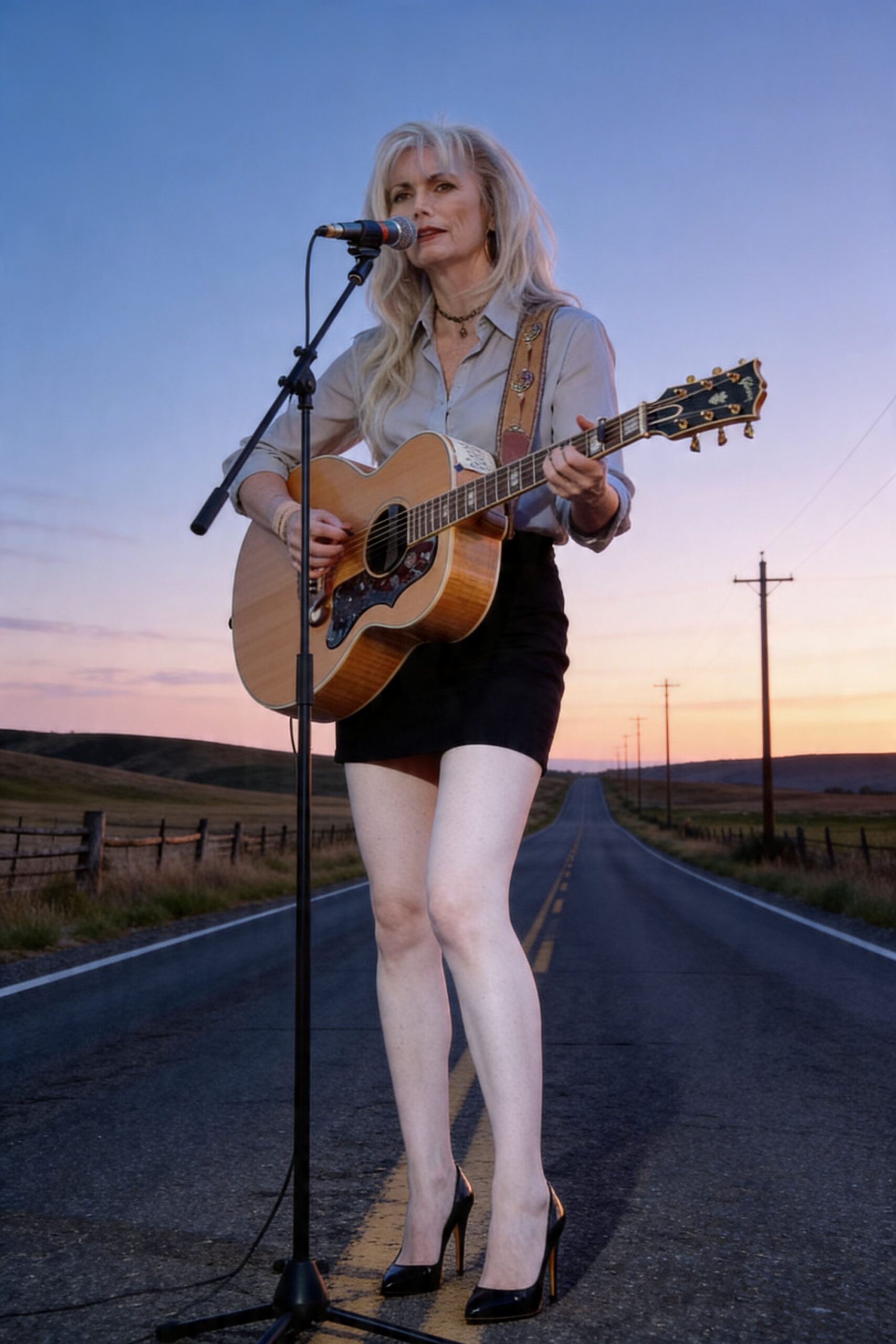
On Emmylou Harris’s “Tragedy”, the sorrow is not carried by one voice alone; it gathers meaning in the quiet harmonies of Bruce Springsteen and Patti Scialfa.
Released in 2000 on Red Dirt Girl, “Tragedy” belongs to the remarkable period when Emmylou Harris moved her own songwriting closer to the center of her art. The album, issued by Nonesuch Records and produced by Malcolm Burn, came after the atmospheric turn of Wrecking Ball and found Harris working in a space where country, folk, rock, and ambient textures could blur without losing their human center. “Tragedy”, co-written by Harris and longtime musical ally Rodney Crowell, is made even more affecting by the harmony vocals of Bruce Springsteen and Patti Scialfa. Their appearance is not decorative. It is part of the emotional architecture of the song.
That is what makes the collaboration so quietly powerful. Springsteen and Scialfa do not arrive as famous names trying to transform the track into a grand event. They enter like witnesses, lending weight without taking the spotlight away from Harris. Their voices sit close to hers, adding a roughened warmth and a sense of shared memory. The result is not a duet in the showpiece sense, nor a dramatic contest of personalities. It feels more like three seasoned singers standing around the same hard truth, each understanding that some songs ask for companionship rather than display.
By the time Red Dirt Girl appeared, Harris had already spent decades proving the depth of her interpretive gifts. She could make another writer’s song sound as if it had been waiting for her voice all along. From her work with Gram Parsons to her solo recordings and her collaborations across country, folk, and rock, she had built a career on taste, empathy, and the ability to hear the emotional grain inside a melody. But Red Dirt Girl carried a different charge. It was a record where her own voice as a writer stepped forward with unusual confidence, exploring loss, distance, spiritual searching, and the strange endurance of love after certainty has faded.
“Tragedy” fits that landscape beautifully. It is not tragic in the theatrical sense. It does not throw itself at the listener or demand tears. Its sadness is more adult, more measured, shaped by the awareness that life’s deepest turns rarely announce themselves with thunder. The song moves through a bittersweet emotional country where fate, choice, regret, and tenderness seem tangled together. Harris sings with the restraint that has always been one of her greatest strengths. She does not force the feeling; she lets it rise in the spaces between phrases.
The presence of Bruce Springsteen and Patti Scialfa deepens that restraint rather than disrupting it. Springsteen’s voice has long carried the sound of working-class prayer, roadside memory, and bruised persistence, while Scialfa’s harmonies often bring a grounded, steady glow. On “Tragedy”, those qualities blend naturally with Harris’s clearer, more ethereal tone. The contrast matters. Harris seems to float above the wound, while Springsteen and Scialfa keep the song close to the earth. Together, they create a small chorus of experience, as if the song is being sung not from one life but from several lives that have learned similar lessons in different rooms.
There is also a history inside the Crowell connection. Rodney Crowell had been part of Harris’s musical world since the 1970s, including his time in her celebrated Hot Band, and his songwriting sensibility has often met hers in that place where country plainspokenness and poetic reflection overlap. His co-writing credit on “Tragedy” gives the song a familiar root system, while the Springsteen and Scialfa harmonies expand its horizon. It becomes a piece of American music that does not sit neatly inside one genre. It has the ache of country, the weathered conscience of folk, and the dusky atmosphere of late-century roots rock.
Red Dirt Girl would go on to win the Grammy Award for Best Contemporary Folk Album, recognition that suited its restless, handmade character. Yet the album’s lasting value is not only in the honor it received, but in the way it revealed Harris as a writer willing to risk intimacy without overexplaining herself. The songs often feel like fragments of letters, prayers, and memories recovered from places where the dust has not quite settled. “Tragedy” is one of the moments where that approach finds a particularly graceful balance: personal but not narrow, sorrowful but not hopeless, collaborative but still unmistakably hers.
What lingers after the track ends is the feeling of voices choosing solidarity over spectacle. Harris leads the way, but Springsteen and Scialfa help shape the emotional weather around her. Their harmonies suggest that grief, regret, and longing are rarely solitary things, even when they are felt alone. Sometimes the right voices do not explain the hurt. They simply stand near it, steady and unhurried, until the song becomes a place where sorrow can breathe.
