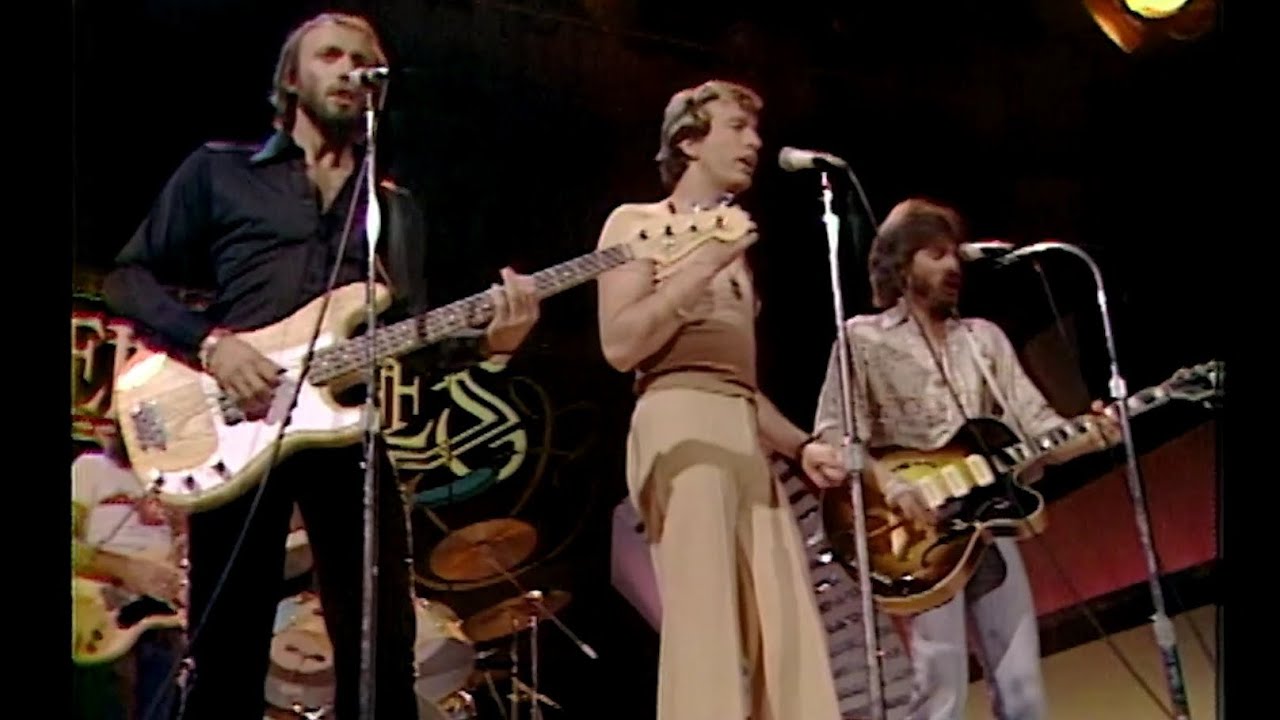
On “Ghost Train”, the Bee Gees let rhythm carry the memory forward, turning a 1991 album cut into a restless glimpse of their early-1990s reinvention.
Released on the Bee Gees’ 1991 album High Civilization, “Ghost Train” sits in that fascinating place where a famous group is not asking to be rediscovered through its biggest hits, but through the tracks that reveal how carefully it was listening to the world changing around it. It was not the album’s obvious calling card in the way “Secret Love” was for many listeners, and it did not arrive with the familiar mythology of their 1970s dance-floor peak. Instead, “Ghost Train” moves as a rhythmic deep cut, a song that shows the Gibb brothers pushing their sound into early-1990s dance-pop territory without surrendering the melodic instincts that had always defined them.
By 1991, Barry Gibb, Robin Gibb, and Maurice Gibb had already lived several musical lives. They had been young harmony prodigies, orchestrators of melancholy pop, architects of a global disco moment, hitmakers for other artists, and survivors of the kind of public overexposure that can turn admiration into fatigue. The late 1980s had brought them back into contemporary conversation, especially with the album One in 1989. But High Civilization was different. It arrived as pop was becoming sleeker, more programmed, more club-conscious, and more dependent on the pulse of machines. The brothers did not stand outside that shift. They stepped into it.
“Ghost Train”, credited to the Gibb brothers, has the feel of a song built around forward motion. Its title alone suggests something spectral and mechanical: a vehicle moving through the dark, familiar and strange at the same time. That image fits the track’s position in the High Civilization era. The Bee Gees were not trying simply to repeat the glide of Saturday Night Fever, nor were they abandoning the emotional detail that made their ballads endure. They were testing how their voices and melodic phrasing could live inside a new rhythmic architecture, one shaped by synthesized textures, programmed drive, and the polished pressure of early-1990s pop production.
What makes the track interesting is not merely that it sounds more modern for its time. Many veteran artists tried to update themselves as the decade turned, often by placing a familiar voice over a fashionable surface. The Bee Gees had a different advantage: rhythm had never been foreign to them. Long before the culture reduced them to a white-suited image, they understood how a groove could lift a melody without flattening its feeling. On “Ghost Train”, that history is present but not obvious. The beat does not feel like nostalgia wearing new clothes; it feels like a machine with memory inside it.
Listen closely and the song’s energy comes less from spectacle than from persistence. It has a sense of motion that does not pause to explain itself. The arrangement places the group in a glossy, kinetic world, but the human signature remains in the phrasing, in the way the vocal lines move through the track rather than simply riding on top of it. That was always one of the Bee Gees’ great gifts: they could make complex emotional colors feel almost effortless. Even inside a production style tied to its era, their songwriting sense gives the song a center.
The broader High Civilization album can now be heard as one of the more revealing chapters in the Bee Gees’ later catalog. It is not the easiest record to separate from the production language of its moment, and that is part of its appeal. The album sounds like 1991 in an honest way: ambitious, glossy, programmed, sometimes dramatic, and deeply aware that pop music was changing quickly. Where some listeners came looking for the warmth of earlier Bee Gees records, “Ghost Train” offered a cooler surface and a more percussive engine. It asked to be heard not as a throwback, but as a group still in motion.
That motion matters. The Bee Gees’ career is often told through peaks: the 1960s ballads, the 1970s phenomenon, the later comeback moments. But deep cuts like “Ghost Train” remind us that a career is also made of experiments, adjustments, and tracks that do not carry the burden of being an anthem. They show artists working inside the present tense. In this case, the present tense was early-1990s dance-pop, a landscape of electronic rhythm and radio polish where veteran songwriters had to decide whether to retreat, imitate, or transform.
The Bee Gees chose transformation, imperfect and intriguing. “Ghost Train” may not be the first song casual listeners name when they think of the group, but that is precisely why it deserves attention. It catches the brothers at a point where history was heavy behind them and the new decade was moving beneath their feet. The track feels like a night ride through their own legacy: a rhythmic machine, a pop experiment, a reminder that even familiar voices can sound different when the rails change direction.
