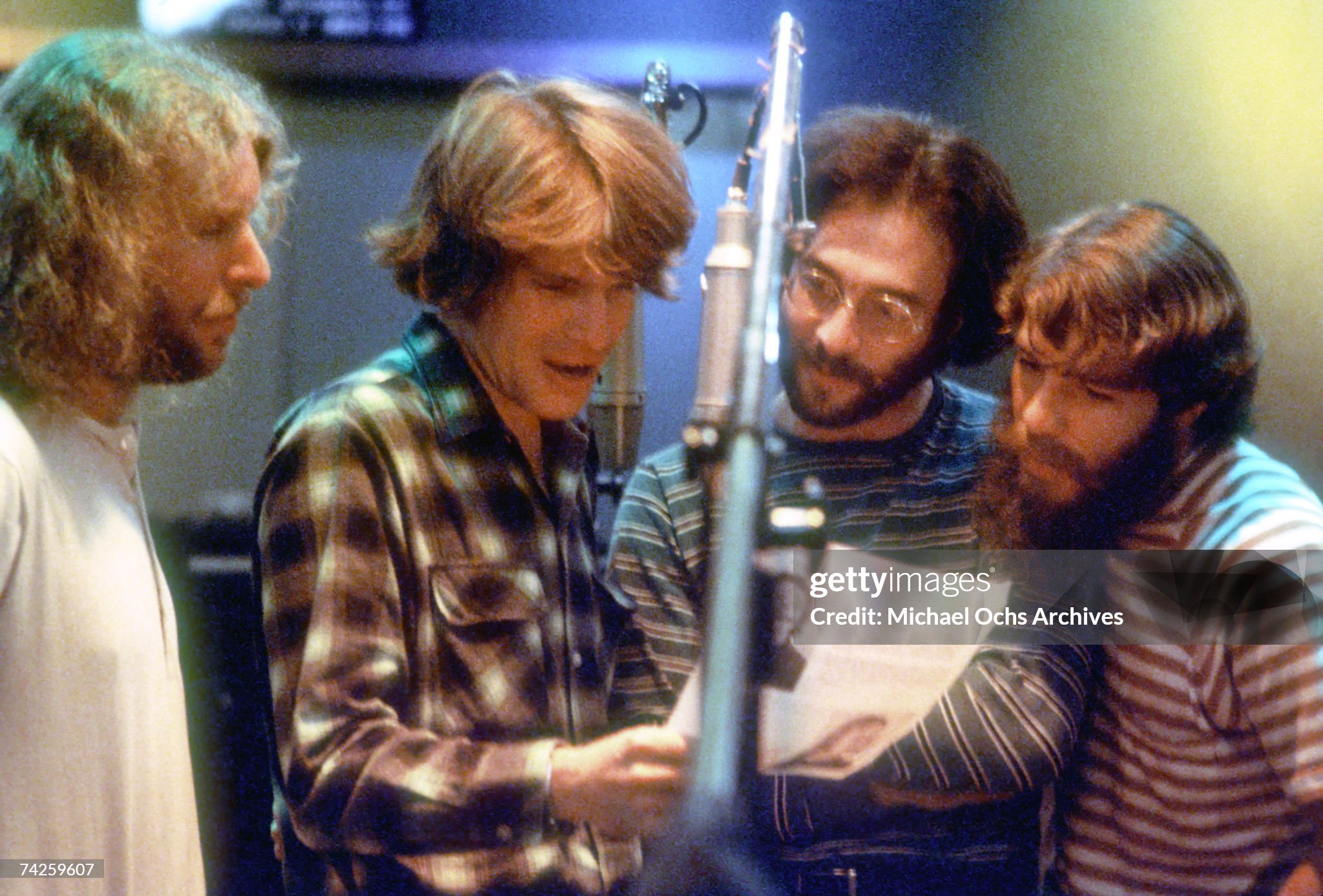
On a record packed with major singles, Creedence Clearwater Revival used ‘Ooby Dooby’ to look backward with joy, turning a quick cover into John Fogerty’s salute to Roy Orbison and the snap of Sun Records.
When Creedence Clearwater Revival released Cosmo’s Factory on Fantasy Records in 1970, the album hardly needed one more attraction. It already held some of the band’s most enduring work, from the restless sprawl of ‘Ramble Tamble’ to the twin-force pairing of ‘Travelin’ Band’ and ‘Who’ll Stop the Rain’, along with ‘Up Around the Bend’, ‘Run Through the Jungle’, ‘Lookin’ Out My Back Door’, and ‘Long As I Can See the Light’. Yet tucked into that crowded, hard-charging record was a brief cover of ‘Ooby Dooby’, the song written by Dick Penner and Wade Moore that became one of Roy Orbison’s earliest calling cards. In the middle of a blockbuster album, John Fogerty used it as something smaller and, in its own way, more revealing: a compact studio tribute to Orbison’s early rockabilly spark and to the lean, lively spirit associated with Sun Records.
That choice matters because Cosmo’s Factory is such a confident album. It does not sound like a band rummaging through the past because it has run out of ideas. If anything, it sounds like a band working at full pressure, with Fogerty writing, arranging, producing, and driving CCR through one of the most concentrated runs in American rock. Against that backdrop, ‘Ooby Dooby’ feels intentional. It is not filler, and it is not a novelty break. It is a return to first principles: a reminder that before rock records became statements, concepts, or epics, they were often compact bursts of rhythm, echo, and attitude built to leap from a small speaker in under three minutes.
CCR had always treated covers as declarations of ancestry. Earlier records had already made room for ‘Suzie Q’ and ‘I Put a Spell on You’, not as museum pieces but as living material. ‘Ooby Dooby’ belongs to that same instinct, though here the salute is especially focused. This time, the band was not just reaching back to old rock and roll in general; it was zeroing in on a very particular doorway into it.
That is exactly the world Roy Orbison inhabited when ‘Ooby Dooby’ first entered the picture in the mid-1950s. Long before Orbison became the voice of songs like ‘Only the Lonely’, ‘Crying’, or ‘In Dreams’, he was part of the young rockabilly current swirling around Southern studios, radio towers, and small labels. Choosing ‘Ooby Dooby’ meant reaching back not to the later, stately Orbison of dramatic ballads, but to the eager, fast-moving singer at the beginning of the road. That distinction is what gives CCR’s version its charm. Fogerty is not saluting the myth of Roy Orbison from a distance; he is saluting the ignition point, the quick pulse before the grandeur.
CCR plays the song with exactly the kind of discipline that keeps it from becoming costume. The arrangement is tight, brisk, and unpretentious. Fogerty’s guitar attack is clipped and direct, Doug Clifford keeps the beat pushing forward, Stu Cook locks the bass to the groove, and Tom Fogerty helps hold the frame in place. There is no attempt to over-explain the song, and no effort to modernize it into something heavier than it wants to be. Just as important, John Fogerty does not try to imitate Orbison. He brings his own rougher, more hard-driven vocal sound to the track, which lets the performance feel like homage rather than impersonation. The band seems to understand that the honor lies in energy, not mimicry.
That sensibility also says something important about Cosmo’s Factory itself. The album title came from the band’s rehearsal-room nickname, built around drummer Doug Clifford’s ‘Cosmo’ moniker and the almost industrial seriousness with which Fogerty pushed the group to work. On a record born from that kind of repetition and discipline, ‘Ooby Dooby’ arrives like a flash of remembered freedom. It is the sound of musicians who practiced hard enough to make looseness believable. The track lasts only a little more than two minutes, but it opens a much older door. You can hear the band’s affection for the architecture of early rock and roll: the short form, the strong backbeat, the vocal urgency, the sense that a record can smile without turning weightless.
It also clarifies something about Fogerty’s larger musical imagination. Creedence Clearwater Revival was a California band, but its sound was built from deep listening to Southern and roots traditions: blues, country, swamp textures, rhythm and blues, rockabilly. Fogerty often fused those elements so completely that they felt like one native language. By covering ‘Ooby Dooby’, he pulled one of those sources into plain view. The tribute to Sun Records is not about copying a label’s exact sonic fingerprint; it is about honoring a way of making records that prized force, economy, and personality over polish. In that sense, the song sits comfortably beside the rest of CCR’s catalog. It reveals the bones beneath the swamp mist.
The placement becomes even more interesting when you remember that Cosmo’s Factory also contains the band’s long, exploratory take on ‘I Heard It Through the Grapevine’. On one album, CCR could stretch out for more than ten minutes and then turn around and say everything it needed to say in a rockabilly sprint. That contrast is part of the record’s appeal. Fogerty understood duration as a tool, not a virtue. Some songs needed space to uncoil; ‘Ooby Dooby’ needed only ignition.
That is why the cover still carries weight beyond its running time. It lets listeners hear Creedence Clearwater Revival not only as hitmakers, but as musicians still in conversation with the older records that formed them. In a year when the band stood near the height of its commercial power, Fogerty made room for a salute to the music that came before fame, before expectation, before the machinery around a successful group grows too large to ignore. ‘Ooby Dooby’ rushes past like a grin, but it is an informed grin, affectionate and exact. For a brief moment on Cosmo’s Factory, the room seems to fill with the older electricity of early rock and roll, and you can hear John Fogerty tipping his hat to Roy Orbison and the bright, restless language that helped make CCR possible in the first place.
