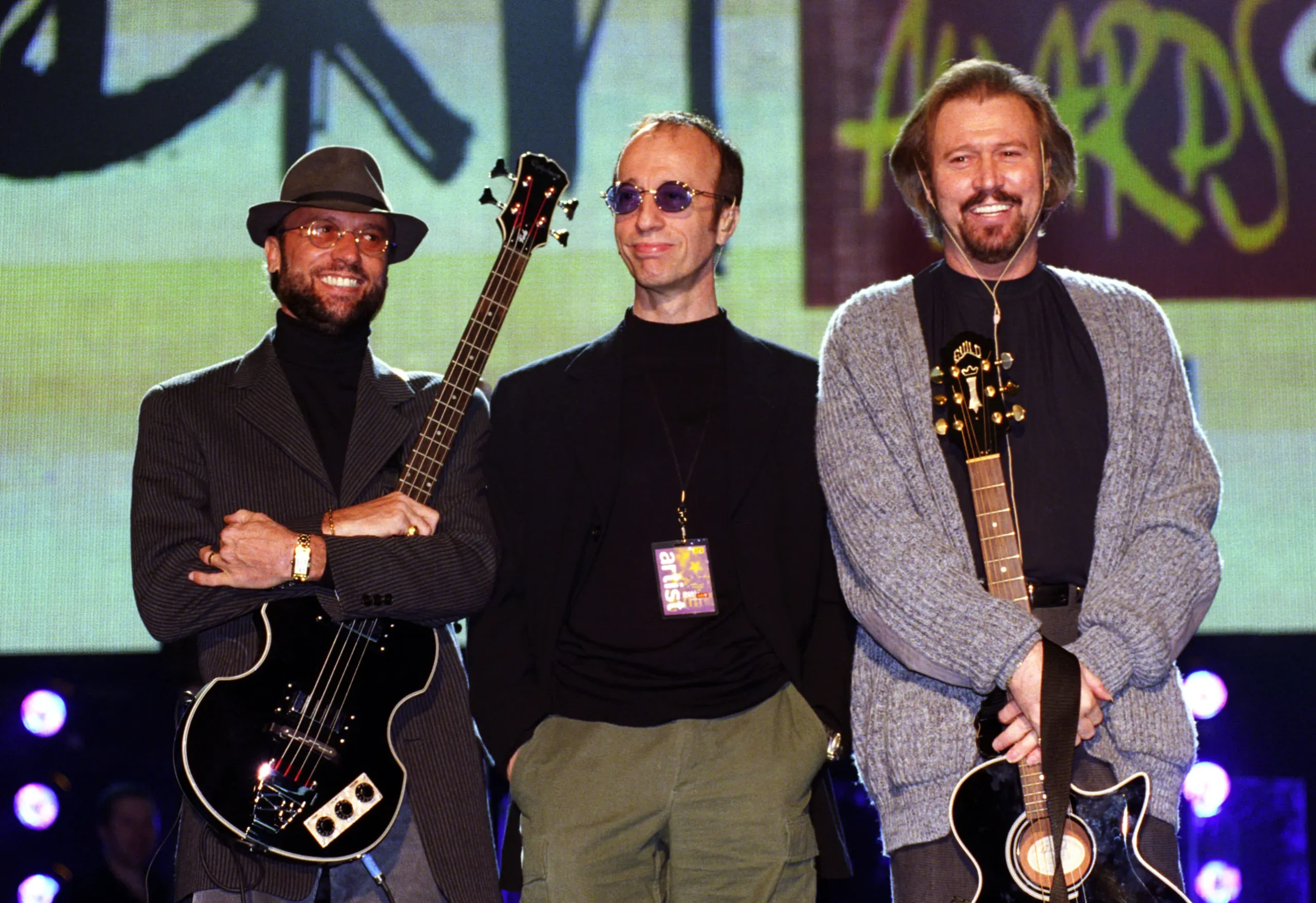
Before the disco avalanche made the Bee Gees unavoidable, Edge of the Universe proved something just as important: a great live performance can rescue a hidden song and give it the life radio missed the first time.
There is something deeply satisfying about the story of Edge of the Universe, because it reminds us that not every hit is born as a hit. Some songs wait. They sit quietly on an album, admired by the faithful, half-hidden behind bigger singles, until one night onstage changes everything. That is exactly what happened here. First released in 1975 on Main Course, the song was never pushed as a single in its original studio form. Yet when the Bee Gees brought it to Here at Last… Bee Gees… Live in 1977, the song found a new pulse, a new urgency, and eventually a new audience. Issued from that live album, it climbed to No. 26 on the Billboard Hot 100 in early 1978, a remarkable second life for what had once been a deep cut. The live album itself reached No. 8 on the Billboard 200, confirming that the group’s stage power was every bit as real as their studio craft.
To understand why this transformation matters, it helps to remember where the Bee Gees stood in 1975. Main Course was not just another album; it was the record that reinvented them. After a difficult early-1970s stretch, the brothers emerged with a leaner, more rhythm-driven sound shaped by Miami sessions, sharper grooves, and Barry Gibb’s rising falsetto confidence. The album gave them a No. 1 smash with Jive Talkin’, followed by the Top 10 hit Nights on Broadway. In other words, Main Course already had obvious headlines. Within that company, Edge of the Universe could easily be overlooked, tucked late in the running order, more mysterious than immediate, more searching than flashy.
But that studio version had qualities that were built for rediscovery. It was restless, spacious, and emotionally unsettled. Even the title feels as though it stands at a threshold, looking out into something larger and lonelier than ordinary pop songs usually dare to name. This was not simply a love song with neat answers. It carried the feeling of distance, of longing, of standing in some private outer darkness and trying to be heard. In the hands of lesser performers, that kind of song can drift away. In the hands of the Bee Gees, especially live, it could become dramatic without losing its ache.
That is what makes the version on Here at Last… Bee Gees… Live so compelling. Onstage, Edge of the Universe stops sounding like an album track that happens to be good and starts sounding like a statement. The rhythm section bites harder. The arrangement breathes differently. Barry’s lead has more lift and edge, Robin’s phrasing adds that unmistakable emotional tremor, and Maurice helps hold the center with the group’s beautifully disciplined harmony architecture. What had seemed slightly shadowed on Main Course becomes vivid in performance. The song opens up. It moves air. It reaches the back of the room.
And perhaps that is the real secret of why the live version connected. The Bee Gees were often discussed as songwriters, craftsmen, studio innovators, and later as defining voices of the disco era. All of that is true. But Here at Last… Bee Gees… Live captured something that can be forgotten when a group becomes historically fixed in public memory: they were a formidable live act. They understood dynamics. They knew when to hold tension and when to release it. They knew how to let harmony sound both polished and human. On a song like Edge of the Universe, those gifts mattered enormously, because the track depends less on obvious hooks than on atmosphere, lift, and emotional conviction.
The timing also gives the song a special place in the group’s history. The live album arrived just before the world-changing commercial force of Saturday Night Fever fully reshaped the Bee Gees into a cultural phenomenon of a different scale. That means this version of Edge of the Universe stands on a fascinating border. It belongs to the post-Main Course reinvention, but it also points toward the confidence and theatrical reach that would soon define the brothers on a much larger stage. It is a bridge between eras, and that may be one reason it still feels so alive. You can hear a group not merely performing a song, but discovering what that song can become in front of an audience.
There is also something moving about the way listeners answered. Radio had passed over Edge of the Universe the first time. The album audience may have loved it, but the wider market did not immediately embrace it. Then the live take arrives, and suddenly the same composition is heard differently. That tells us something beautiful about music. A song is not always finished when it is first pressed to vinyl. Sometimes it takes lights, distance, road wear, confidence, and a room full of people to reveal its true shape.
For longtime admirers of the Bee Gees, this story carries a special kind of pleasure. It confirms that their catalog was deeper than the obvious singles and that even in a period full of major hits, there were still treasures waiting below the surface. Edge of the Universe may never be mentioned as often as How Deep Is Your Love, Stayin’ Alive, or Jive Talkin’, but its journey from Main Course deep cut to a live Billboard Top 30 entry is one of the most revealing chapters in the group’s career. It shows how performance can change reputation, how audience response can rewrite a song’s destiny, and how the Bee Gees, at their best, could turn uncertainty into lift and introspection into momentum.
In the end, that is why this live version still resonates. It is not merely a successful rearrangement. It is the sound of a song finally meeting its moment.
