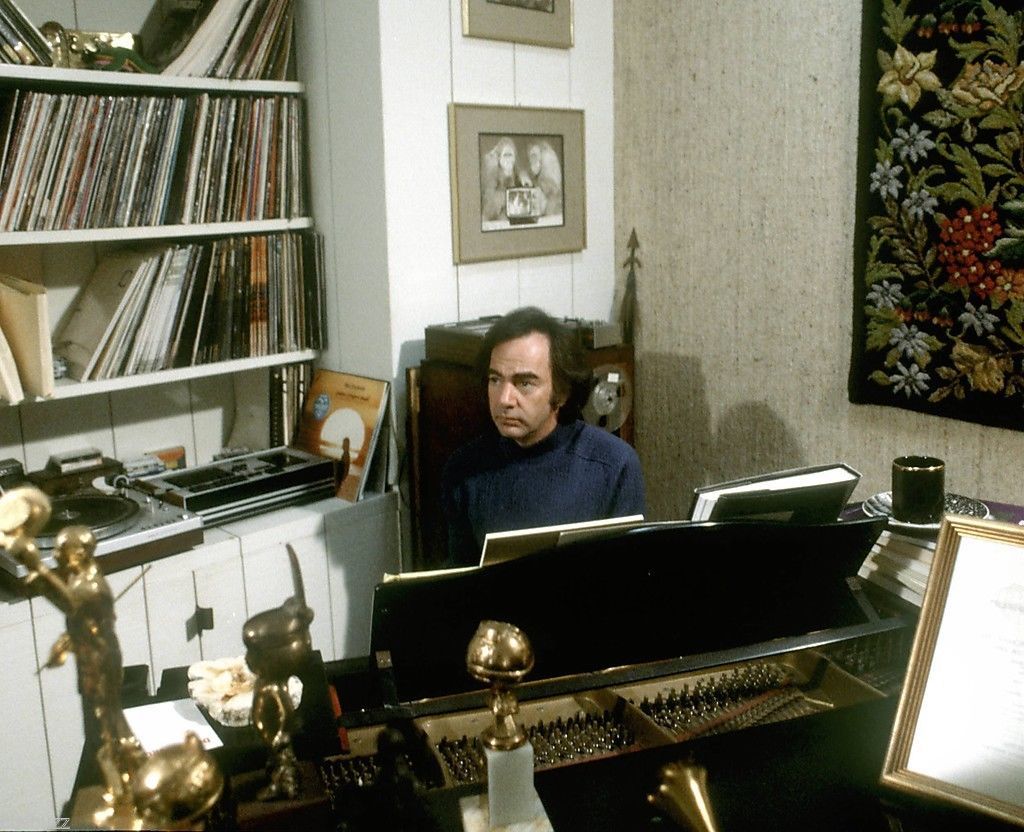
Mothers And Daughters, Fathers And Sons finds Neil Diamond turning away from the big romantic spotlight and toward the deeper bonds that shape a life long before any love song begins.
There are songs that arrive with fanfare, and there are songs that wait quietly in the corner until life catches up with them. Mothers And Daughters, Fathers And Sons belongs to that second category. Tucked into Neil Diamond‘s 1978 album You Don’t Bring Me Flowers, it was never the headline song, never the one that carried the commercial push, never the track most casual listeners named first. And yet for many longtime admirers of Diamond’s writing, this is exactly where some of his most human work can be found: not in the obvious hit, but in the reflective deep cut that speaks in a lower voice and lingers longer.
One important fact belongs near the top. Mothers And Daughters, Fathers And Sons was not released as a major chart single, so it did not have its own run on the Billboard Hot 100. But the album that carried it, You Don’t Bring Me Flowers, was no small moment in Diamond’s career. The record reached No. 1 on the Billboard 200, and it arrived during one of the most visible stretches of his late-1970s success. Around the same period, the title song You Don’t Bring Me Flowers became part of one of pop’s most famous stories, when the separate recordings by Neil Diamond and Barbra Streisand inspired a duet version that went on to top the Hot 100. In other words, this album lived in bright public light. That may be one reason its quieter treasures were so easy to overlook.
What makes Mothers And Daughters, Fathers And Sons so striking is its subject. Neil Diamond had always understood how to write for the heart, but he was often celebrated for songs of romantic longing, restless motion, and wide-screen emotion. Here, he narrows the lens. The title alone suggests generations standing face to face, each seeing themselves reflected and changed in the other. It is a song built not on grand drama, but on recognition: the old patterns that pass through families, the tenderness that sits beside misunderstanding, the strange way love can feel both inherited and unfinished.
That emotional territory mattered in 1978. By then, Neil Diamond was already a major star, a performer capable of filling arenas and delivering chorus after chorus that audiences could carry home with them. But one of the reasons his catalog has lasted is that he was never only a maker of large public moments. He also understood quieter adult truths. On You Don’t Bring Me Flowers, amid polished late-1970s production and a record built for a broad audience, Mothers And Daughters, Fathers And Sons feels almost like a private conversation left on tape.
Musically, the song works because it does not force its emotions. The arrangement is measured and warm, closer to contemplation than spectacle. Instead of rushing toward a show-stopping release, it lets the melody carry the weight in a patient way, allowing Diamond’s phrasing to do what he did so well in his best introspective material: sound conversational, then suddenly devastating. There is a dignity in that restraint. The song does not beg to be admired. It trusts the listener to come closer.
Its meaning, too, grows richer with time. A lesser writer might have treated the subject of parents and children as pure sentiment, smoothing over the complications. Neil Diamond was rarely that simple. In songs like this, he understood that family is made of devotion, expectation, repetition, silence, resemblance, and distance all at once. Mothers And Daughters, Fathers And Sons carries the feeling that we spend a lifetime learning the emotional language we inherited long before we had words for it. It is about continuity, but not in a shallow or decorative way. It is about what gets passed down, consciously and unconsciously, through love, habit, hope, and hurt.
That is also why the song feels so different from the record’s famous title track. You Don’t Bring Me Flowers became legendary because it dramatized a relationship in decline so vividly and memorably. Mothers And Daughters, Fathers And Sons, by contrast, looks beyond the couple and toward the longer chain of human connection behind every household, every argument, every reconciliation, every silence at the dinner table. If the title song is about what happens when romance grows fragile, this deep cut feels more like a meditation on the emotional foundations people carry into adulthood in the first place.
There is something deeply characteristic about Neil Diamond in that choice. For all the grandeur associated with his name, he often wrote from a place of longing for home, belonging, roots, and personal truth. That is why his best songs do not simply entertain; they accompany people. Mothers And Daughters, Fathers And Sons may not have become a radio staple, but it belongs to that durable part of his work that reveals itself slowly. The first listen may register as thoughtful. The tenth may feel uncannily personal.
In the end, this is what makes the song such an overlooked gem from You Don’t Bring Me Flowers. Its value is not in commercial mythology, but in emotional durability. It never needed chart glory to matter. It needed time, and it needed listeners willing to hear the softer things. Hidden beneath the glare of a No. 1 album and one of the era’s most famous pop narratives, Mothers And Daughters, Fathers And Sons remains a reminder that Neil Diamond‘s catalog is full of songs that do not shout for attention, yet somehow stay with us the longest.
