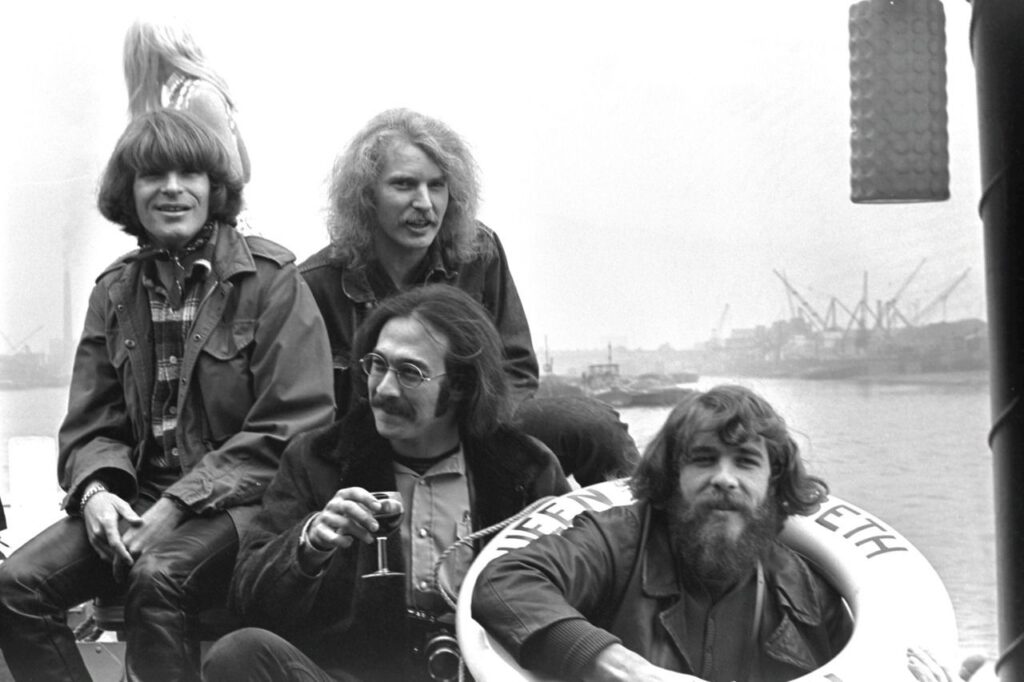

Bright on the surface and shadowed underneath, Bad Moon Rising turned a 1969 radio smash into one of John Fogerty’s clearest warnings about trouble gathering just beyond the light.
When Creedence Clearwater Revival released Bad Moon Rising in 1969, the song seemed to arrive with the ease of a summer hit. It was short, catchy, fast on its feet, and built on a rhythm that felt almost cheerful. Yet underneath that bright musical motion was something far more unsettled. Written by John Fogerty, the single climbed to No. 2 on the Billboard Hot 100 in the United States and reached No. 1 on the UK Singles Chart, a remarkable transatlantic run that showed how deeply its strange mixture of lift and unease connected with listeners. Released ahead of the album Green River and backed with Lodi, it became one of those records that sounded instantly familiar even on first hearing.
That tension between sound and meaning is the secret at the center of Bad Moon Rising. The guitars move with a sharp, rolling bounce. The beat is clean and urgent. The chorus is easy to sing after only one pass. If someone only heard the arrangement from a distance, they might mistake it for a carefree rocker. But Fogerty was not writing about romance, freedom, or simple good times. He was writing about warnings. The lyrics speak of earthquakes, storms, overflowing rivers, and a sense that something bad is coming. Few songs in rock history have hidden dread inside such an inviting frame so effectively.
The story behind the song is one of those details that makes its mood even more vivid. John Fogerty has said the idea came after he watched the 1941 film The Devil and Daniel Webster, particularly a scene involving a violent storm and disaster. That image stayed with him. What followed was not a detailed narrative, but a concentrated burst of foreboding. Fogerty took that feeling of impending catastrophe and shaped it into a song so lean and direct that it never wastes a second. In typical Creedence Clearwater Revival fashion, the band did not dress the idea up with excess. They delivered it plainly, with force and clarity.
And that is part of why the song still feels so alive. Bad Moon Rising never explains too much. It does not tell the listener exactly what the bad moon is. It leaves space for personal meaning. Some hear social unrest in it. Some hear nature itself turning hostile. Some hear the private dread that comes when life begins to tilt and the sky no longer looks safe. In 1969, that uncertainty was especially powerful. It was a year marked by anxiety, division, and a growing sense that the world could change very quickly. Fogerty did not need to turn the song into a speech. A few strong images were enough. The times rushed in and filled the spaces.
Musically, the record is also a perfect example of what made CCR so different from many of their peers. While other groups stretched outward into long forms, studio experimentation, and psychedelic abstraction, Creedence Clearwater Revival often favored compression, grit, and immediacy. John Fogerty’s voice has that clipped urgency that sounds half warning, half testimony. The band around him is tight and unshowy: Tom Fogerty on rhythm guitar, Stu Cook on bass, and Doug Clifford on drums, all serving the song rather than crowding it. Their gift was not just writing memorable records. It was making those records feel inevitable, as if they had always existed somewhere in the American air.
The chart story matters because it reveals how widely that feeling traveled. In the United States, Bad Moon Rising stopped just short of the top, peaking at No. 2 on Billboard. In the United Kingdom, however, it went all the way to No. 1. That contrast says something important. The song was deeply rooted in an American idiom, with its swampy drive and plainspoken imagery, yet its emotional core was universal. A warning wrapped in melody can cross oceans very easily. People do not need a long explanation to recognize a song that senses the weather changing.
Over time, Bad Moon Rising also took on another kind of life: the affectionate folklore that surrounds beloved records. Fogerty’s pronunciation led many listeners to hear the famous misquoted line as ‘there’s a bathroom on the right,’ a mondegreen so persistent that it became part of the song’s legend. Rather than fight it, he eventually leaned into the joke in live performance. It is a charming footnote, but it also says something larger. Songs that enter everyday speech, even by accident, are songs that have fully entered culture. They stop belonging only to the artist and start living among people.
Still, what keeps this record from becoming mere oldies-radio comfort is the unease that remains lodged inside it. Listen closely, and the song does not smile for long. It keeps looking toward the horizon. That is why Bad Moon Rising has endured far beyond its chart peak. It captures a contradiction that great music often understands better than conversation does: life can feel bright and threatened at the same time. The radio can be full of sunlight while the lyric quietly points to gathering clouds.
In the end, John Fogerty gave Creedence Clearwater Revival one of their most lasting songs by refusing to separate pleasure from warning. Bad Moon Rising remains thrilling because it never asks us to choose between the two. It lets the rhythm carry us forward even as the words tell us to pay attention. And perhaps that is why a record that rose to No. 2 in America and No. 1 in Britain still sounds so immediate today. It remembers how quickly the mood of an era can change, and how a great song can feel both like celebration and prophecy at once.
