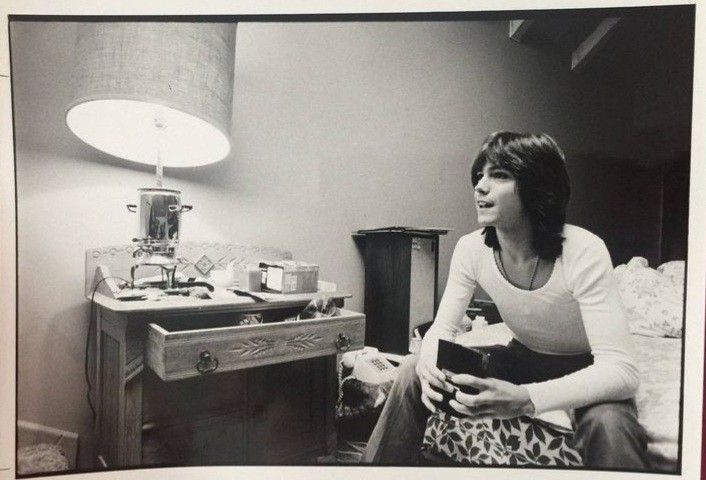
I Think I Love You lasts because it turns first love into a beautiful hesitation, and David Cassidy sings it with the startled wonder of someone hearing his own heart speak back.
There are songs that become hits, and then there are songs that seem to arrive carrying an entire season of life with them. I Think I Love You belongs to that second kind. Released in 1970 as the debut single by The Partridge Family, with lead vocals by David Cassidy, it quickly moved beyond television promotion and became a genuine pop event. The record spent three weeks at No. 1 on the Billboard Hot 100 in November 1970, and in the process it introduced Cassidy not simply as a fresh face on a new TV series, but as a voice that listeners instantly trusted. Even now, decades later, the song still carries that same bright rush of surprise.
It is worth saying clearly, because memory sometimes blurs these things: the official hit single was credited to The Partridge Family, not to David Cassidy as a solo artist. Yet for millions of listeners, Cassidy was the emotional center of the record. His voice is what made the song feel personal. That distinction matters, because one of the quiet fascinations behind I Think I Love You is the way it lived in two worlds at once. It was born from television, tied to the sitcom The Partridge Family, but it never sounded trapped by its premise. Instead, it escaped into radio and memory like a real confession.
The song was written by Tony Romeo, who understood something essential about young love: that it rarely arrives with dignity. It arrives in confusion, in sleeplessness, in overthinking, in that almost comic panic of feeling too much too fast. The lyric says exactly that. “I’m sleeping and right in the middle of a good dream…” is such a memorable opening because it begins in disruption. Love is not presented as calm wisdom. It is an interruption. It shakes the singer awake. And then comes the title line itself, one of the cleverest in pop music: I Think I Love You. Not “I know.” Not “I will.” Just “I think.” That small uncertainty is the whole magic of the song.
David Cassidy understood how to sing that uncertainty. His performance is light, melodic, and radio-friendly, but underneath it there is a real tremor of vulnerability. That is why the song has lasted when so many bright, well-made pop singles from that era have faded into period charm. Cassidy does not oversell the emotion. He does not push too hard for grandeur. He sounds amazed by what he is feeling, and that makes the listener believe him. In a record built for broad appeal, he found room for something intimate.
The backstory behind the recording also adds an important layer. On television, The Partridge Family was presented as a family band, but on the records, much of the instrumental work was handled by seasoned studio musicians. David Cassidy and Shirley Jones were the principal cast members who actually sang on the early recordings, with top Los Angeles session players helping create that polished pop sound. In lesser hands, that setup might have made the music feel artificial. But I Think I Love You survived that potential limitation because the record itself was so expertly built and because Cassidy’s voice gave it real human warmth. It may have arrived through a manufactured framework, but the feeling in the performance was not manufactured.
That is part of what makes the song such an intriguing artifact of its time. The early 1970s were full of musical seriousness, experimentation, and cultural change, yet here came a tune connected to a television comedy that still managed to cut through the noise and claim the top of the chart. Some critics then, and some listeners since, have been tempted to file it away as simple bubblegum. But that label has always been a little too easy. Yes, the melody is sweet. Yes, the arrangement is accessible. Yet listen closely and there is craft everywhere: the pacing of the verses, the lift of the chorus, the gentle tension between lyrical embarrassment and musical confidence. It is pop made with precision, and precision is often what gives a song its long life.
For David Cassidy, the success of I Think I Love You changed everything. Almost overnight, he became one of the defining teen idols of the era. The fame that followed was enormous, exhilarating, and at times overwhelming. But before the frenzy, before the posters and magazine covers and screaming crowds, there was this song. This was the first moment so many people heard what he could do. And what they heard was not merely prettiness. They heard clarity, timing, charm, and a voice that could make uncertainty sound beautiful.
The song’s deeper meaning has only grown richer with time. When people are young, I Think I Love You can feel like a charming anthem of nervous desire. Later in life, it can sound like something even more touching: a reminder of how honest people once were before they learned to guard every feeling. There is no cynicism in it, no game-playing, no ironic distance. It is simply the sound of someone startled by affection and brave enough to admit it, even imperfectly. That emotional innocence is harder to find than many listeners realize.
And perhaps that is why the record still lands with such force. The world around I Think I Love You may have been brightly colored, commercially packaged, and tied to a television fantasy, but the center of the song remains deeply recognizable. Most people remember a time when feeling arrived before language did, when the heart moved faster than certainty, when even happiness could be frightening because it mattered so much. David Cassidy captured that fragile threshold in just a few minutes, and he did it so naturally that the song still feels alive whenever it starts.
If one wants the exact chart fact, the record was a No. 1 single. If one wants the cultural fact, it launched a phenomenon. But if one wants the lasting truth, it is simpler than that: I Think I Love You endures because beneath the polish, beneath the sitcom origin, beneath the pop machinery, it sounds like a real human heart recognizing itself for the first time.
