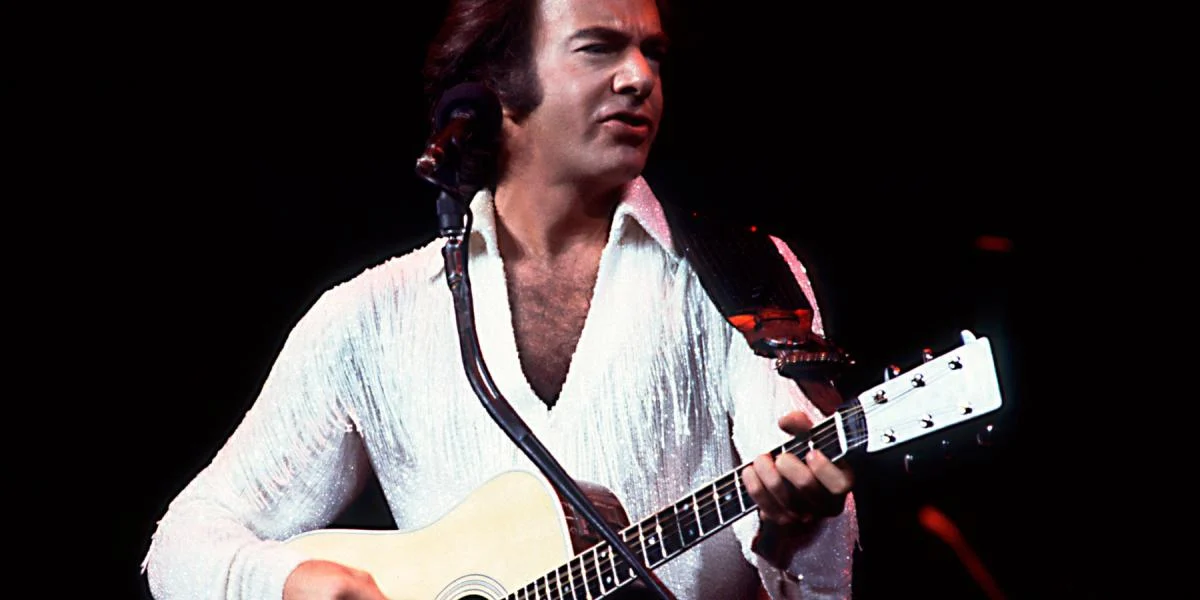
On Beautiful Noise, “Surviving the Life” feels like a private reckoning set to motion—Neil Diamond sounding tougher, leaner, and more inward as Robbie Robertson helped reshape the room around him.
In 1976, when Neil Diamond released Beautiful Noise, the headline story was already compelling: here was one of the most successful singer-songwriters in American pop stepping into the studio with Robbie Robertson of The Band, looking for a sound with more grain in it, more road dust, more band feel. That collaboration gave the album its distinct atmosphere, and while the title track became the obvious doorway into that era, “Surviving the Life” is one of the songs that reveals the deeper mood of the record. It is not built like a grand statement. It moves more like an admission, a portrait of endurance rather than victory.
That matters because Beautiful Noise was never just a cosmetic change in production. Diamond had already proven he could deliver huge melodies, emotional declarations, and polished pop records that traveled far beyond the radio. What Robertson brought was something a little more weathered. The album often feels as if Diamond is standing in brighter light but with fewer curtains around him. On “Surviving the Life”, that shift becomes especially clear. The song carries a title that sounds almost conversational, but there is fatigue and wisdom folded into it. It suggests not glamour, not escape, but persistence. Not the romance of the road, but what it costs to keep going.
As an album track, it occupies an important place in the emotional architecture of Beautiful Noise. This was a period when Diamond’s voice had grown fuller and more commanding, yet he was also becoming more expressive in smaller ways: a dragged syllable, a line that sounds held back rather than pushed forward, a phrase that lands with the weight of someone who has already lived the sentence before singing it. “Surviving the Life” benefits from that maturity. He does not oversell the idea. He lets the title do its work, and the performance meets it with a mix of steadiness and strain.
Robertson’s production is central to why the song lingers. Rather than smothering the track in lush decoration, the arrangement leaves room for texture and tension. The groove feels grounded. The instrumentation has shape, but it does not rush to flatter the singer. That restraint is one of the great qualities of Beautiful Noise as an album. Robertson understood that Diamond’s voice did not always need more drama; sometimes it needed contrast. A slightly rougher edge, a more rooted rhythm section, and a less ornamental frame could bring out something truer. On “Surviving the Life,” that approach gives the song a lived-in quality. It sounds less like performance as spectacle and more like a man taking account of himself in public.
There is also something very 1976 about it, though not in a flashy way. This was a decade full of singer-songwriters rethinking scale, image, and authenticity. For Diamond, whose career had moved through Brill Building craft, pop stardom, and large-stage charisma, Beautiful Noise captured an artist trying to reconcile polish with grit. He did not abandon melody, and he did not stop being unmistakably himself. But on this record, and especially on songs like “Surviving the Life,” he allowed more shadow into the frame. The song feels aware of weariness without collapsing into it. That balance gives it its strength.
What makes the track especially rewarding now is that it is not one of the songs most casually remembered first. That can be an advantage. Without the burden of overfamiliarity, it arrives fresh, and the listener hears the craftsmanship more clearly. Diamond’s writing here is less about a neat hook than a state of being. The song seems to understand that adulthood is often measured not by arrival but by continuation. You carry what you can. You keep your footing. You make sense of the noise around you and inside you. In the wider context of Beautiful Noise, that idea feels almost like a hidden thesis.
The title of the album promised color, energy, and public sound. “Surviving the Life” offers the human echo behind that promise. It reminds us that the mid-1970s Neil Diamond was not simply making records designed to fill space; he was shaping mood, character, and self-awareness inside songs that could still reach a broad audience. Robertson’s presence helped sharpen that instinct, giving the music firmer contours and a subtle toughness that served Diamond well.
That is why this track deserves to be heard as more than a deep cut. It is one of the places where the real character of Beautiful Noise comes into view: not just the shine, but the stamina underneath it. The song does not plead for attention. It simply stays with you, carrying the weary grace of someone who has seen enough to know that getting through is its own form of art.
