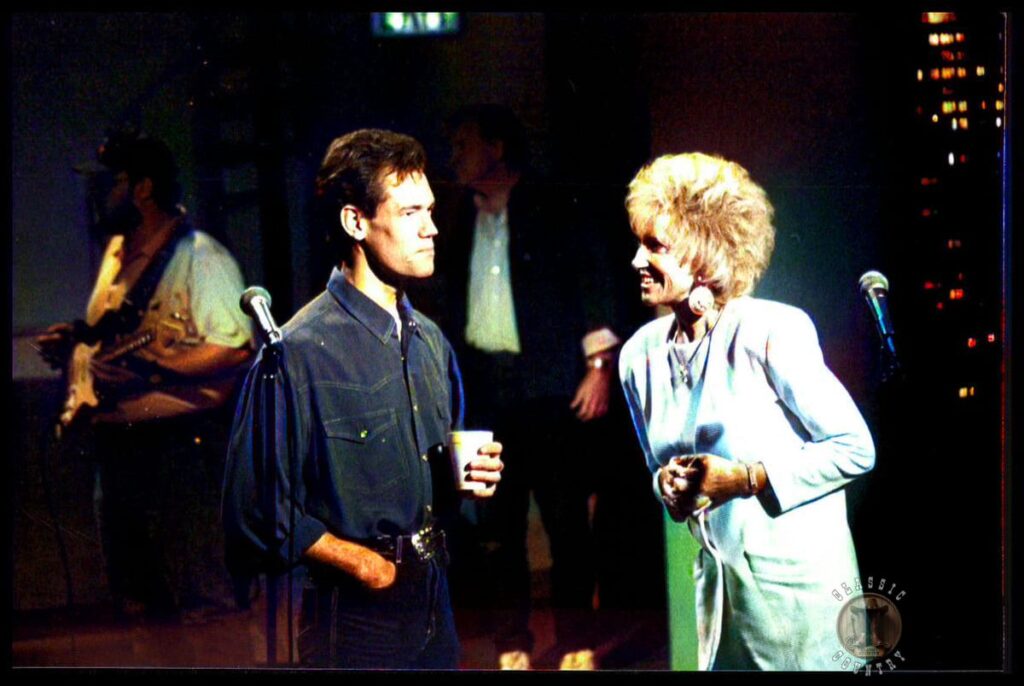
A Timeless Duet: Where Voices Meet in the Twilight of Love
When Randy Travis and Tammy Wynette joined their voices on “We’re Strangers Again,” released in 1990 on Travis’s duet album Heroes & Friends, it was more than a simple collaboration. It was the convergence of two country music luminaries, each carrying a legacy shaped by triumph, hardship, and the emotional honesty that defines the genre. The album, arranged around musical partnerships with artists who influenced or inspired Travis, further cemented his role as a leading force in neotraditional country music. Yet among these notable pairings, “We’re Strangers Again” stands out as a poignant meditation on the quiet unraveling of love.
Written by Merle Haggard and Leona Williams, the song interlaces Travis’s grounded baritone with Wynette’s expressive and timeworn voice. Together they paint a portrait of two people who once shared everything but who have drifted apart until only distance remains. Their vocal chemistry is subtle and deeply affecting, and it mirrors the emotional restraint of a relationship that dissolves not through conflict but through silence and gradual separation.
Lyrically, “We’re Strangers Again” explores familiar yet profound terrain. The verses trace the small, private moments in which intimacy erodes. There is no dramatic confrontation here. Instead the song gives voice to the slow drifting apart, the small silences that widen into unbridgeable gaps. Travis and Wynette deliver these lines with restraint, which allows each quiet phrase to land with a gentle but undeniable weight.
Musically the arrangement adheres to the traditional foundations both artists revere. Soft guitar lines and understated instrumental touches support rather than overshadow their harmonies. This pared back production mirrors the song’s theme. By stripping away excess, the recording reveals the raw feeling at the heart of the story.
Placed within the broader tapestry of country music history “We’re Strangers Again” resonates as both tribute and revelation. For Randy Travis it demonstrates his ability to honor earlier generations while channeling traditional storytelling through his own sensibility. His steady and resonant voice provides a perfect counterpoint to Wynette’s emotive phrasing, creating a dialogue between youth and experience. For Tammy Wynette the duet offered renewed visibility alongside a contemporary torchbearer, and it underscored her enduring capacity to communicate heartbreak with profound sincerity.
The cultural significance of the duet lies not only in its artistry but in its meditation on partnership as something fragile and ever changing. In many ways “We’re Strangers Again” reflects country music at the turn of a decade, rooted in tradition while continuing to be reshaped through collaboration and evolving perspectives.
Listening to “We’re Strangers Again” today evokes a gentle nostalgia for a moment when country music bridged generations through shared emotion and storytelling. Its lasting appeal rests in its honesty and subtlety, and in the way it reminds listeners that even when people drift apart, echoes of connection remain.
In the end “We’re Strangers Again” is more than a highlight on a celebrated duet album. It is a moving study of human vulnerability voiced by two icons who understood that sometimes parting is not a dramatic rupture but a quiet acknowledgment of change. Through their collaboration Randy Travis and Tammy Wynette captured the sorrow and grace of becoming strangers once more, while remaining forever linked by memory and melody.
