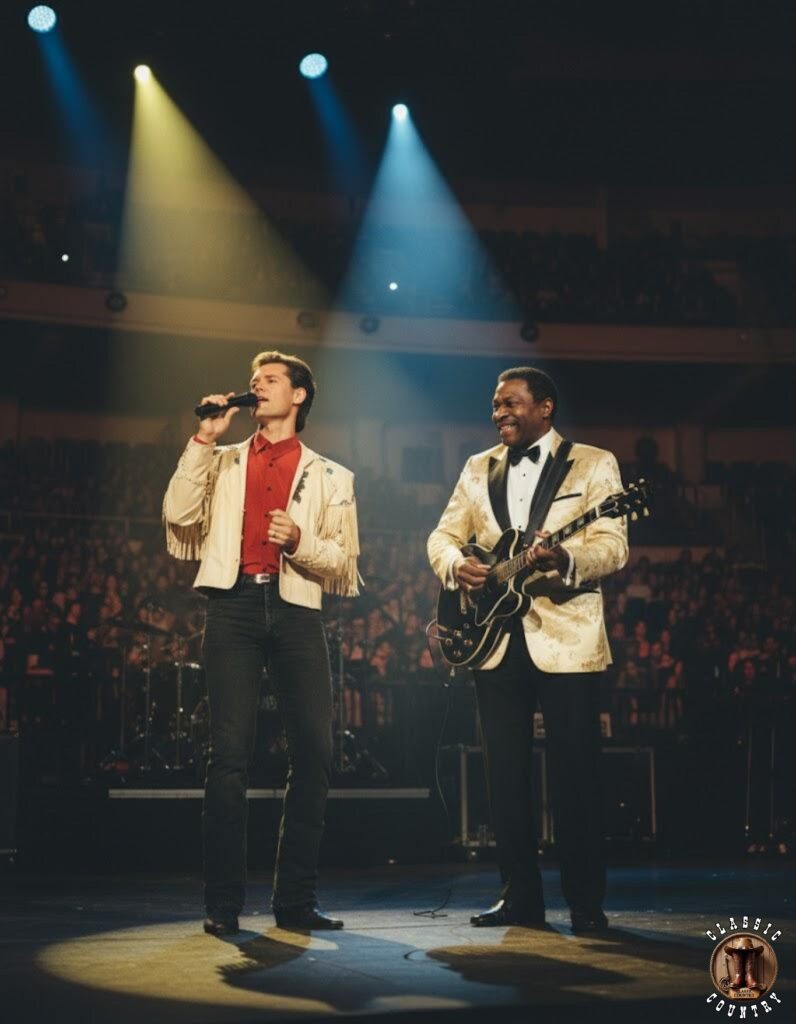
A Harmony of Hope and Blues: When Country Meets the King of Strings
Randy Travis, the deep voiced baritone who helped shape the contours of modern country music, recorded the collaborative gem Waiting On the Light to Change with B. B. King in 1990. Featured on the duet-centered album Heroes & Friends, this track stands as one of the album’s most distinctive pairings, bringing together two towering figures from different musical lineages. While Heroes & Friends was released as a celebration of the artists who influenced or inspired Travis, the collaboration with King remains one of its most striking bridges between genres, offering a rare blend of country storytelling and blues expression.
The creation of Waiting On the Light to Change reflects Travis’s openness to exploring musical boundaries even at an early point in his career. Written by Richard C. Leigh and Gary Nicholson, the song pairs Travis’s warm, grounded baritone with King’s unmistakable guitar voice. King’s bending notes and soulful vibrato move through the track like a second narrator, illuminating feelings that the lyrics only hint at. Together, their performance creates a space where blues and country meet naturally, without either overshadowing the other.
Lyrically, the song centers on anticipation and emotional stillness, a moment suspended between resignation and hope. The idea of waiting on the light to change becomes a metaphor for the pauses in life when clarity has not yet arrived. Travis carries these themes with his signature sincerity, delivering each line with patience and an understated ache. His vocal presence grounds the song in a familiar country warmth, while King’s guitar interjections deepen the emotional landscape, turning silence into dialogue.
Musically, the arrangement strikes a delicate balance between country restraint and blues color. The structure is simple, leaving wide spaces for King’s guitar phrases to breathe. Every riff feels like a soft conversation between two artists who understand one another even without words. The interplay between vocals and guitar creates a reflective atmosphere, inviting listeners to lean into the quiet moments the song evokes.
Within Travis’s career, this collaboration illustrates both his artistic confidence and his respect for musical heritage. Though he was already known as a leading voice in the neotraditionalist movement, this track showed his willingness to embrace influences beyond the usual borders of country music. Working with King allowed Travis to explore blues inflected textures while remaining true to his own storytelling identity.
The cultural resonance of the track lies in its seamless blending of genres. At a time when cross genre collaborations were far less common, Waiting On the Light to Change stood as proof that country and blues could share emotional terrain. Travis and King each bring their history, their emotion, and their artistry, and the result is a song that feels organic rather than experimental.
Listening to the track conjures an atmosphere of reflection and tender honesty. It is a song that asks listeners to sit with uncertainty, to find meaning in the small spaces between decisions, and to trust that change eventually arrives. Travis and King together create a portrait of hope tempered by experience, a reminder that waiting is sometimes its own kind of journey.
In the end, Waiting On the Light to Change remains a luminous moment in Randy Travis’s discography, a rare meeting of two musical giants who find common ground in patience, longing, and the quiet courage of holding on. Through its lyrical depth and emotional resonance, the song endures as a testament to the timeless connection between country and blues.
