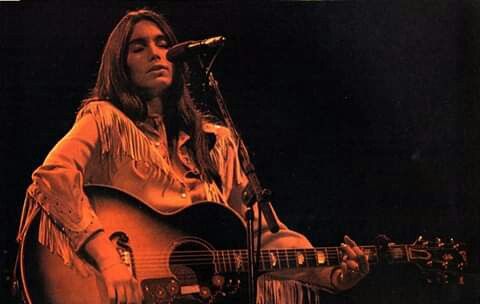
“Goin’ Back to Harlan” is a song about returning to the place that shaped your inner ear—where old folk melodies, first loves, and half-remembered legends still call you home.
On September 26, 1995, Emmylou Harris released Wrecking Ball, the Daniel Lanois–produced album that re-lit her voice in a new atmosphere—spare, shadowed, and quietly electric. Inside that career-redefining record, “Goin’ Back to Harlan” sits like a memory you can’t quite put away: not a radio bid, not a chart-chasing single, but a centerpiece for anyone who listens with their whole past. The album itself peaked at No. 94 on the Billboard 200 (and hit No. 46 in the UK, while reaching No. 1 on the UK Country Albums chart), a modest commercial footprint for something so influential—proof that certain records change lives without needing to dominate them.
The song’s authorship is essential to its spell. “Goin’ Back to Harlan” was written by Anna McGarrigle, and on Wrecking Ball it’s credited exactly that way—Anna McGarrigle alone, a songwriter with a rare gift for making personal memory feel like shared folklore. (Catalog references also list Harris’ 1995 recording as the song’s first release, which adds an extra twist to its legacy: Emmylou didn’t just interpret it—she introduced it to the world.)
So what is “Harlan,” and why does it sound like a distant bell? In the orbit of American traditional music, “Harlan” most often points listeners toward Harlan, Kentucky / Harlan County, a name steeped in Appalachian identity and the hard poetry of coal-country history. But the song isn’t a travel brochure. “Harlan” becomes a symbol—an emotional birthplace—where the singer’s imagination was first stocked with old tunes and characters that feel older than any single life. One perceptive profile of the McGarrigle sisters describes “Goin’ Back to Harlan” as a celebration of how traditional music shaped those who discovered it in the mid-1960s, offering myths and inner maps different from the world their parents tried to build after war and hardship. That idea—music as the secret country you carry within you—hangs in every line.
In Emmylou Harris’ hands, the song becomes even more uncanny, because Wrecking Ball itself is an album about ghosts that don’t threaten—they accompany. Lanois’ production is famous for its spacious, nocturnal feel, and “Goin’ Back to Harlan” moves through that space like a lantern in fog: gentle, persistent, and strangely brave. The lyric’s most moving trick is the way it name-checks the folk universe—not as trivia, but as living company. A later critical appraisal notes how the song summons figures and titles from the traditional and protest-song world—echoes that populated teenage listening (the kind of listening that changes you permanently). Harris sings as if she’s opening an old record sleeve and finding her younger self still there, still leaning in.
And that’s the deeper meaning: “Goin’ Back to Harlan” isn’t only about geography. It’s about origin—the place in your mind where the first true songs entered, where you learned the shape of longing, where you first understood that beauty can be both comforting and dangerous. There’s nostalgia here, yes, but it isn’t sugary nostalgia. It’s the kind that carries splinters: the knowledge that going back may not restore anything, yet the heart keeps asking anyway.
That tension is why the chorus feels like a vow and a risk at the same time. To “go back” is to admit you were formed by something you didn’t choose: a culture, a family story, a soundtrack of old ballads that taught you how love ends and how it endures. Harris doesn’t dramatize that admission—she inhabits it. Her phrasing is lucid, almost conversational, yet it glows with the hush of recognition, as if she knows that some parts of life can only be revisited through song.
In the end, “Goin’ Back to Harlan” is a quiet masterpiece of remembrance: Emmylou Harris walking into a room made of old melodies, letting them call her by name, and answering—softly, steadily—because the truest home is sometimes not a house or a town, but the music that taught you who you were.
