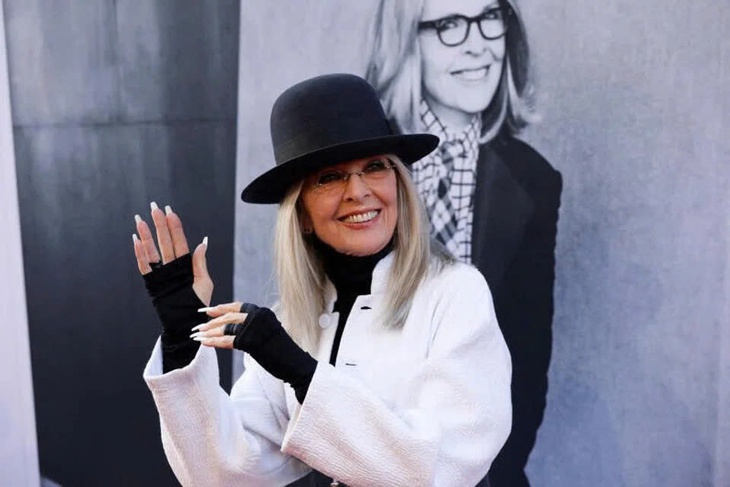
Diane Keaton, an actress of singular presence whose offbeat charm and understated rigor made her one Diane Keaton, an actress of singular presence whose offbeat charm and understated rigor made her one of the most distinctive performers of her generation, has died at the age of 79. Her passing was confirmed by Dori Rath, a producer of several of Ms. Keaton’s recent films. No information about the time, place or cause of death has been disclosed.
Ms. Keaton’s career spanned nearly a hundred film and television roles and encompassed an uncommon range: from buoyant, quirky comedies such as Sleeper to piercing dramatic work in films like The Godfather and Marvin’s Room. She won the Academy Award for Best Actress for Woody Allen’s Annie Hall and earned three additional Academy Award nominations for her performances in Reds, Marvin’s Room and Something’s Gotta Give. Over decades she was alternately celebrated as a comedienne, a dramatic actor, a director and an author, and she remained a public figure noted for a distinctive personal style that often informed her screen personae.
Born Diane Hall on January 5, 1946, in Los Angeles, she was the eldest of four children of John Newton Ignatius Hall, a civil engineer, and Dorothy Deanne (Keaton) Hall, an amateur photographer who had been crowned Mrs. Los Angeles in a homemakers’ pageant. Nicknamed “Perkins” by her father, she was raised in Santa Ana, California. After brief attendance at community colleges in Santa Ana and at Orange Coast, she moved to New York at nineteen to study acting at the Neighborhood Playhouse.
Her professional stage career began on Broadway. She made her debut in the original production of Hair, first as a member of the ensemble and subsequently in the role of Sheila. Her work on stage continued and led to her performance in Play It Again, Sam (1969), in which she played an attractive married woman opposite Woody Allen (who also starred). That role earned her a Tony Award nomination and inaugurated a creative partnership with Mr. Allen that would shape the early and most celebrated phase of her film career.
Ms. Keaton’s film debut followed in Lovers and Other Strangers (1970). She then appeared as Kay Adams, the non-Sicilian girlfriend and later wife of Michael Corleone, in Francis Ford Coppola’s The Godfather (1972). Her subsequent filmography included a mixture of comedies and serious dramas and demonstrated a facility for both. At thirty-one, and already a veteran of eight mostly comic films, she undertook the title role in Woody Allen’s Annie Hall (1977). Her portrayal of Annie — a spirited, independent New Yorker with idiosyncratic style and a distinctive, candid emotional life — became iconic. Annie Hall earned four Academy Awards including Best Picture and conferred on Ms. Keaton a number of honors from critics’ groups and film institutions. She accepted her Oscar at the 1978 Academy Awards in a layered, androgynous ensemble — linen skirts, a scarf, and heels with socks — a look she would later reflect on in her memoir Then Again (2014).
Critical recognition of Ms. Keaton’s range extended well beyond Annie Hall. Her other Academy Award nominations were for Reds (1981), in which she portrayed the journalist Louise Bryant opposite Warren Beatty; for Marvin’s Room (1996), in which she played the selfless daughter tending a dying father while confronting a leukemia diagnosis of her own; and for Something’s Gotta Give (2003), in which she was celebrated for a performance that married comic timing with emotional candor, opposite Jack Nicholson and Keanu Reeves.
Her work with Woody Allen encompassed a string of films across tones and genres: following Play It Again, Sam she appeared in Sleeper (1973), Love and Death (1975), Interiors (1978), Manhattan (1979) and Manhattan Murder Mystery (1993), among others. She also undertook darker dramatic material, earning praise for her performance in Looking for Mr. Goodbar (1977), a film many critics described as harrowing and powerful.
Ms. Keaton’s contribution to cinema also included directing. Her first film as director was the documentary Heaven (1987), a reflection on beliefs about the afterlife. She later directed the feature Unstrung Heroes (1995), a coming-of-age drama that was selected for the Un Certain Regard sidebar at the Cannes Film Festival, and Hanging Up (2000), a comedy-drama she directed and in which she co-starred with Meg Ryan and Lisa Kudrow. Unstrung Heroes was noted by reviewers for its tender balance of humor and pathos, and Hanging Up marked Ms. Keaton’s final directorial outing.
Her filmography across the 1980s and 1990s displayed a sustained alternation between dramatic seriousness and mainstream comedy: from Shoot the Moon (1982) and Crimes of the Heart (1986) to Baby Boom (1987), Father of the Bride (1991) and its 1995 sequel, and the box-office success The First Wives Club (1996), in which she starred alongside Goldie Hawn and Bette Midler. In later years she appeared in The Family Stone (2005), 5 Flights Up (2014), Poms (2019) and her final film, Summer Camp (2024). On television she appeared in the mini-series The Young Pope (2016), portraying a nun who serves as the pope’s personal secretary and confidante.
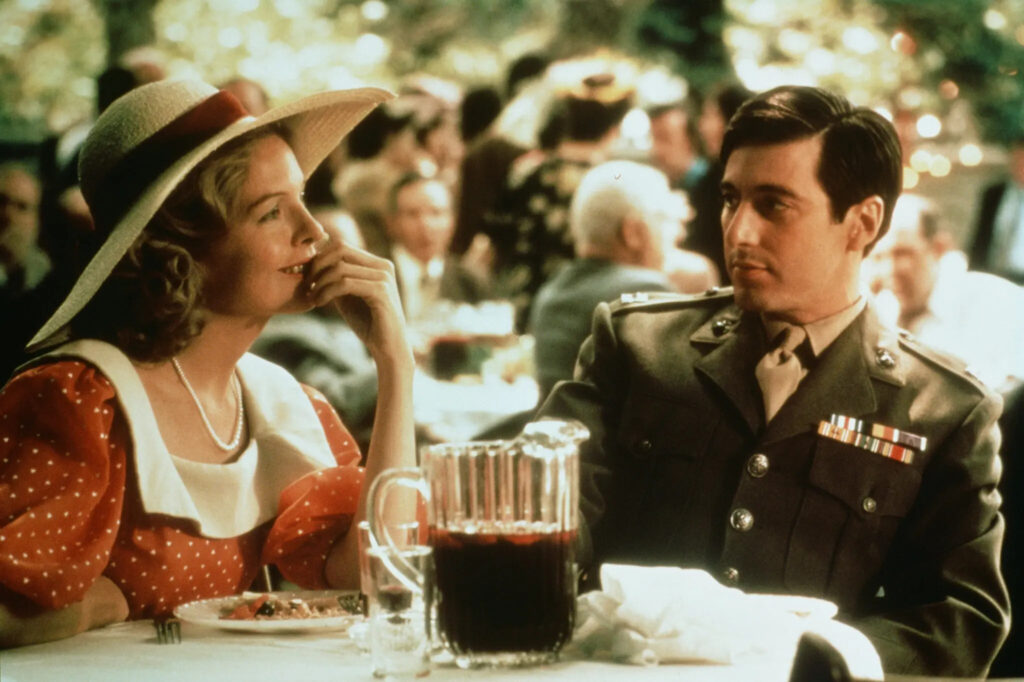
One of the defining and more complex facets of Ms. Keaton’s career was her portrayal of Kay Adams-Corleone in The Godfather trilogy. Cast as an outsider to the Corleone family’s world, Kay initially represents a moral perspective external to the family’s criminal enterprise. Over the course of the series she becomes more deeply affected by Michael Corleone’s transformation and the corrosive influence of power. Ms. Keaton later recounted that she had never read Mario Puzo’s novel prior to auditioning and that she approached the role simply as an actor seeking work; she has said that she was, at first, uncertain of how she fit into a film that seemed at odds with the comic work she had previously done. She has also related that she was cast before Al Pacino was finalized for Michael Corleone, and that a chemistry read contributed to Pacino’s selection. Critics have at times argued that Kay is relatively underwritten compared with the male leads, but many commentators and colleagues credited Ms. Keaton with investing the role with emotional restraint and humanity, thereby providing a moral and emotional counterpoint within the narrative. Francis Ford Coppola later observed that Ms. Keaton possessed qualities that made her suitable for the part: a capacity for seriousness tempered by depth and, at times, spontaneous humor. Ms. Keaton reprised Kay in The Godfather Part II (1974) and The Godfather Part III (1990), and the role remains a pivotal element of her body of work.
Beyond her screen work Ms. Keaton was a prolific author and an avowed student of visual culture. She published roughly a dozen books on subjects ranging from fashion to art and architecture as well as memoirs. Her 2014 memoir Then Again was widely read for its candid and wry reflections; in it she observed with characteristic self-deprecating humor about fame, style and the vagaries of personal life.
Her private life, though guarded in many respects, attracted public attention. Ms. Keaton never married. She adopted two children, a son, Duke Keaton, and a daughter, Dexter Keaton. Over the years she had high-profile relationships, including ones with Al Pacino, Warren Beatty and Woody Allen. She often spoke with frankness about the uncertainties of aging and the limits of personal authority; in 2019 she told People magazine, “Getting older hasn’t made me wiser. I don’t know anything, and I haven’t learned.” In Then Again she reflected, “I learned I couldn’t shed light on love other than to feel its comings and goings and be grateful.”
Critical appraisals of Ms. Keaton’s contribution to film were numerous and emphatic. The Hollywood Reporter and other outlets lauded her as a consummate actress whose combination of charm, warmth and spontaneity lent credibility to the characters she embodied. Her work earned honors from bodies including the National Board of Review, the New York Film Critics Circle and the British Academy of Film and Television Arts, in addition to Academy recognition.
Her career included experiments in form and subject as well as steady work in mainstream cinema; she moved fluidly between auteur projects, studio comedies and character-driven dramas. Her directorial efforts—both documentary and narrative—reflected an interest in the interplay of belief, memory and family, while her performances consistently displayed an attention to nuance: an ability to permit humor and heartbreak to coexist without contrivance.
Ms. Keaton’s last credited film appearance was in Summer Camp (2024). She remained active in public life through writing and occasional public appearances, and she continued to be spoken of as a writer and a visual chronicler as well as an actor.
A correction appended to earlier reporting noted an earlier misstatement of the release year of Marvin’s Room—it was released in 1996, not 1993—and clarified the role of Nancy Meyers in Baby Boom: Ms. Meyers wrote the film but did not direct it.
Nicole Sperling contributed reporting to accounts of Ms. Keaton’s life and work.
—End—
