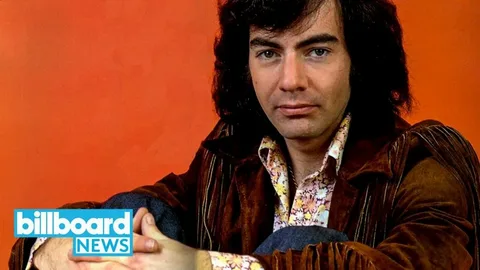
On Hot August Night, Neil Diamond turned Morningside into something larger than a song: a lived-in story of loneliness, dignity, and the forgotten corners of ordinary life.
Morningside is not the loudest moment on Hot August Night, and that is exactly why it matters so much. Recorded at the Greek Theatre in Los Angeles on August 24, 1972, and released later that year, Hot August Night rose to No. 5 on the Billboard 200 and quickly took its place among the defining live albums of the era. Many listeners come to it for the electricity, the applause, the sweeping confidence of Neil Diamond at full command. But when he reaches Morningside, something more intimate and, in many ways, more revealing begins to happen. This is where the entertainer gives way to the dramatist.
The song itself was not new in 1972. Morningside first appeared on Velvet Gloves and Spit in 1968, during a period when Neil Diamond was broadening the emotional and narrative range of his writing. He had already proven that he could write direct, unforgettable songs with enormous popular pull, but Morningside belonged to another side of his craft. It was a story-song, built less on instant singalong release than on observation, atmosphere, and character. At its heart is a portrait of isolation in a crowded world, a small human life seen with compassion and a little ache. Even in the studio, it carried unusual weight. Live at the Greek Theatre, it grew taller.
That is the real miracle of the Hot August Night version. Neil Diamond does not simply perform Morningside; he enlarges it. He gives it room to breathe, room to move, room to gather silence around itself. In the studio, the song feels like a carefully drawn sketch. On stage in 1972, it feels like a short film unfolding in front of an audience that suddenly understands it is being asked to listen, not merely react. The live arrangement gives the narrative more sweep, but it never buries the story. If anything, the wider stage makes the loneliness at the center of the song feel even more exposed. That contrast is part of what makes this performance so memorable: a very human, almost private sorrow being carried into a vast open-air theatre.
And that open-air setting matters. The Greek Theatre had a way of making performances feel ceremonial without draining them of warmth. On Hot August Night, you can hear the sense of occasion all through the record, yet Morningside benefits from something even more precious than occasion. It benefits from patience. Neil Diamond sings it like a man who knows the story deserves the same attention as the hits. He leans into the lines, shapes the phrases with a storyteller’s instinct, and lets the emotional turns land without forcing them. There is confidence here, of course, but there is also restraint. That balance is what allows the song to open up.
The meaning of Morningside has always lived in that tension between distance and sympathy. It is a song about people who are easily overlooked, about lives the world passes every day without fully seeing. In lesser hands, such a subject can become sentimental. Neil Diamond avoids that trap by writing with detail and moral unease. He does not ask for easy pity. He asks the listener to notice. In the 1972 live version, that impulse becomes even stronger. The song no longer feels like a well-written album cut tucked among stronger commercial contenders. It feels like evidence of something central to his artistry: he understood that a pop concert could still make room for narrative depth, for characters, for the sadness of ordinary streets and ordinary rooms.
That is why this performance says so much about the evolution of Neil Diamond as a writer. By the time of Hot August Night, he had already mastered the big public song, the kind that could lift thousands of voices at once. But Morningside shows that he was aiming at more than mass response. He was interested in storytelling that carried social texture and emotional ambiguity. He could move from anthem to miniature drama without sounding false in either mode. In the context of the Greek Theatre show, the song becomes a bridge between two gifts: the craftsman who knew how to hold a crowd and the writer who knew how to bring a quiet life into focus.
There is also something deeply moving in the way the audience receives it. On a live album famous for its momentum, Morningside creates a different kind of tension. The attention shifts from excitement to absorption. That shift tells us a great deal about Neil Diamond at this moment in his career. He was not simply riding the strength of his catalog; he was shaping a concert experience with peaks, valleys, release, and reflection. A song like Morningside might have remained a respected deep cut in another artist’s hands. On Hot August Night, it becomes part of the emotional architecture of the evening.
Years later, that is what still lingers. Not just the applause, not just the command, not just the famous title of the album itself, but the way Morningside suddenly reveals the scale of Neil Diamond‘s ambition as a songwriter. He was never only writing hooks. He was writing scenes, moral tensions, private histories, and the ache of people who rarely become the center of the stage. At the Greek Theatre in 1972, he gave one of those stories a larger frame without losing its humanity. That is no small achievement. It is the kind of performance that reminds us how a live version can do more than revisit a song. It can reveal what the song was capable of all along.
So when people speak of Hot August Night as a triumphant live album, Morningside deserves to be part of that conversation. It may not arrive with the most obvious fireworks, but it carries another kind of power: the power of a writer standing before thousands and trusting a carefully told story to hold the room. In that moment, Neil Diamond proved that his story-song writing could be as expansive as his biggest crowd-pleasers. And under the California night at the Greek Theatre, Morningside became not smaller for being human, but grander because it was.
