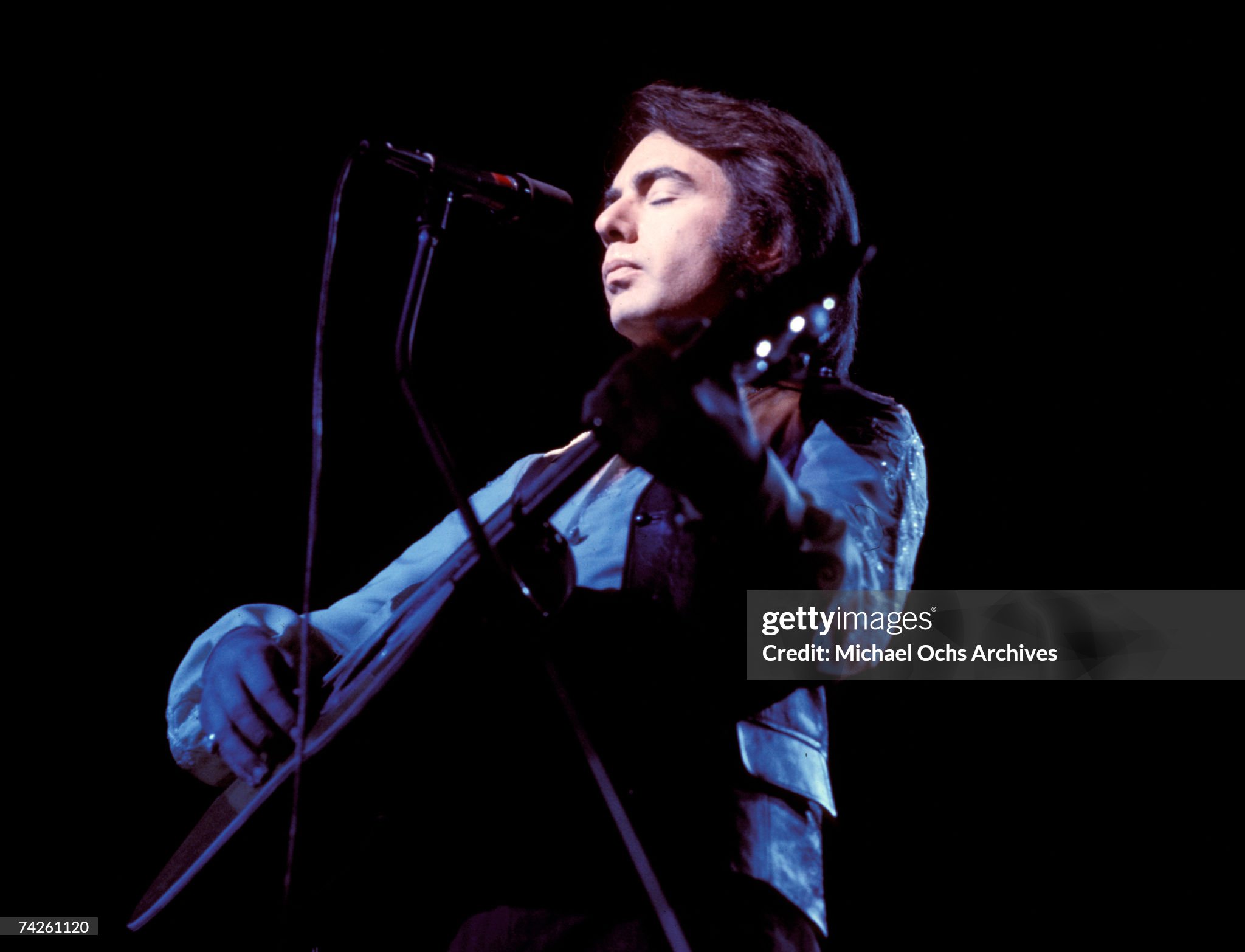
A song that sounded gentle on the radio, Girl, You’ll Be a Woman Soon carries a deeper ache: the loneliness of being judged, the impatience of youth, and the trembling hope that love might survive the world around it.
When Neil Diamond released Girl, You’ll Be a Woman Soon in 1967, he was doing more than adding another title to a growing catalog. Issued during his rich early Bang Records period and featured on the album Just for You, the single climbed to No. 10 on the Billboard Hot 100. That chart run mattered. It confirmed that Diamond was no longer simply a gifted writer behind the curtain. He was becoming one of the most recognizable emotional voices in American pop, able to take a compact radio song and fill it with restlessness, tenderness, and the bruised feeling of someone asking to be understood.
That may be why the record still lingers so strongly. On the surface, Girl, You’ll Be a Woman Soon can seem like a straightforward declaration from a young man to a girl standing at the edge of adulthood. But the title tells only part of the story. The real tension lives in the lyric’s unease. Diamond’s narrator is not simply making a romantic promise. He is pushing back against suspicion and disapproval. He sings of being misunderstood, of hearing others say he is not the right kind for her, and of carrying that judgment like a wound. Suddenly the song feels less like a sweet serenade and more like a plea for trust in the middle of social pressure.
That emotional contradiction is where Neil Diamond was often at his strongest. He knew how to write songs that seemed immediately accessible, then let something more complicated rise through the cracks. In a few short verses, he suggests youth, desire, class or family disapproval, and the ache of waiting for life to move forward. The phrase Girl, You’ll Be a Woman Soon may sound tender, but the song itself is filled with impatience. It is a record about crossing a line, about wanting love to become real before the world says it is allowed. That is why it has always carried a hint of unease beneath its warm melody.
There is also something unmistakably theatrical in the way Diamond delivers it. Before he became a superstar of arenas and grand-stage storytelling, he was already writing and singing with a dramatist’s instinct. The melody is memorable, even inviting, but he never performs it as something weightless. There is insistence in the phrasing, a subtle pressure in the repeated title line, as though reassurance and urgency are arriving together. His voice does not float above the song. It leans into it. That quality gave many of his early recordings their staying power, and it is one of the reasons this one still feels emotionally alive.
The timing of the song in Diamond’s career also gives it added resonance. By 1967, he had already shown his gifts not only as a performer but as a songwriter whose work could travel far beyond his own records. He had written major hits for others, including I’m a Believer for The Monkees, yet his own recordings carried a different kind of intimacy. On Just for You, listeners could hear that he was not interested only in catchy choruses. He wanted atmosphere, narrative tension, and songs that suggested an entire private life in a few minutes. Girl, You’ll Be a Woman Soon is one of the clearest examples of that early strength.
What makes the song especially enduring is that it never resolves its tensions too neatly. Diamond does not turn the story into a simple victory. He leaves the ache intact. The young man in the lyric may sound certain in his longing, but the world around him still feels doubtful. That lingering uncertainty gives the song depth. It reminds us that many of the finest pop records are not built on answers. They are built on yearning, on the space between what is felt deeply and what can be spoken safely.
The song later gained a new life when Urge Overkill recorded a cover that reached a wide audience through Pulp Fiction in the 1990s. That version became famous in its own right, but it also sent listeners back to the original. And in the original Neil Diamond recording, there is something especially vulnerable that remains hard to replace. Where later interpretations can feel cooler or more detached, Diamond’s reading is open-hearted and exposed. It lets the uncertainty show.
That is why Girl, You’ll Be a Woman Soon has lasted far beyond its chart year. Yes, it was a hit, and its No. 10 showing on the Billboard Hot 100 secured its place in Diamond’s early rise. But its real power comes from the feeling underneath the success. It captures a moment when love is still mixed with fear, when adulthood is close enough to imagine but not close enough to hold, and when being judged by others can make tenderness feel almost defiant. Few songwriters could express that much emotional weather in such a compact form.
For anyone returning to the record now, that may be the revelation. It was never merely a soft old pop song. It was a song about wanting to be seen clearly before time, society, and doubt close in. In the hands of Neil Diamond, that longing became unforgettable. And that is why Girl, You’ll Be a Woman Soon still sounds less like a relic and more like a memory that keeps deepening every time it returns.
