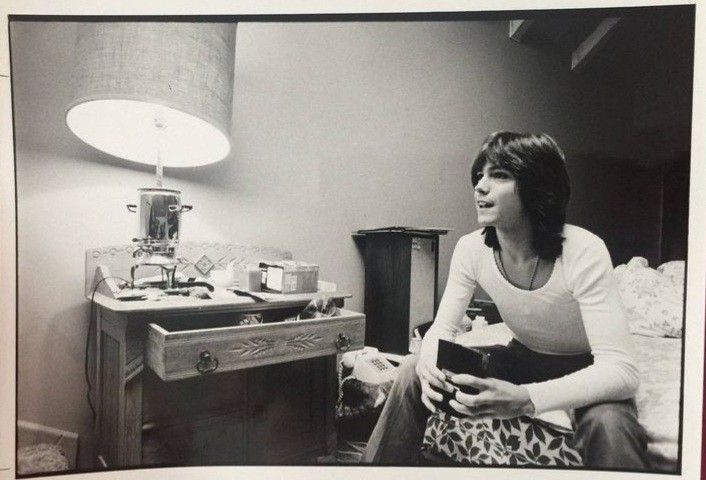
“I Think I Love You” captured the dizzy, innocent panic of first love—and in doing so, it turned David Cassidy from a fresh television face into a genuine pop phenomenon almost overnight.
There are songs that become hits, and then there are songs that seem to arrive like a change in the weather. “I Think I Love You” was one of those records. Released in 1970 as the debut single by The Partridge Family, with David Cassidy on lead vocals, it did far more than promote a new television series. It leapt beyond the screen, beyond the bright colors and sitcom charm, and planted itself deep in the pop culture memory of the early 1970s.
Commercially, the song was enormous. “I Think I Love You” climbed to No. 1 on the Billboard Hot 100 in November 1970 and stayed there for three weeks, a remarkable achievement for what could easily have been dismissed as a novelty tie-in from a TV show. Instead, it became the biggest hit of The Partridge Family and one of the defining records of David Cassidy’s career. It also sold in the millions and helped launch a wave of teen-pop devotion that would soon make Cassidy one of the most recognizable young stars in the world.
The story behind the song is just as fascinating as the record itself. “I Think I Love You” was written by Tony Romeo, a songwriter with a gift for crafting melodies that sounded effortless and immediate. The record was produced by Wes Farrell, who understood exactly how to package the freshness of television with the polish of mainstream pop radio. Although The Partridge Family appeared to be a performing family band on screen, much of the instrumental work on the recording was handled by accomplished Los Angeles studio musicians, while the principal vocals came from David Cassidy and Shirley Jones. That combination gave the song a polished studio sheen without losing the warmth that made it feel personal.
And that is part of why the song endures. On paper, “I Think I Love You” is beautifully simple. It tells the story of someone standing on the edge of a confession, overwhelmed by a feeling too large to control and too new to fully trust. The lyric does not swagger. It hesitates. It blushes. It almost trips over itself with sincerity. “I think I love you” is not a dramatic declaration—it is uncertainty wrapped inside wonder. That emotional balance is exactly what gave the song its sweetness. It understands that love, especially at the beginning, rarely arrives with confidence. More often, it arrives with nerves, disbelief, and a racing heart.
David Cassidy was the perfect voice for that moment. He did not sing the lyric with heavy grandeur or mature heartbreak. He sang it with bright urgency, with enough vulnerability to make the words believable and enough energy to make them unforgettable. There is a youthful spark in his performance that helped separate the song from many of its era’s more carefully manufactured pop singles. It sounded clean and radio-friendly, yes, but it also sounded alive. Cassidy was not simply singing a catchy tune; he was embodying that awkward, thrilling split-second when emotion outruns language.
It is also impossible to discuss “I Think I Love You” without recognizing what it meant in the larger story of David Cassidy. Before the pressures of global fame, before the screaming crowds and tabloid attention, this was the record that introduced him to millions of listeners as something more than a handsome actor on a new TV series. It made him a voice. It made him a feeling. For many fans, this song was the first spark. The fame that followed would become complicated, even burdensome at times, but the freshness of this performance still carries none of that weight. It remains suspended in that first bright moment when everything seemed possible.
Musically, the record is a small masterclass in pop construction. The arrangement is crisp, melodic, and inviting, with a buoyant rhythm that keeps the song moving forward even as the lyric circles around uncertainty. There is no wasted motion in it. Every phrase feels designed to be remembered. Yet beneath the catchy surface, there is a tenderness that keeps the song from becoming disposable. That is often the difference between a hit and a memory: one may dominate the charts for a season, but the other lingers for decades because it carries a real human feeling.
In the end, “I Think I Love You” still matters because it preserved a very specific emotional truth. It reminds listeners of a time when saying too much felt dangerous, when saying too little felt impossible, and when love could begin as a half-whispered thought. In that sense, the song never really ages. It remains one of those rare pop records that can still make the world feel younger for three minutes at a time.
For David Cassidy, it was the beginning of a storm of fame. For everyone else, it was—and still is—a perfect little rush of uncertainty, melody, and heart.
