
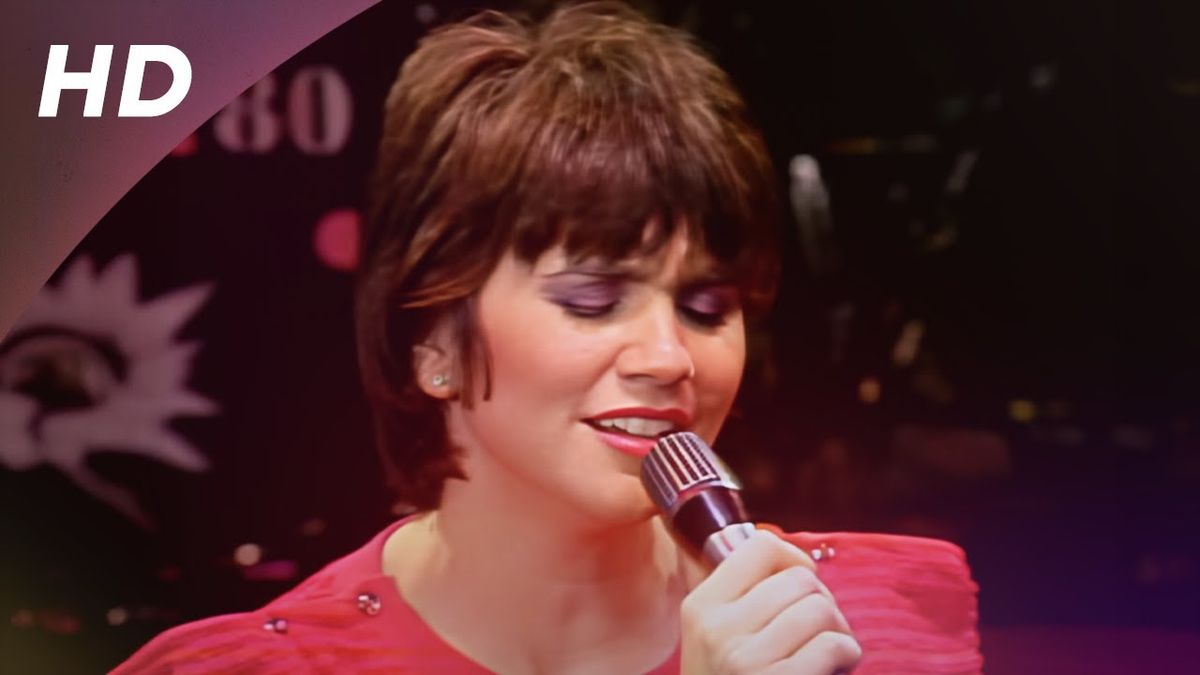
In Crazy He Calls Me, Linda Ronstadt turns love into a quiet vow, singing with such calm devotion that the song feels less like performance and more like memory.
When Linda Ronstadt recorded Crazy He Calls Me for her 1983 album What’s New, she was doing far more than revisiting an old standard. She was stepping away from the rock and country-pop sound that had made her one of the biggest voices in American music and into the elegant, demanding world of classic popular song. It was a gamble at the time, but it became one of the most graceful turns of her career. What’s New, created with legendary arranger Nelson Riddle, climbed to No. 3 on the Billboard 200, proving that this music still had a place in the modern era and that Ronstadt’s voice could carry far more than radio hits. Although Crazy He Calls Me was not pushed as a major chart single in the pop sense, it arrived inside an album that became a cultural event.
The song itself already carried a long and distinguished history before Ronstadt ever touched it. Written by Carl Sigman and Bob Russell, Crazy He Calls Me is most closely associated with Billie Holiday, whose 1949 recording gave it a lasting place in the American songbook. It is one of those rare songs that sounds simple on paper but reveals astonishing emotional depth in the right hands. The lyric is built around a lover who seems irrational to the outside world. She would cross rivers, endure hardship, and follow devotion wherever it leads, and so he calls her crazy. Yet the song never treats that love as foolish. Instead, it quietly asks whether the deepest forms of loyalty always look unreasonable from a distance.
That question is exactly why Ronstadt’s version remains so affecting. She does not sing Crazy He Calls Me as a torch song soaked in melodrama. She sings it with restraint, with patience, with the kind of poise that allows the words to settle into the heart before the listener even realizes what has happened. This was one of the miracles of the What’s New era. Rather than decorating every line, Ronstadt trusted tone, breath, and phrasing. The result is intimacy. You hear a woman who understands that love is not always loud. Sometimes it is strongest when spoken almost under the breath.
The backstory behind the recording makes the performance even more meaningful. By the early 1980s, Linda Ronstadt had already conquered commercial radio with songs such as You’re No Good, When Will I Be Loved, and Blue Bayou. She did not need to prove her popularity. What she wanted was to follow a deeper musical instinct. Collaborating with Nelson Riddle, whose arrangements had once framed singers like Frank Sinatra and Ella Fitzgerald, she entered a repertoire many people considered old-fashioned for a contemporary star. Some in the industry doubted the move. Ronstadt went forward anyway. That courage hangs over every track on What’s New, and on Crazy He Calls Me it feels especially personal. There is a beautiful symmetry in an artist taking a risk to sing a song about fearless devotion.
Musically, the arrangement serves the lyric rather than overwhelms it. Nelson Riddle understood orchestral space better than almost anyone, and his setting for Crazy He Calls Me gives Ronstadt room to linger without drifting. The orchestra does not crowd her. It cradles her. That distinction matters. A lesser arrangement could have turned the song into a museum piece, polished but lifeless. Here, it breathes. The melody moves with old Hollywood elegance, yet the feeling is immediate, close, and human. Ronstadt sounds neither nostalgic nor imitative. She sounds present.
The meaning of the song has always lived in its paradox. The title suggests instability, but the performance reveals the opposite. This is not the portrait of a reckless heart. It is the portrait of someone who knows exactly what she feels and has made peace with the vulnerability that comes with it. In Ronstadt’s hands, the song becomes almost defiant in its softness. The singer does not apologize for loving deeply. She does not defend herself. She simply tells the truth and lets that truth stand. That is part of why the song still reaches listeners decades later. It honors emotion without exaggerating it.
There is also something especially moving about where this recording sits in Ronstadt’s larger legacy. Many great singers have power. Fewer have interpretive wisdom. On Crazy He Calls Me, Linda Ronstadt shows the latter in abundance. She knows when to hold back, when to let the line bloom, when to allow silence to do part of the work. It is a performance of maturity, and maturity in music has its own kind of radiance. It does not beg for attention. It simply lasts.
For listeners who came to Linda Ronstadt through her rock and country years, Crazy He Calls Me may have felt like a revelation in 1983. For others, it was a reminder that the great American standards could still feel alive in modern hands. Today, it stands as both. It is a lovely interpretation of a classic song, yes, but it is also evidence of what happens when a major artist stops chasing expectation and sings from conviction instead. That is why this recording still glows. Not because it is loud, but because it is sure of itself. Not because it demands to be remembered, but because once heard, it stays with you.
