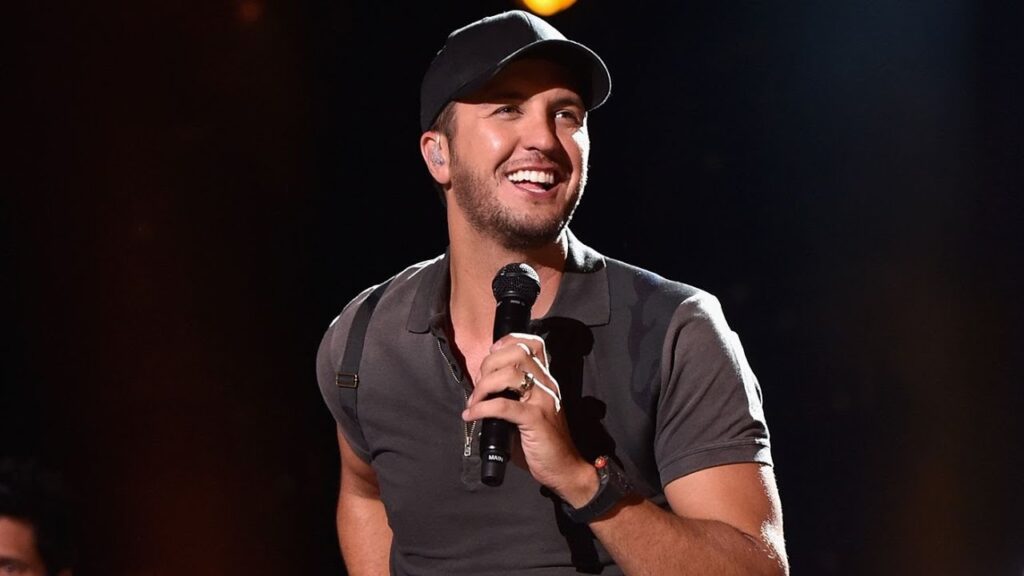
Beneath the grin and the tailgate swagger, “Country Girl (Shake It for Me)” is the sound of a moment when Luke Bryan stopped merely rising and started taking over the room—loud, playful, divisive, and impossible to ignore.
There are songs that become hits because they are polished. Then there are songs that hit because they arrive with enough nerve to change the air around an artist. “Country Girl (Shake It for Me)” was that kind of record for Luke Bryan. Released on March 14, 2011 as the lead single from Tailgates & Tanlines, it did not just continue his momentum—it kicked the door wider open. The song climbed to No. 4 on Billboard’s Hot Country Songs chart and No. 22 on the Billboard Hot 100, becoming his first Top 30 pop crossover hit and helping push him from successful country star to something much larger in the culture.
What makes the song worth revisiting is not subtlety. It was never built for that. It was built to move, to provoke, to swagger, to make a crowd respond before the mind had fully caught up. And perhaps that is exactly why it still lingers. Luke Bryan wrote it with Dallas Davidson, and Davidson later described it simply as a song about “a country girl getting up there getting a little wild.” Bryan himself was more candid about his own uncertainty: he later said he worried the chorus might be “kind of cheesy,” and that it was Davidson who insisted they had something. That little behind-the-scenes hesitation is one of the most telling details in the whole story. The song that would help define an era almost seemed too blunt, too obvious, too risky at first—even to the man singing it.
But that bluntness became the hook.
Because “Country Girl (Shake It for Me)” does not try to charm through mystery. It puts its cards on the table at once. The rhythm comes on hard, the invitation is immediate, and the whole record carries the charged energy of a song that knows it is a little excessive and plans to enjoy that fact anyway. That confidence was part of its power. It felt less like a carefully tasteful country single and more like a summer anthem designed to kick dust into the air. In 2011, that mattered. The genre was already shifting toward a louder, more physical, more openly party-driven style, and this song landed right at the point where that change stopped feeling temporary and started feeling cultural. Billboard would later call it a “new approach” for Bryan and even for country music itself, noting how bold and sexualized the chorus felt in that moment.
That is why the song has always carried a double life.
On one side, it is pure release: flirty, rowdy, made for open windows, cheap speakers, packed fields, and the rough joy of people wanting music to feel immediate again. On the other side, it is one of the clearest early signposts of what many listeners would soon call the bro-country wave—a shift that made Bryan both bigger and more controversial. Even years later, writers looking back on the song have described it as career-changing and culturally divisive, the kind of record that thrilled one audience and alienated another.
And yet, to hear the song only as a cultural argument is to miss why it worked so well in the first place.
Luke Bryan does not sing it like a theory. He sings it like a grin he cannot suppress. That matters. So much of the record’s appeal comes from how unforced his energy feels. There is nothing tortured or mannered in the performance. He sounds fully committed to the song’s world—its flirtation, its momentum, its appetite. Even people who disliked what the song represented often had to admit that it was effective. It knew exactly what it wanted to be, and it reached that target with startling force.
Commercially, that force was undeniable. The song debuted on the Hot 100 at No. 22 with 105,000 downloads, and over time it became one of Bryan’s most successful sellers, later moving into the multi-million-sales range in the United States. It also helped define Tailgates & Tanlines, the album that truly changed the scale of his career. What followed from there was not just more success, but a new level of permanence. Bryan himself later reflected that songs like this one solidified his place in the genre and helped set him up for longevity.
So yes, “Country Girl (Shake It for Me)” is loud. It is showy. It is deliberately built for instant reaction. But that is only part of why it still matters. It marks the moment when Luke Bryan stopped sounding like a promising hitmaker and started sounding like a force who could pull the center of mainstream country toward him. The song’s reputation remains mixed because its effect was so large. It drew a line through the genre. It energized crowds, irritated purists, and helped define an era whether people loved that fact or not.
That is why the song still has life in it. Not because it is graceful, and not because it aims for depth in the usual sense. It lasts because it caught a moment of country music mid-shift and threw itself headlong into it. In Luke Bryan’s hands, “Country Girl (Shake It for Me)” became more than a flirtatious party single. It became a spark—one that lit up arenas, arguments, careers, and a whole sound that would dominate the decade.
