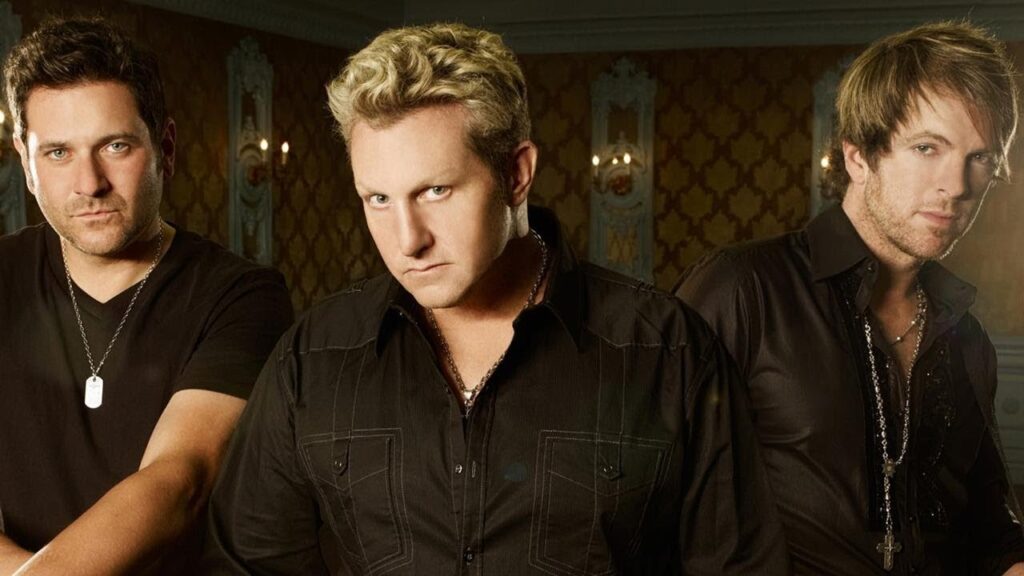
In “What Hurts the Most,” Rascal Flatts do not sing heartbreak as a dramatic ending. They sing it as unfinished business—the ache of words unsaid, chances missed, and love that might have been saved if pride had only moved faster.
There are breakup songs built on betrayal, and there are breakup songs built on absence. “What Hurts the Most” belongs to the second kind, and that is why it still lands so deeply. The pain in it does not come from a grand scene or a cruel final blow. It comes from hesitation. From the terrible realization that love may have been lost not only because it failed, but because something important was never said in time.
When Rascal Flatts released “What Hurts the Most” in January 2006 as the lead single from Me and My Gang, they gave that regret a voice big enough for radio, but tender enough to feel private. The song became their fifth No. 1 on Billboard’s Hot Country Songs chart, spent four weeks at the top, and also climbed to No. 6 on the Billboard Hot 100, giving the trio its first true top-10 pop crossover hit. It reached No. 1 on Billboard’s Adult Contemporary chart as well. Meanwhile, Me and My Gang, released on April 4, 2006, debuted at No. 1 on the Billboard 200 and stayed there for three weeks, confirming just how fully the group had entered the center of American popular music.
Those facts matter, of course. But the warmer story lies behind the song itself. “What Hurts the Most” was written by Jeffrey Steele and Steve Robson, and it did not begin as a Rascal Flatts song at all. It was first recorded by Mark Wills in 2003. Steele later explained that he had originally wanted to write from a more personal, familial place tied to the loss of his father, but he turned instead toward a more universal story of lost love. That small shift may be exactly why the song has lasted. Beneath its polished country-pop surface, it still carries the emotional weight of grief, only translated into a form almost anyone can recognize. It is not just about missing someone. It is about living with the knowledge that your own silence may now be part of the loss.
That is what makes the title so devastating.
What hurts the most is not, in this song, the obvious wound. It is not the fact that the other person is gone. It is not even the loneliness that follows. It is the memory of standing close enough to speak and failing to do so. That emotional angle is everything. Rascal Flatts understood that instinctively. They did not perform the song as if it needed to be overcomplicated. They let the central regret remain clear and human. And because they did, the song still feels painfully direct all these years later.
Gary LeVox’s voice is the key. He had always possessed that unusual combination of brightness and ache, a tone that could rise into dramatic emotion without losing its bruised sincerity. On “What Hurts the Most,” he does not merely sing sadness. He sings self-reproach. He sounds like a man looking back at a moment he cannot revisit, knowing the heart can survive many things but has a harder time surviving the thought of what might have been prevented. That is why the record still feels so intimate even at its biggest. It is large enough for arenas, yet it never loses the feeling of one person alone with his mistake.
And then there is the production. Dann Huff and the band gave the track the kind of clean, swelling arrangement that defined mid-2000s Rascal Flatts at their peak, but the record never becomes merely glossy. Its polish works because the wound underneath is real. According to the song’s recording history, it was actually producer Dann Huff who suggested the trio record it for the album. That detail matters. Sometimes a song arrives not through strategy, but through recognition—the sudden understanding that this story belongs in this voice.
Perhaps that is why “What Hurts the Most” has outlasted so many other breakup hits of its era. It does not hide behind attitude. It does not harden into blame. It stays vulnerable. That vulnerability is the song’s real strength. In a culture that often teaches people to protect themselves with indifference, Rascal Flatts let this song stand bare. They let it admit that the deepest pain may come not from rejection, but from emotional delay—from being too proud, too frightened, or too late.
So yes, “What Hurts the Most” remains one of Rascal Flatts’ defining recordings because it understands something many heartbreak songs miss: love does not always end in one clear instant. Sometimes it fades into memory carrying a question that never stops hurting. Why didn’t I say it? Why didn’t I go back? Why did I wait? In Rascal Flatts’ hands, those questions become music—warm, wounded, and unforgettable. And that is why the song still reaches people so quickly. It does not just remember heartbreak. It remembers hesitation. And for many hearts, that is the sharper pain.
