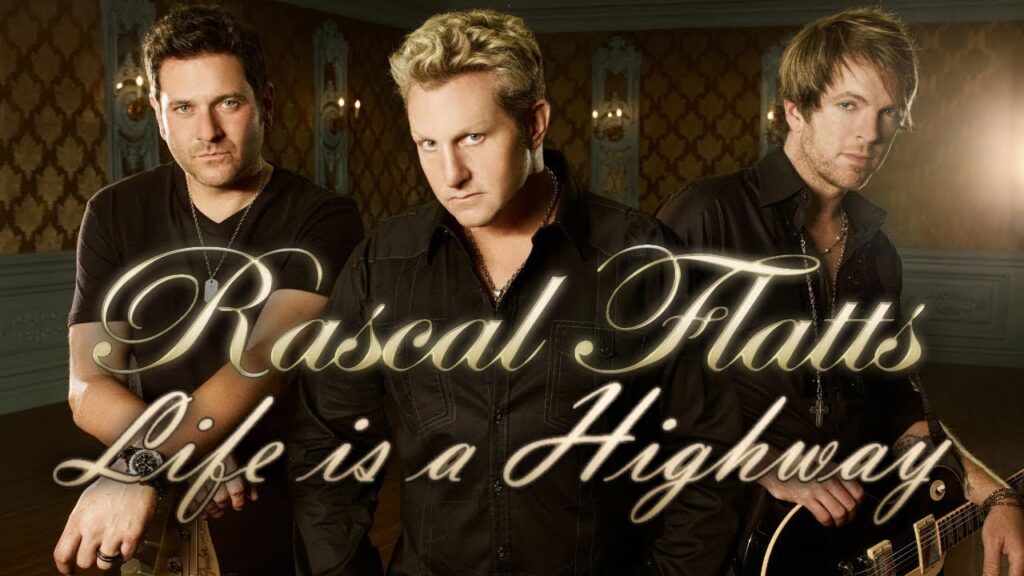
In “Life Is a Highway,” Rascal Flatts turned motion into emotion. What could have been just a bright, fast soundtrack hit became something warmer and more enduring—a song about momentum, appetite, and the stubborn joy of staying in the race while life is still flying past the window.
Some songs arrive already moving. They do not seem to begin so much as burst into the room with the wheels turning. Rascal Flatts’ “Life Is a Highway” has always carried that kind of energy, but what makes it last is that the excitement is not empty. Beneath the speed, beneath the easy sing-along rush, there is a feeling of hunger—for life, for distance, for another mile before the daylight goes. That is why the song has remained so irresistible. It was released in 2006 as part of Pixar’s Cars soundtrack, with the film opening on June 9, 2006, and the track went on to reach No. 7 on the Billboard Hot 100 and No. 18 on Hot Country Songs, even though it was not formally pushed to country radio in the usual way. It later became one of the band’s most widely recognized crossover recordings, and in the larger history of Rascal Flatts, it stands just behind “What Hurts the Most” as one of their highest-peaking Hot 100 hits.
But the story becomes richer when one remembers that “Life Is a Highway” did not begin with Rascal Flatts at all. The song was written and first recorded by Tom Cochrane, released in 1991, and became a major hit—No. 1 in Canada and No. 6 on the U.S. Billboard Hot 100. Cochrane later explained that the song was shaped, in part, by a family trip to eastern Africa with World Vision, where what he saw struck him as “shocking and traumatic.” Out of that experience, he searched for something positive to hold on to, and the song became, in his own words, a kind of pep talk to himself. That matters enormously, because it means the song’s joy was never merely decorative. Even in its original form, it was about pushing forward through a world that can be difficult to absorb.
And that, perhaps, is why Rascal Flatts were such a natural fit for it.
Because their version does not sound ironic, and it does not sound borrowed in any cold or technical sense. It sounds embraced. By 2006, the trio already knew how to make uplift feel personal. They were experts at taking big emotional ideas and giving them polish without draining away their warmth. On “Life Is a Highway,” they do something especially effective: they keep the song’s open-road exhilaration, but they brighten it just enough that it feels made for motion pictures, summer travel, and the emotional optimism of Cars—without losing the human pulse that made the song worth covering in the first place. The result is not merely a remake. It is a reintroduction, delivered with enough charm and velocity to make a whole younger audience feel as though the song had always belonged to them.
What warms the story most is that the song was never officially released to country radio in the conventional sense, yet country stations picked it up anyway. That unsolicited airplay helped drive it onto the country charts. There is something revealing in that. It suggests that the song did not need to be forced into people’s lives. It already had the instinctive, communal appeal of something listeners wanted to keep close. Some records are promoted into success. Others break through because they feel too alive to ignore. Rascal Flatts’ “Life Is a Highway” belongs to the second kind.
And of course, one cannot separate the song from Cars, because the film gave the performance its cultural runway. Yet the reason it endured after the credits rolled is that it matched the emotional architecture of the story so well. Cars is, beneath all its bright surfaces, a tale about motion learning humility, speed learning meaning, and ambition learning how to share the road with memory and community. “Life Is a Highway” fits that world beautifully because it celebrates forward motion without sounding shallow. It tells us that life moves fast, yes—but also that the answer is not to step aside from it. The answer is to ride it with the windows down and the heart still open.
That is where the song becomes more than a soundtrack favorite. It becomes a philosophy disguised as a sing-along.
The title itself is simple, almost too simple, and that may be part of its genius. A highway is not a destination. It is movement, uncertainty, passing scenery, bad weather, appetite, risk. To say life is a highway is to accept that we are not here to stand still. In Rascal Flatts’ hands, that metaphor feels especially inviting. Their performance does not dwell on danger. It dwells on readiness. The band sounds eager for the next curve, the next stretch, the next burst of sun. That eagerness is what keeps the recording youthful without making it feel disposable.
There is also a lovely irony in the song’s afterlife. For many listeners, especially those who encountered it through Cars, this version became the definitive one—even though the original carried its own deeper history and more rugged emotional origins. That is not a failure of memory so much as proof of how effectively Rascal Flatts translated the song into a new emotional language. They did not erase Tom Cochrane’s spirit. They recast it in brighter light. They made the road gleam.
So yes, “Life Is a Highway” is fun, catchy, and built for open roads. But that is only part of why it lasts. In Rascal Flatts’ version, the song becomes a little more than celebration. It becomes a reminder that motion itself can be a form of faith—that to keep going, to keep singing, to keep reaching toward whatever lies over the next hill, is already a kind of answer. And that is why the record still feels so alive: not because it outruns life, but because it races straight into it with a grin wide enough to make you follow.
