
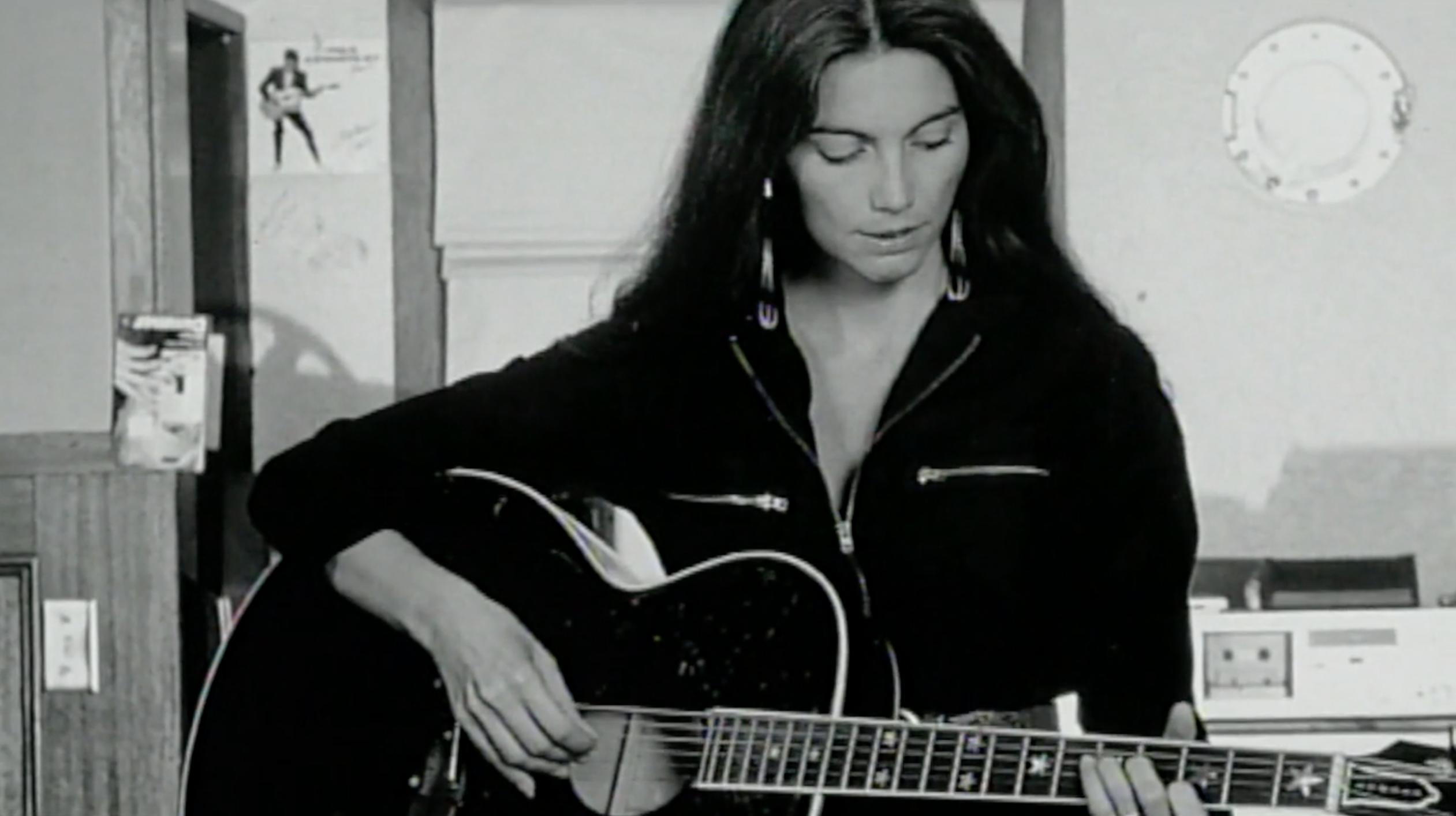
More than a cover, “Rose of Cimarron” becomes in Emmylou Harris’s hands a wide, twilight ballad of longing and legend—one of those songs that seems to carry open country, old sorrow, and impossible tenderness all at once.
There are songs that feel large because they are loud, and there are songs that feel epic because they open a horizon inside the listener. “Rose of Cimarron” belongs to the second kind. When Emmylou Harris recorded it for Cimarron, released in November 1981, she was taking on a song that already had stature: Poco’s 1976 title track, written by Rusty Young, itself a sweeping piece of country-rock mythmaking. Harris’s album reached the Top 10 on Billboard’s country albums chart, and though Cimarron is often remembered for its hit singles and somewhat patchwork origins, “Rose of Cimarron” stands apart as one of its grandest emotional spaces. It does not feel like filler, and it certainly does not feel small. It feels like a story seen at dusk, with all its colors deepening at once.
The precious fact at the center of the song is the woman herself. “Rose of Cimarron” was inspired by Rose Dunn, a figure from frontier lore who became associated with outlaw history through her relationship with George “Bittercreek” Newcomb. Rusty Young later explained that he first encountered her story in a brochure he happened upon while touring in Oklahoma in 1973, a small accidental discovery that grew into one of Poco’s signature songs. That origin matters because the song never feels like empty Western decoration. It carries the dust of legend, yes, but also the ache of something half-remembered, half-romanticized—the old American habit of turning lonely lives into ballad light.
And then comes the second detail that gives Emmylou Harris’s version its added resonance: she used “Rose of Cimarron” not merely as an album track, but as the emotional and symbolic center of a record that took its title from the song itself. That choice says everything. She was not just borrowing a beautiful composition; she was letting it define the atmosphere of the album. On her official site, the song remains part of the preserved Cimarron and later Songs of the West repertoire, which tells you it continued to matter in the way some songs do when they carry more than melody—when they hold landscape, identity, and memory in a single frame.
What makes the song feel more epic than most remember is that Harris understands its scale without ever overplaying it. She does not try to make it thunder. She lets it widen. That is a harder art. A lesser singer might approach “Rose of Cimarron” as a grand Western tableau and push too hard at its cinematic edges. Harris does something finer. Her voice enters the song with that familiar mixture of purity and distance, and because of that, the longing inside the lyric becomes even more striking. The story may come from frontier legend, but the feeling is painfully human: the ache of someone who exists in memory more vividly than in life, someone both idealized and lost. The narrative reaches outward into the mythic West, yet the emotional current keeps pulling inward toward loneliness.
That is why the song can still stop listeners cold. It is not only a story song. It is a longing song. And longing, when sung this well, can feel larger than plot. Harris had a special gift for taking songs rooted in image and place and revealing the exposed heart underneath them. Here, she lets the title itself do much of the work. Rose of Cimarron—the phrase already sounds like a legend carried by distance, like a name spoken after the person has vanished beyond the ridge. In Harris’s voice, that vanishing becomes the song’s secret wound. Beauty remains, but it remains at a distance. You can see it. You cannot keep it.
There is also something quietly moving about the contrast between Poco’s original and Harris’s reading. Poco’s version, released as a single in October 1976, reached No. 94 on the Billboard Hot 100, and over time it became one of the band’s signature songs. Rusty Young himself later said it was the Poco song he was most proud of, praising both its visual lyrics and its melody. Harris does not erase any of that grandeur; she inherits it. But she draws the song slightly away from the forward motion of country-rock and toward a more reflective, haunted emotional space. The expanse is still there. So is the romance. Yet in her hands, the song feels less like a ride through history and more like a memory of history passing through the heart.
That, finally, is why “Rose of Cimarron” endures so beautifully. It proves that storytelling and longing do not weaken each other; they deepen each other. The legend gives the song its shape, but longing gives it its afterlife. Without longing, it would simply be a handsome tale. Without the tale, it might lose some of its wide-screen splendor. Together, in Emmylou Harris’s voice, they create something rarer: a ballad that feels at once intimate and immense, as if the old West itself had paused long enough to remember one vanished soul with tenderness. And once that feeling settles in, the song is very hard to forget.
