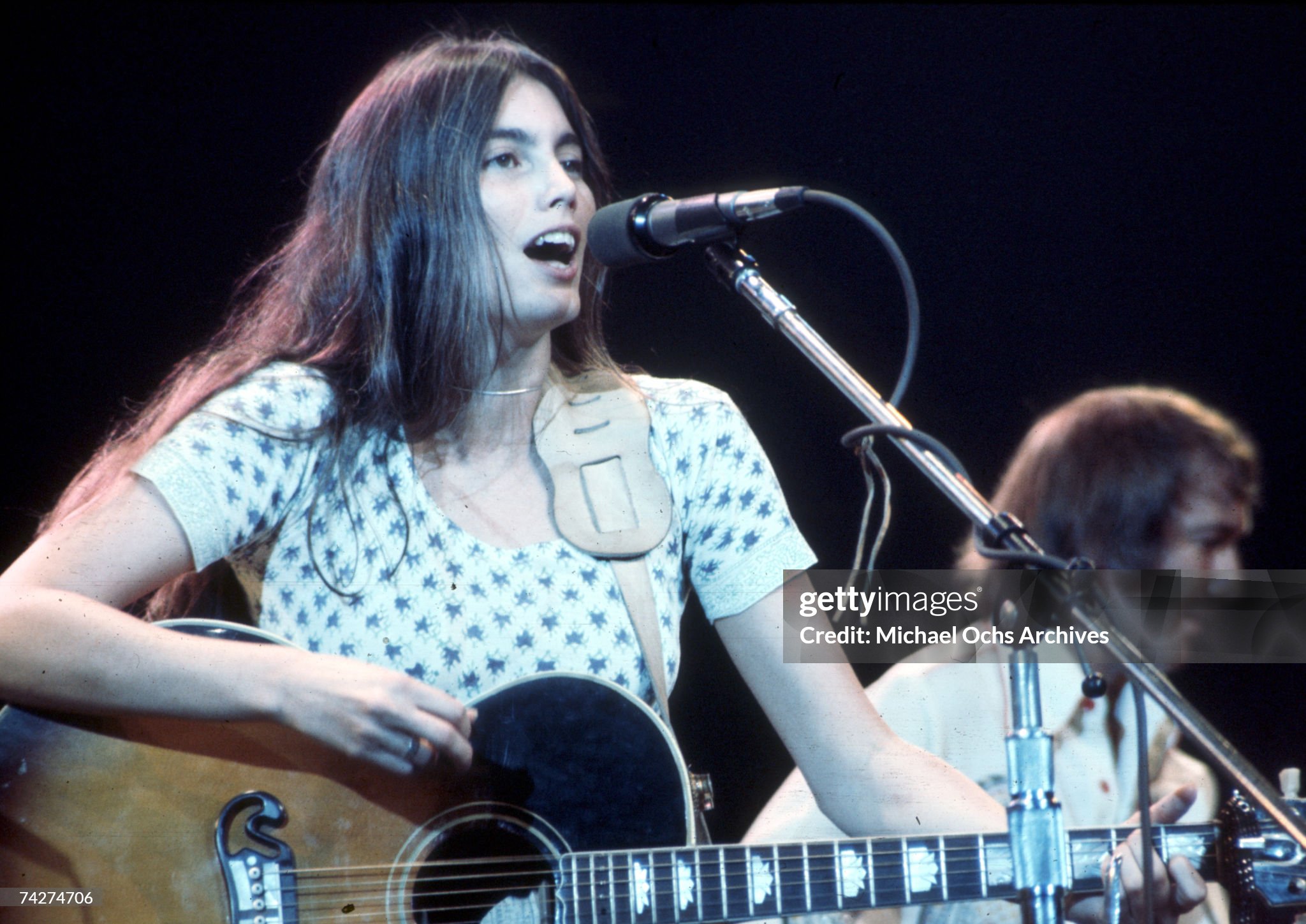
“O Little Town of Bethlehem” becomes, in Emmylou Harris’ voice, a quiet lantern-song—faith not as proclamation, but as a steady light held close against the cold wind of the world.
Among the many ways Christmas music can reach for us—through grandeur, through childhood sparkle, through sheer volume—Emmylou Harris chooses something rarer: reverence without stiffness. Her recording of “O Little Town of Bethlehem” sits on her first Christmas album, Light of the Stable (released November 1979, produced by Brian Ahern), and it feels less like seasonal programming than like a small, hand-written letter placed gently into the listener’s palm.
If you’re looking for “chart position at debut,” the clearest, most honest way to say it is this: “O Little Town of Bethlehem” was not issued as a stand-alone single, so it doesn’t have an individual chart peak of its own. Its public “arrival” is bound to the album that carries it—and Light of the Stable did have a measurable, modest chart life: it reached No. 102 on the Billboard 200 (listed in 1980 chart records) and No. 22 on Top Country Albums (listed in 1981). Those numbers are not the story of a blockbuster. They’re the story of something that found its audience quietly—by being returned to, year after year, like a familiar ornament pulled from tissue paper.
What makes Harris’s reading so affecting is how naturally it honors the carol’s origins. “O Little Town of Bethlehem” began as a poem written in 1868 by Phillips Brooks, inspired by his earlier visit to Bethlehem; the melody most associated with the song in North America—“St. Louis”—was composed by his organist Lewis Redner. On Light of the Stable, the track credit reflects that traditional lineage: Phillips Brooks / Lewis H. Redner. In other words, Harris isn’t “reinventing” the carol so much as stepping into a long candlelit corridor of voices—and then, with her own unmistakable tone, making the corridor feel inhabited again.
The album placement matters, too. On the original sequence, “O Little Town of Bethlehem” appears right near the beginning—track two—after “Christmas Time’s A-Coming.” That early placement signals intention: this is a Christmas record that isn’t chasing tinsel or punchlines. It’s drawn toward the Nativity story’s stillness, toward the hush that falls when the room finally stops talking and you can hear your own thoughts again.
Harris has always sung as if clarity were a form of kindness. On this song, that quality becomes almost devotional. The lyric is full of paradox—Bethlehem is “little,” the streets are “still,” and yet the “hopes and fears of all the years” gather there. Harris doesn’t overplay the paradox; she simply allows it to be true. Her voice—clean, luminous, and emotionally unforced—makes the carol feel less like pageantry and more like the inward act it really is: the act of believing, if only for a few minutes, that the world can be remade by gentleness.
It also helps to remember what Light of the Stable represents in her broader story. By 1979, Emmylou Harris was already a master interpreter—someone who could walk into old material and emerge with it sounding freshly inhabited, never museum-dusted. This record extends that gift to sacred and traditional repertoire, and it does so with a rootsy sincerity that suits her perfectly. The album is also known for its sense of community—featuring notable guest harmonies elsewhere in the track list—an atmosphere that makes even a familiar carol feel like something sung with you, not at you.
In the end, Harris’s “O Little Town of Bethlehem” doesn’t try to “sell” wonder. It trusts wonder. It trusts the listener’s memory, too—the memory of winter evenings, of small rooms made warmer by song, of a faith that sometimes arrives not as certainty but as quiet endurance. And that may be why her version lasts: it understands that the truest Christmas feelings aren’t always bright. Sometimes they’re simply steady—like a light in a window, promising that, for tonight at least, you can find your way home.
