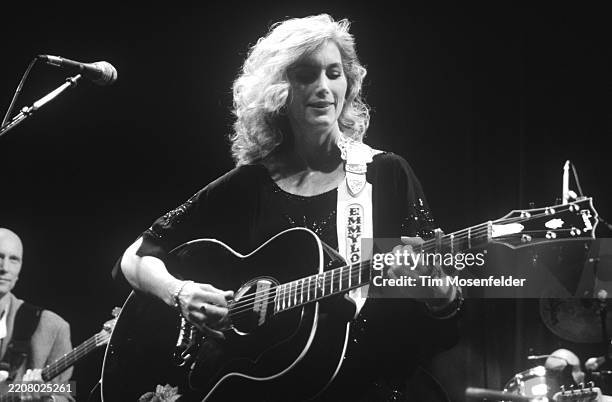
“Lonely Girl” is Emmylou Harris speaking softly from the far side of experience—where loneliness isn’t drama, but a long, familiar room you’ve learned to walk through in the dark.
If you come to “Lonely Girl” expecting the old fireworks—those bright, high harmonies that once rode alongside the highway romance of country rock—you might be surprised by how still it is. This isn’t a song that kicks the door open. It simply turns the knob, steps inside, and sits with you. And that quiet is exactly where its power lives.
“Lonely Girl” appears on Hard Bargain (released April 26, 2011, on Nonesuch Records), an album that arrived like a late-season letter—unhurried, plainspoken, and full of things that had clearly been carried for a long time. Importantly, Hard Bargain wasn’t a minor footnote in her catalogue: it debuted at No. 18 on the Billboard 200 and No. 3 on Billboard’s Top Country Albums, a striking commercial crest for an artist making mature, reflective work on her own terms. (In the UK, it reached No. 30 on the official albums chart.) That context matters because it tells you this music didn’t merely “age gracefully” in a corner—it met the world, and the world listened.
The song itself is credited to Emmylou Harris as writer—no protective co-writers, no borrowed scaffolding, just her name on the page. And you can hear that authorship in the way the lyric refuses to glamorize its ache. It opens with the bluntest kind of confession—“As a lonely girl in a lonely world”—a line that doesn’t ask for pity so much as it asks for honesty. There’s a particular courage in that: admitting that a life can be “so blessed” and still feel empty in the places where a hand should be, a voice should be, a small daily warmth should be.
What sits behind “Lonely Girl” is the emotional weather system of Hard Bargain as a whole. Nonesuch described the album as largely made up of new songs by Harris, produced by Jay Joyce, and framed it as a record that looks back on relationships central to her creative life—songs like “The Road” (touching the memory of Gram Parsons) and “Darlin’ Kate” (written for Kate McGarrigle, who died in 2010). In other words: the album carries grief not as spectacle, but as atmosphere. Within that atmosphere, “Lonely Girl” feels less like a standalone vignette and more like a room in the same house—one where the lights are low and the clock is loud.
Critics heard that, too. Uncut wrote that “Lonely Girl” “ponders a woman finding herself stranded alone,” placing it among the album’s portraits of life’s disappointments and fleeting happiness. Another review described it as a reflective piece—an older narrator looking back on a love lost and still regretted. Those readings ring true because the song doesn’t posture. It doesn’t give you an easy villain, or a tidy moral. Instead, it offers the most painful lesson adulthood teaches: sometimes loneliness isn’t the result of one catastrophe—it’s the accumulation of small distances, the quiet drift of time, the moments you didn’t notice were turning into years.
Musically, the beauty of Emmylou Harris has always been her ability to make a whisper feel like a headline. Here, she uses restraint the way some singers use volume. The melody moves patiently, as if it’s careful not to break something already fragile. And when the vocal arrives, it carries that unmistakable Harris signature—clear as glass, but never cold. You don’t feel like you’re being performed at. You feel like you’ve been trusted with someone’s private truth.
That’s the lasting meaning of “Lonely Girl”: it’s not a song about loneliness as a dramatic identity; it’s loneliness as a human condition—ordinary, unphotogenic, and therefore deeply real. In Hard Bargain, a record shaped by memory and absence, “Lonely Girl” becomes a kind of emotional keystone: the moment where the singer stops narrating the past and admits what remains when the past goes quiet. And strangely, that admission doesn’t leave you emptier. It leaves you steadier—because there is comfort, sometimes, in hearing a great voice say the thing we often try not to name.
