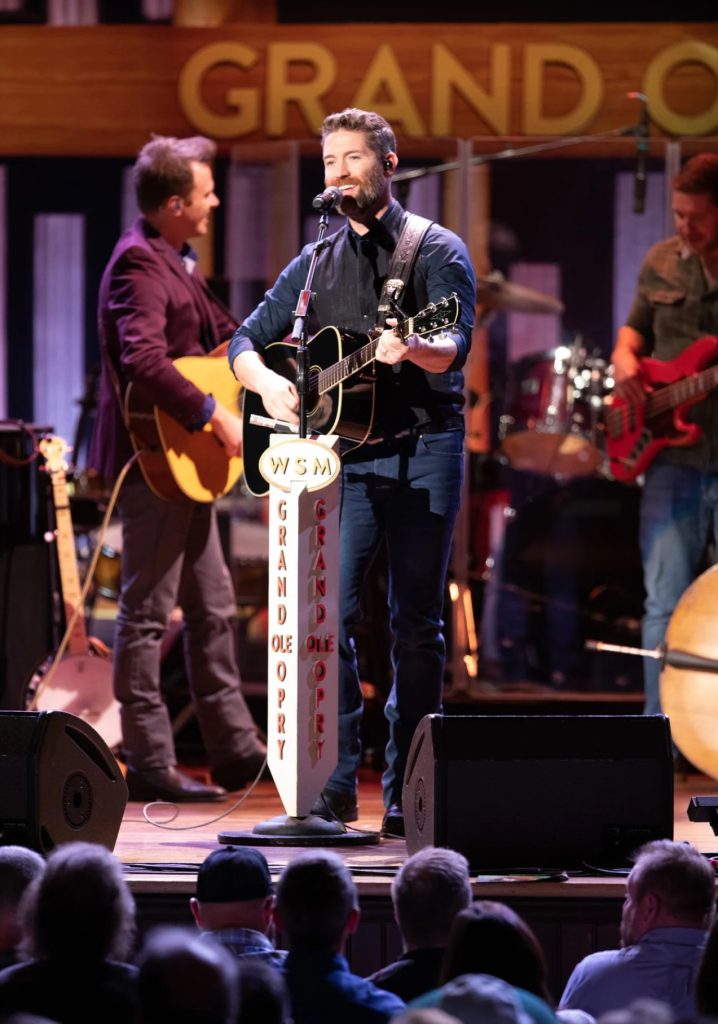
A country song can feel like a prayer without ever raising its voice, and Me and God is one of those rare songs that carries simple faith, homegrown warmth, and deep peace into every room it enters.
When Josh Turner brings Me and God to the stage of the Grand Ole Opry, the song seems to return to the very place it was always meant to live. There is something about that room, with its history, its wood, its reverence for plain truths and unadorned emotion, that makes a song like this feel even more honest. Released as a single from Turner’s breakthrough album Your Man, Me and God reached No. 15 on Billboard’s Hot Country Songs chart in 2007. That number tells part of the story, but only part. The deeper truth is that the song has lasted because it speaks in a language country music has always understood: humility, conviction, and a kind of everyday spirituality that never needs to shout.
Originally included on Your Man, the song stood out because it revealed another side of Josh Turner. By then, listeners already knew the rich baritone, the strong traditional instincts, and the magnetic presence he brought to modern country. But Me and God was different from the flirtation of Your Man or the radio-ready sweep of some of the album’s other material. This was a song built on stillness. Its power came not from drama, but from certainty. It sounded like front-porch wisdom, Sunday-morning calm, and the kind of belief carried quietly through a lifetime.
The studio version was made even more meaningful by the presence of Ralph Stanley, whose unmistakable voice gave the recording an old mountain soul. That pairing mattered. Turner had always shown deep respect for country’s roots, and bringing in a figure like Stanley connected Me and God to an older spiritual current running through American music. It was not just a duet choice. It was a statement of lineage. The song did not belong only to one era of country music. It belonged to the old church benches, the back roads, the family harmonies, and the quiet moments when faith is not a performance, but a companionship.
That is also why the Grand Ole Opry setting feels so right. The Opry has long been the home of songs that carry memory as much as melody. On that stage, Josh Turner does not have to decorate Me and God with anything extra. The song breathes on its own. His deep voice, steady and unhurried, lets each line land with the plainspoken grace the lyric requires. The performance feels less like entertainment and more like testimony in the most human sense of the word: one man standing in a storied place, singing about the relationship that steadies his life.
Lyrically, Me and God is striking because it does not reach for grand theology or complicated poetry. Instead, it rests on the intimacy of the title itself. Not God as a distant force. Not religion as ceremony. Just me and God — a phrase so conversational it almost feels disarming. That simplicity is exactly the song’s brilliance. It suggests a faith built not on spectacle, but on closeness. The lyric speaks of trust, guidance, and a bond that remains firm through confusion, temptation, and change. In country music, where the strongest songs often sound like they were spoken before they were sung, that conversational ease gives the song its lasting weight.
There is also something deeply American in the way the song frames belief. It is personal, direct, and unpretentious. It does not argue. It does not preach at the listener. It simply says: this is what anchors me. That quality has helped the song endure far beyond its chart run. Many country songs are admired in their moment. Fewer become companions. Me and God has become that kind of companion for many listeners, because it offers reassurance without sentimentality and faith without ornament.
In the larger story of Josh Turner’s career, the song remains an essential piece of what made him stand apart. He arrived at a time when country music was broadening in many directions, yet he never sounded disconnected from the genre’s foundation. His affection for gospel tones, traditional phrasing, and rural sincerity gave songs like Me and God unusual credibility. He was not borrowing this language for effect. He inhabited it naturally. That authenticity is what makes an Opry performance of the song feel so moving. The room recognizes truth when it hears it.
And perhaps that is the enduring meaning of Me and God. It reminds us that some of the most powerful songs do not dazzle us with complexity. They return us to what is essential. A voice. A belief. A little space for gratitude. On the stage of the Grand Ole Opry, Josh Turner turns that simplicity into something quietly unforgettable. The song does not rush past the heart. It settles there, gently, like an old certainty remembered at exactly the right time.
