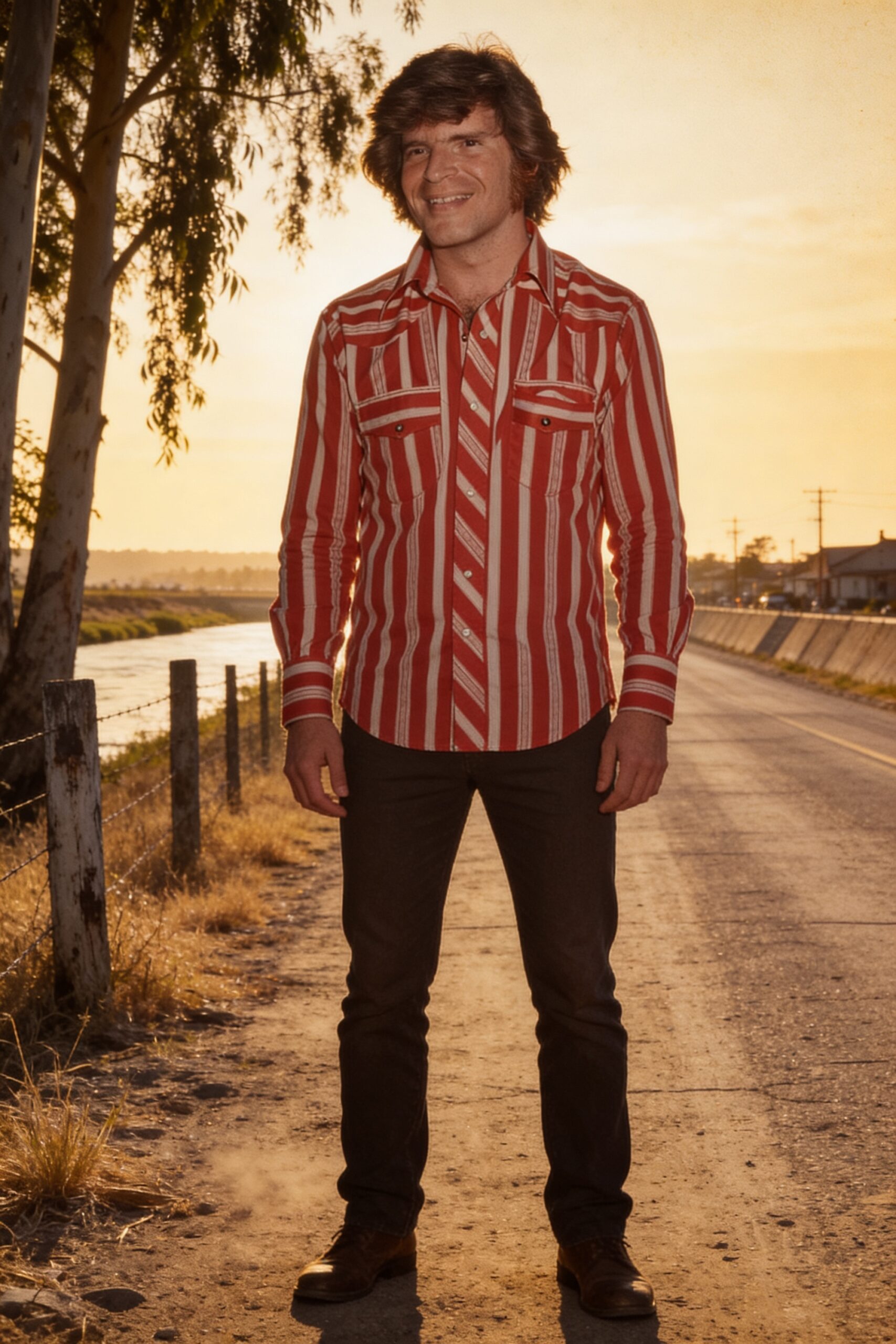
On Centerfield, John Fogerty made the old Memphis train feel like forward motion again.
John Fogerty released Big Train (From Memphis) on his 1985 album Centerfield, a record that returned him to the center of American rock after a long stretch away from the charts and from regular public visibility. The song was not one of the album’s biggest singles, but it carries a revealing charge: it shows Fogerty looking backward without standing still, turning the pulse of early rockabilly into a disciplined, propulsive act of renewal.
The title announces its destination before the music fully opens. Memphis is not used as a decorative place-name; it is a shorthand for one of rock and roll’s most concentrated origin stories. In the 1950s, the city became a meeting ground for country rhythm, blues feeling, gospel force, and the bright, nervous snap of rockabilly. The train image belongs naturally to that world. Trains were movement, work, distance, escape, and arrival. In popular music, they also became rhythm machines, teaching drummers, guitarists, and singers how to suggest motion without needing to describe it.
Fogerty understood that language deeply. Long before Centerfield, his writing and singing with Creedence Clearwater Revival had drawn from older American materials: blues patterns, country directness, swampy grooves, revival-meeting urgency, and the plainspoken drama of folk narrative. He rarely treated those sources as museum pieces. His gift was compression. He could make a song sound as if it came from somewhere older than radio while still moving with the precision of a three-minute rock single. Big Train (From Memphis) fits inside that same ecosystem, but it points more openly toward the early rockabilly rail line.
The groove is the song’s central argument. It does not merely imitate a train; it organizes itself like one. The beat has a forward-leaning insistence, the kind of tempo that suggests wheels catching the track and refusing to lose speed. The guitar attack is clipped and bright, closer to the economical snap of Sun-era rock and roll than to arena-scale heaviness. Fogerty’s vocal sits in that motion rather than floating above it. He sings with the alertness of someone keeping time with a machine, letting the phrasing ride the rhythm in short bursts instead of stretching the song into nostalgia.
That restraint matters. A weaker tribute might have dressed itself in obvious period costume, leaning on imitation until the present disappeared. Fogerty’s approach is sharper. He borrows the grammar of early rockabilly — quick tempo, clean rhythmic bite, a sense of rural and urban styles colliding — and folds it into the sound of his 1980s comeback album. The result is not a replica of Memphis in the 1950s. It is Fogerty’s version of what that Memphis energy made possible: concise songs built from impact, clarity, and momentum.
Centerfield itself gives the track extra resonance. The album is often remembered for its title song’s baseball imagery and for the tense, swamp-rock edge of The Old Man Down the Road. But Big Train (From Memphis) helps explain the deeper architecture of the record. Fogerty was not only reintroducing himself; he was reconnecting the present tense of his craft to the music that had formed his instincts. In that sense, the train is not simply coming from Memphis as a matter of geography. It is carrying a method: keep the rhythm clear, keep the story moving, let the old sources breathe through new work.
There is also something quietly revealing in the way Fogerty uses speed. Fast music can become a display of force, but here the motion feels purposeful rather than frantic. The train-tempo groove gives the song discipline. Every part seems to know its job. The drums push, the guitar cuts, the vocal lands, and the arrangement avoids unnecessary weight. That compactness connects Fogerty to the rockabilly records he is invoking, where small bands made large impressions through timing, tone, and nerve. The economy is part of the emotion.
As a tribute, Big Train (From Memphis) is most moving because it does not ask the past to stay frozen. It treats influence as a living current. Fogerty had already built a career from the belief that American roots music could be renewed by pressure, imagination, and a hard-working beat. On this track, he lets the listener hear one of those roots more directly: the train rhythm that helped early rock and roll sound like it was leaving the station before anyone had finished naming it.
That may be why the song still feels useful within Fogerty’s catalog. It is not simply an album cut about old rock and roll. It is a map of artistic inheritance, drawn in rhythm. A musician returns after silence, reaches back to the first engines that moved him, and finds not a relic but a way forward. The big train does not arrive as memory alone. It arrives as proof that a durable groove can carry history without slowing down.
