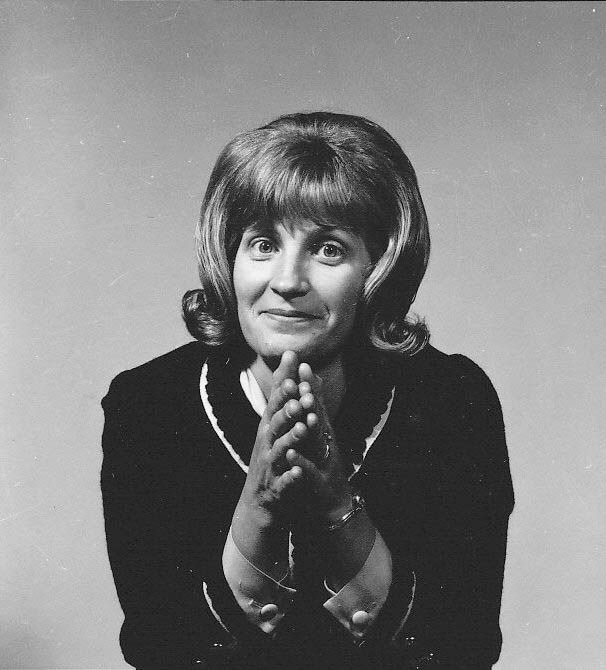
In Skeeter Davis’s 1962 “The End of the World,” heartbreak sounds less like collapse than control.
Skeeter Davis released “The End of the World” on RCA Victor in 1962, and by the following year it had become one of the clearest examples of a country ballad crossing into the broader American pop imagination. Written by Arthur Kent and Sylvia Dee, and produced by Chet Atkins, the record belongs to the era often described as the Nashville Sound: country music shaped with smoother textures, carefully balanced arrangements, and an ear toward listeners who might never have thought of themselves as country fans.
Yet the power of the single does not come from polish alone. Its lasting force is in the difference between the enormous claim of the title and the smallness of Davis’s delivery. A song called “The End of the World” could easily invite theatrical despair. Davis chooses something more unsettling. She sings as if the catastrophe has already happened and the only thing left is the effort to speak plainly.
The lyric is built on a simple emotional contradiction: the outside world continues, indifferent and orderly, while the singer’s inner life has come apart. The sun, the sea, the birds, and the human heart all go on doing what they have always done. That ordinary continuation is what makes the sorrow so sharp. The song does not describe public disaster. It describes the private bewilderment of realizing that one person’s absence can make familiar reality feel strangely unreal.
Davis’s vocal is haunting because it refuses to dramatize that bewilderment. Her tone is light, steady, and almost conversational, with a tremor suggested more by phrasing than by volume. She does not press the melody for effect. She lets the lines fall into place with a disciplined calm, and that calm becomes the emotional wound of the record. The listener hears a singer maintaining composure while the words quietly prove that composure impossible.
That restraint is central to the country-ballad character of the performance. Davis carries the song with the directness of someone telling the truth without decoration, while the arrangement frames her voice in a softer pop setting. The piano and rhythm section move gently, the background voices cushion rather than crowd her, and the production leaves space around the melody. Nothing in the record rushes. Nothing tries to win the listener by force. The sorrow is allowed to arrive at its own pace.
The result is a kind of emotional double vision. On the surface, “The End of the World” is elegant and accessible, the kind of early-1960s record that could sit comfortably beside pop ballads on radio. Underneath, it carries the plainspoken fatalism associated with country music: love has ended, the fact is irreversible, and the singer must live with what remains. Davis does not blur those identities. She holds them together, and that is why the recording still feels so precise. It is country in its wound and pop in its frame.
One of the most affecting moments comes near the end, when Davis moves briefly into a spoken delivery. The shift is small, but it changes the scale of the song. What had seemed like a graceful performance suddenly feels closer to a private thought said aloud. The spoken lines do not make the record theatrical; they make it more intimate. They draw attention to the central paradox of the song: the language is apocalyptic, but the voice is almost fragile in its refusal to break.
The record’s crossover success makes sense in that light. It reached listeners across format boundaries because it did not ask them to understand a style before understanding a feeling. Davis gave the song a shape that could travel: clean melody, polished production, and a vocal performance rooted in emotional exactness. In the early 1960s, when country music was finding new ways to address mainstream audiences, Skeeter Davis offered a model of expansion without losing the ache that made the song matter.
There is also a quiet artistic courage in the performance. Davis trusts softness. She trusts space. She trusts that a voice does not need to shatter in order to reveal damage. Many singers might have treated the title as an invitation to grandeur, but her version understands that grief often sounds smaller than expected. It can sound like someone looking out at a normal morning and wondering how normality survived.
That is why the vocals remain so affecting. They do not freeze the song in 1962; they keep returning it to a recognizable human moment. After a private ending, the world does not stop. The clocks keep moving, the day continues, and the hardest part may be the fact that everything looks the same. Davis stands inside that contradiction with a voice so composed it lets the listener hear the breaking underneath.
