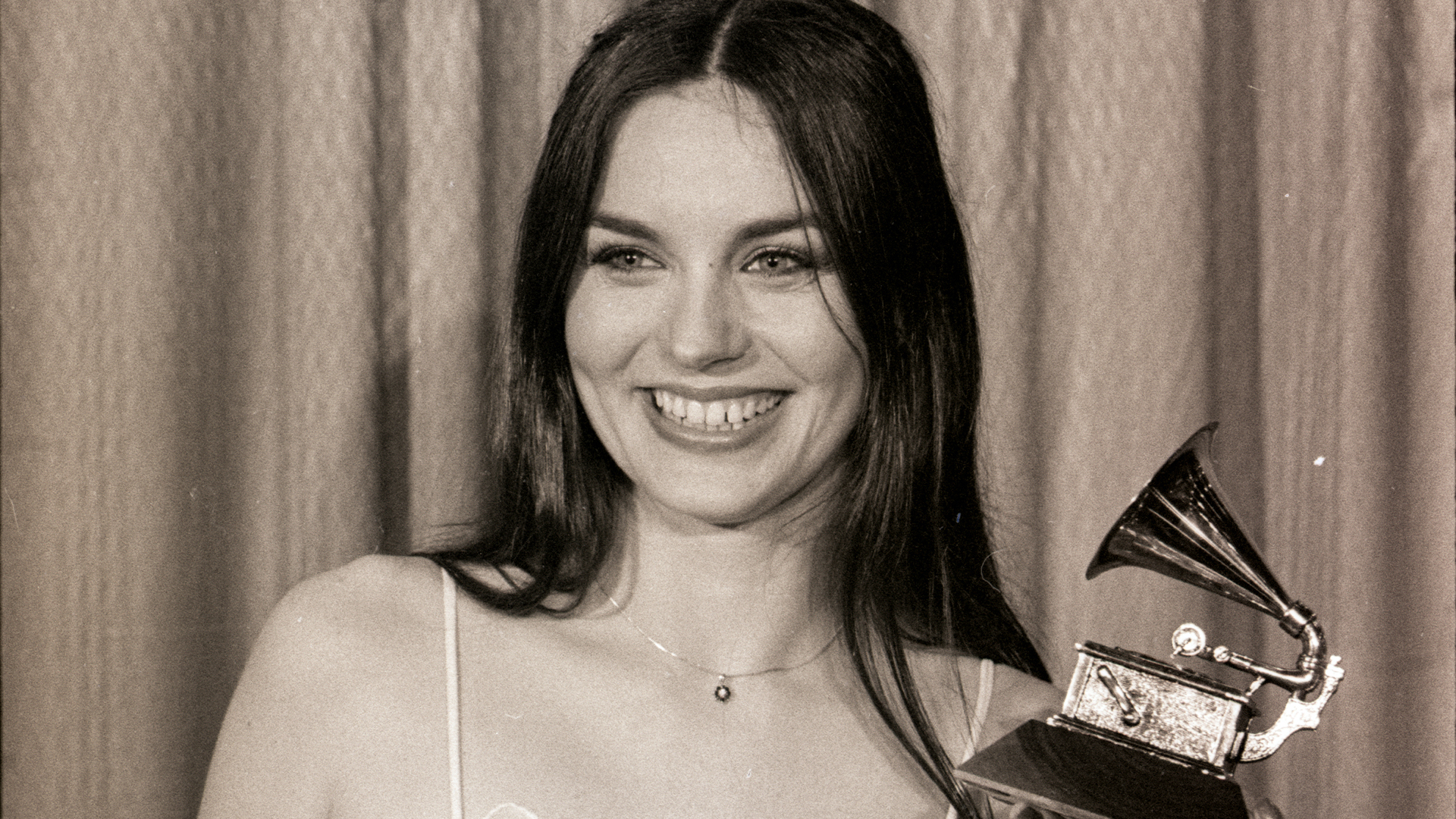
In Crystal Gayle’s calmest heartbreak, country found a pop doorway without losing its ache.
In 1977, Crystal Gayle released Don’t It Make My Brown Eyes Blue, a Richard Leigh song that became the defining recording of her career and one of country-pop’s most graceful crossings into the wider pop world. Issued on the album We Must Believe in Magic and produced by Allen Reynolds, the single reached No. 1 on the country chart and rose to No. 2 on the Billboard Hot 100. At the 1978 Grammy Awards, it earned Gayle the award for Best Female Country Vocal Performance. Those facts are impressive, but they do not fully explain the record’s hold. Its power lies in how little it seems to demand while quietly taking possession of the room.
The song begins with a mood rather than a declaration. The piano does not stride in like a country honky-tonk figure or announce itself with pop grandeur. It settles, almost conversationally, into a soft, jazz-touched space. Around it, the arrangement keeps its distance: brushed rhythm, warm bass movement, tasteful strings, and a sense of air around the vocal. Nothing crowds the lyric. Nothing hurries the sorrow. This restraint is central to the recording’s crossover brilliance. It did not reach pop listeners by sanding away all country feeling; it reached them by presenting country heartbreak in a language of elegance, intimacy, and melodic poise.
Gayle’s voice is the center of that balance. On Don’t It Make My Brown Eyes Blue, she does not sing heartbreak as collapse. She sings it as recognition. The narrator knows the relationship is slipping beyond repair, and the title phrase turns a simple physical detail into an emotional weather report. Brown eyes becoming blue is not literal; it is a compact country image, plain enough to be understood immediately and poetic enough to linger. Gayle’s delivery makes the phrase feel less like a clever line than a small admission spoken after the hardest part has already happened.
That is where the song’s female heartbreak voice becomes so distinctive. Many breakup songs build toward accusation, pleading, or theatrical release. Gayle leaves most of that outside the frame. Her phrasing is smooth, but it is not empty. She lets the consonants soften, lets the melody curve, and avoids forcing the pain into a display. The result is a woman’s voice that sounds wounded without surrendering its composure. There is dignity in the way she holds back. The ache is not hidden; it is disciplined.
The lyric’s simplicity helps make that discipline believable. Richard Leigh wrote a song that gives the singer clean emotional lines rather than a complicated story. We are not given a full history of the relationship, and the recording does not need one. The listener hears the essential moment: someone facing the departure of a lover and understanding that sadness has entered not just the heart but the face, the body, the visible self. The song’s genius is in refusing excess explanation. It trusts one image, one question, and one melody to do the work.
In the context of 1970s country, Gayle’s recording arrived at a moment when Nashville was increasingly comfortable with polished arrangements and pop radio was open to softer country textures. Yet Don’t It Make My Brown Eyes Blue does not feel like a compromise document. It sounds carefully placed between worlds. The piano gives it a lounge-like sophistication; the lyric keeps its country directness; Gayle’s vocal makes the emotional surface clear enough for pop and tender enough for country. The crossover was not only commercial. It was interpretive. She showed that a country singer could move through pop space without raising the temperature or exaggerating the wound.
The performance also marked a clear identity for Gayle. She had already been building a career of her own, but this recording fixed her public image around a particular kind of refinement: soft-spoken, melodically exact, emotionally legible. The success of We Must Believe in Magic helped confirm that country albums by women could command major mainstream attention, and this single became the doorway through which many listeners first encountered her. But the record endures less because it was successful than because the success feels so aligned with the sound. It is a hit that behaves like a private confession.
Listen closely and the song’s sadness is not dramatic in the usual sense. It is domestic, adult, and contained. The tempo allows the singer to breathe between realizations. The arrangement seems to understand that heartbreak often becomes most affecting when it stops arguing. Gayle’s vocal carries the faint tension between being hurt and remaining graceful, between saying goodbye and still wanting to be seen. That tension gives the record its human scale. It is not trying to make heartbreak larger than life. It is showing how large a small sentence can become when sung with clarity.
That may be why Don’t It Make My Brown Eyes Blue remains such a revealing example of country-pop at its best. It does not mistake smoothness for shallowness. It does not confuse restraint with emotional distance. In Gayle’s hands, the polish becomes part of the pain: the sound of someone keeping steady while the color drains from the day. The song crossed charts, genres, and audiences because it understood something plain and durable about heartbreak. Sometimes the most devastating voice is not the one that breaks open, but the one that keeps singing softly enough for the truth to come through.
