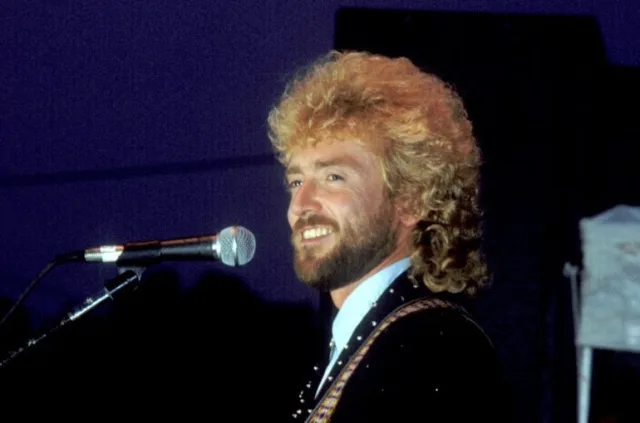
A 1988 country ballad where love is not possession, but a plea to be seen clearly.
Keith Whitley recorded “Don’t Close Your Eyes” for his 1988 album of the same name, turning a Bob McDill composition into one of the defining performances of late-eighties neotraditional country. Released during a period when mainstream country was reaching back toward fiddle, steel guitar, plainspoken storytelling, and vocal authority, the song gave Whitley a setting perfectly suited to his gift: he could make restraint sound devastating.
The premise is simple enough to fit inside a classic country frame. The narrator is with someone who has not fully let go of another love. He does not rage, accuse, or beg in theatrical terms. Instead, he asks for presence. Do not close your eyes and imagine someone else. Do not turn this moment into a substitute for the past. That emotional situation could easily have become melodrama, but McDill’s writing keeps it grounded in adult pain. The song understands that jealousy is not always loud. Sometimes it arrives as a quiet awareness that the person beside you is emotionally elsewhere.
Whitley’s performance gives that idea its gravity. He does not sing the song as a man trying to win an argument. He sings it as someone who already knows the fragility of what he is asking for. His phrasing has a measured ache: the lines are shaped carefully, with small pauses that let the listener feel the distance between desire and certainty. The voice is warm, but it is not soft in a decorative way. It carries the grain of lived experience, the kind of country singing that suggests every word has been weighed before it is released.
The arrangement supports that emotional discipline. “Don’t Close Your Eyes” is built as a ballad, but it avoids excessive ornament. The production leaves room around Whitley’s voice, allowing the steel guitar and gentle rhythm section to color the scene without crowding it. That space matters. In a song about emotional absence, silence becomes part of the storytelling. The listener hears not only what the narrator says, but what he cannot control: memory, comparison, and the lingering presence of someone who is not in the room.
In the context of 1988 country music, the recording also felt connected to a broader return to fundamentals. The neotraditional movement did not simply imitate older sounds; at its best, it renewed the value of direct singing and well-built songs. Whitley, with roots in bluegrass and a deep respect for classic country phrasing, brought a seriousness to the form that never felt museum-like. He was not performing nostalgia. He was singing in a language that still had urgent emotional use.
That is one reason the song has remained so closely associated with him. Bob McDill wrote many finely observed country songs, and here his craft lies in how little he overexplains. The lyric does not need to tell us the full history of the relationship. It gives us a room, two people, and a truth too painful to decorate. The narrator is not asking to erase the past; he is asking not to be turned into its shadow. That distinction is what gives the song its maturity. The wound is intimate, but the dignity is intact.
Whitley’s vocal interpretation deepens that dignity. He resists the temptation to make the chorus a dramatic explosion. Instead, the emotional rise feels inward. When the title line returns, it is not merely a hook; it becomes the central human request of the record. To be loved in the present. To be recognized as oneself. To stand before someone without competing against a memory. Country music has often made powerful art from heartbreak, but this song locates heartbreak before the break itself, in the trembling space where someone still hopes honesty might save the moment.
The fact that “Don’t Close Your Eyes” became one of Whitley’s signature recordings is inseparable from the particular authority of his voice. He had the ability to sound traditional without sounding distant, polished without sounding protected. The performance does not invite pity; it invites recognition. Many singers can communicate sadness. Fewer can communicate the self-command required to speak gently while hurting. Whitley’s reading makes the narrator vulnerable, but not weak. He is open enough to ask, and strong enough not to disguise the cost of asking.
Heard now, the 1988 recording carries both the atmosphere of its era and an emotional clarity that does not depend on period style. The steel guitar, the careful tempo, and the neotraditional frame place it unmistakably within a particular chapter of country music. Yet the central feeling remains immediate because it is so precisely human. Love is not only about being chosen once. Sometimes it is about being chosen in the present tense, without ghosts entering the room.
That is the quiet power of Keith Whitley’s “Don’t Close Your Eyes”. It does not raise its voice to prove its depth. It trusts the song, the singer, and the listener enough to let pain appear plainly. In that restraint, a country ballad becomes something braver than confession: a clear-eyed plea for love to look back.
