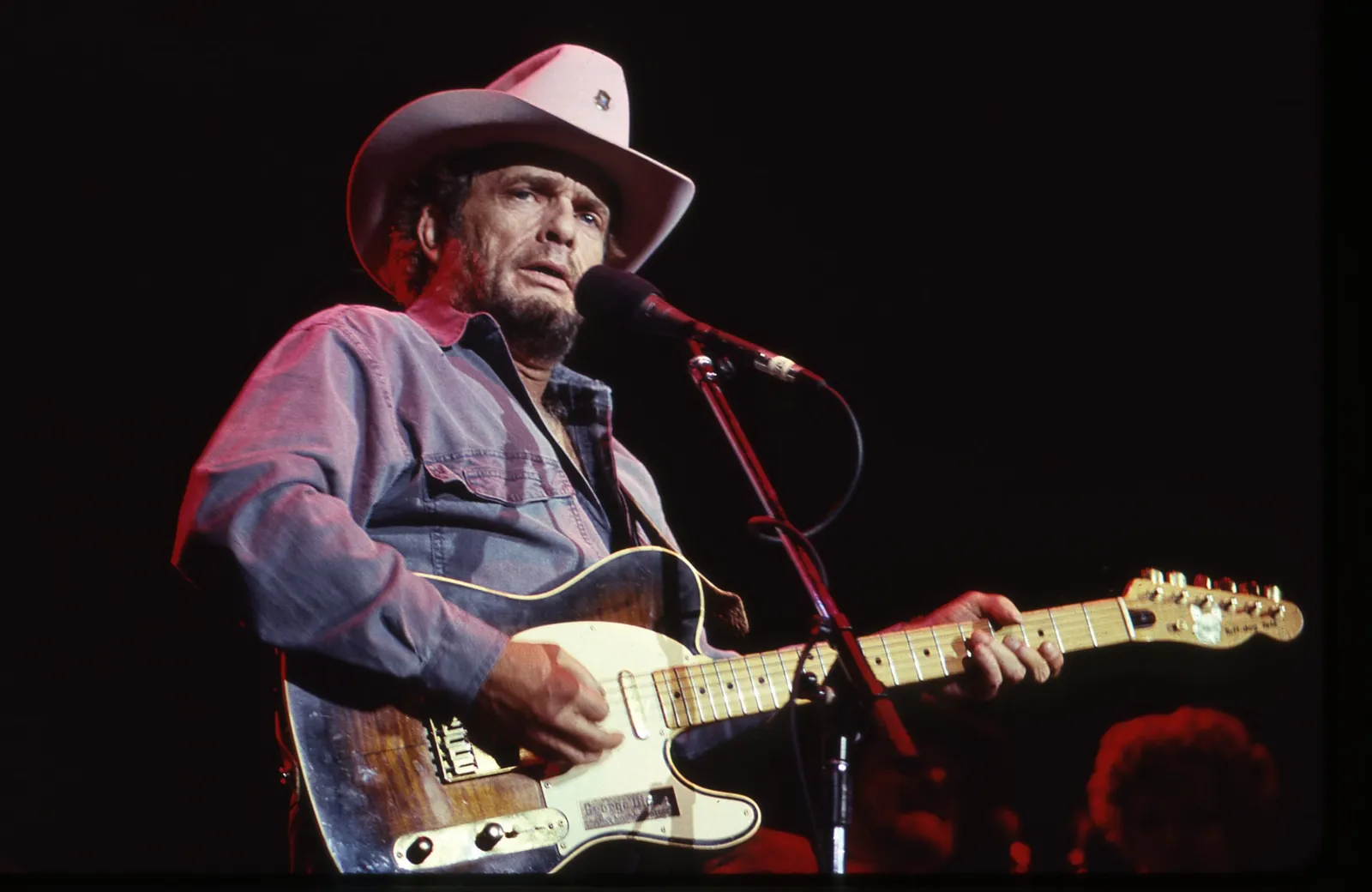
In Mama Tried, Merle Haggard made rebellion sound like a debt he could never repay.
In 1968, Merle Haggard and The Strangers released Mama Tried, a song written by Haggard and issued as the title track of the Capitol album of the same name. Its factual outline is familiar: a son raised by a hard-working mother, a boy who drifts beyond correction, a life that ends up measured against the pain left at home. But the record’s force begins before the story is fully spoken. Roy Nichols’ signature guitar intro cuts in with a bright, clipped authority, giving the song its first sentence without using a word.
That opening matters because it does not soften the listener into sympathy. Nichols’ guitar is clean, quick, and unsentimental, the sound of Bakersfield country sharpened into a declaration. It has the snap of honky-tonk precision rather than the velvet polish often associated with Nashville productions of the period. The phrase does not simply introduce a melody; it establishes a moral climate. By the time Haggard enters, the song already feels as if it is moving down a road too familiar to turn back from.
Mama Tried is often called autobiographical, and the description is useful as long as it is not treated like a court document. Haggard’s early life did include real trouble, juvenile detention, and time in San Quentin before his music career remade his path. He also knew the grief of losing his father young and the pressure that placed on his mother. The song compresses those elements into a harsher, simpler country parable. It turns lived experience into moral autobiography: not every line is literal, but the guilt feels earned.
What keeps the record raw is Haggard’s refusal to perform guilt as spectacle. He does not wail through the lyric or push the vocal toward theatrical regret. His phrasing is measured, almost conversational, and that restraint makes the confession heavier. The narrator understands that the mother’s effort was real, and that his failure cannot be explained away by bad luck alone. Haggard sings as if he is naming the facts because ornament would be dishonest.
The arrangement helps keep that honesty intact. The Strangers play with lean momentum: guitar, rhythm section, and country accents moving with the efficient drive of a working band rather than a staged drama. The tempo is brisk enough to avoid self-pity, but not so fast that the sorrow disappears. Nichols’ guitar presence remains central to the record’s identity, giving the song a restless edge that feels both rural and hard-bitten. It is music with clean lines and rough consequences.
That is where the outlaw-country energy of Mama Tried becomes most interesting. In 1968, outlaw country had not yet settled into the public mythology it would acquire in the 1970s. Haggard was rooted in the Bakersfield sound, shaped by barrooms, dance floors, and the directness of working-class country. Yet this recording carries an outlaw spirit without needing costume or pose. Its rebellion is not romanticized. It is presented as a fact of character, followed by an accounting.
The mother in the song is not a sentimental prop. She is the moral center, the person whose effort gives the narrator’s failure its shape. Haggard does not ask the listener to excuse him because he suffered, nor does he pretend that remorse repairs what was broken. That balance is why the song still feels bracing. It holds two truths at once: a person can be shaped by circumstance, and still be responsible for the pain he causes.
Haggard’s greatest recordings often depend on this kind of tension. He could sing about pride and shame without making either one too simple. In Mama Tried, his voice stands between the swagger of the outlaw and the humility of the son who knows he has disappointed the one person who kept trying. Roy Nichols’ guitar gives the record its hard edge, but Haggard’s vocal gives it its conscience. Together they create a sound that is tough because it refuses to hide tenderness.
More than half a century later, Mama Tried still feels alive because it does not flatter either rebellion or regret. It lets the listener hear the cost inside the rhythm, the apology inside the plain words, the family history inside a country single built for immediacy. The song’s power is not in claiming innocence; it is in refusing to run from what has been done. In that refusal, Haggard turned a personal shadow into one of country music’s clearest statements of consequence.
