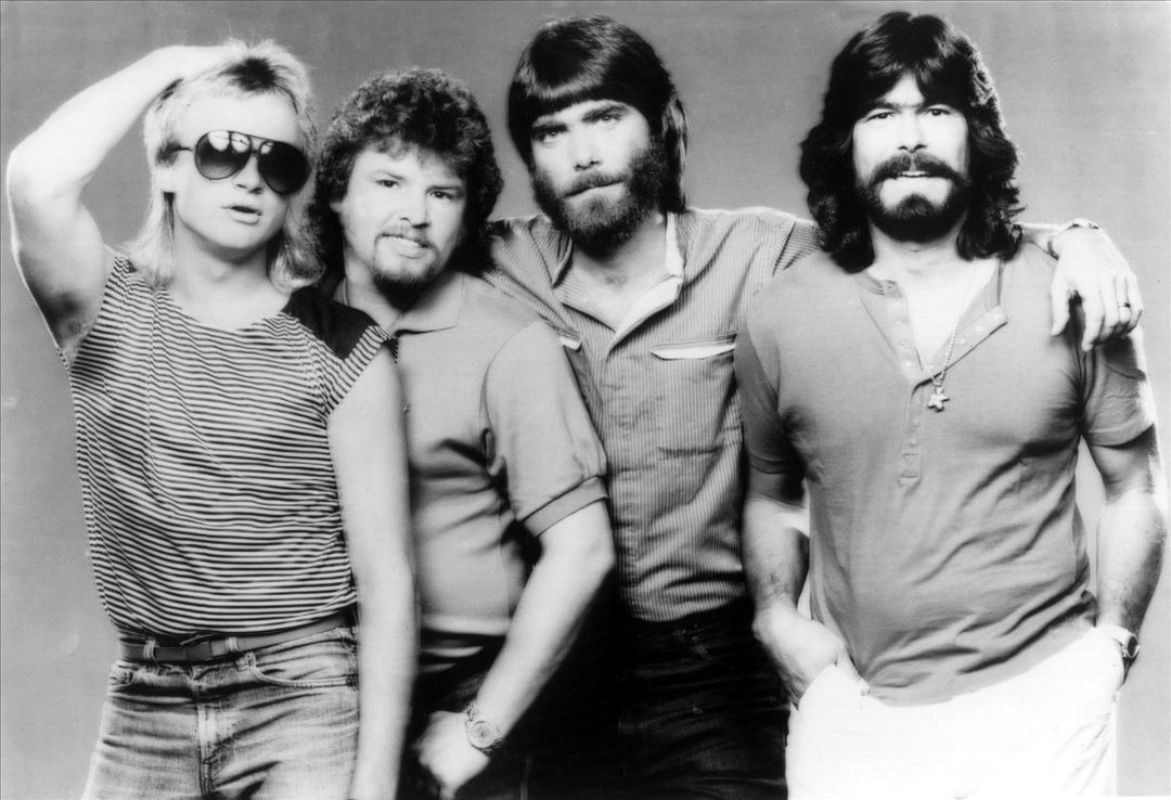
In 1982, Alabama turned a memory of old mountain songs into a bright, electric country-band anthem.
In 1982, Alabama released “Mountain Music”, written by lead singer Randy Owen, as the title track from the album Mountain Music. It quickly became one of the group’s defining records, reaching No. 1 on the country chart and giving the band a song that felt both deeply rooted and unmistakably contemporary. Its power was not only in its hook, or in the way the tempo lifts the room. It was in the blend: Southern rock drive, country storytelling, and the kind of harmony singing that makes a group sound like a shared memory rather than four separate musicians.
By the early 1980s, Alabama had already helped change the shape of mainstream country. The band came from Fort Payne, Alabama, and its core identity was different from the familiar Nashville model of a solo singer standing in front of hired players. Randy Owen, Teddy Gentry, Jeff Cook, and Mark Herndon presented themselves as a working band, with visible instrumental personality and a vocal sound built on togetherness. On “Mountain Music”, that identity becomes especially clear. The record does not separate rural tradition from electric energy. It lets them run side by side.
The song begins with an invitation that is almost plainspoken: play some mountain music, the kind “grandma and grandpa used to play.” That line carries much of the record’s emotional design. It does not describe tradition as something remote or fragile. It places it inside family memory, where music is not an artifact but a living sound associated with porches, rivers, children’s imagination, and handed-down pleasure. The lyric moves through images of rafting, swimming, dreaming, and drifting, drawing on a Southern childhood landscape that is partly real and partly literary. References to figures like Tom Sawyer and Huck Finn give the song a boyhood restlessness, while the chorus keeps returning to the older voices that first made music feel like home.
Musically, the record works because it refuses to stay in one narrow lane. The acoustic colors suggest old-time and bluegrass influence, while the rhythm section and electric accents bring the forward motion of Southern rock. The track has the looseness of a Saturday-night gathering, but it is arranged with discipline. It rises, releases, and circles back to the chorus with a confidence that made it ideal for radio without sanding away its regional character. The fiddle-and-string-band flavor does not feel like decoration; it is part of the song’s argument that modern country could carry older sounds without treating them as museum pieces.
The harmonies are the emotional center. Alabama did not use harmony merely to sweeten the lead vocal. In “Mountain Music”, the voices create the sensation of community. Owen’s lead gives the lyric its direct line, but the answering blend widens the frame, as if the memory belongs to more than one person. That group sound is crucial to the song’s warmth. It allows the chorus to feel communal rather than nostalgic in a solitary way. The listener hears not only a singer remembering the past, but a band building a present tense out of that remembrance.
That is where the record’s Southern rock energy matters. A purely reverent arrangement might have made the song feel quaint. A harder rock treatment might have overwhelmed its family-centered simplicity. Alabama finds the middle ground: guitars and drums give the track muscle, while harmony and acoustic texture keep it close to the ground. The result is not a rejection of country tradition, but a widening of its vocabulary. The old mountain sound is imagined as something that can move at highway speed, something that can belong to the radio age without losing the grain of its origin.
The timing also mattered. In the early 1980s, country music was negotiating between polished crossover appeal, traditional sounds, and the rise of bands that looked and played more like self-contained units. “Mountain Music” sits at that intersection with unusual ease. It is polished enough to be instantly accessible, but its imagery and arrangement remain tied to a specific Southern sense of place. It helped define Alabama not simply as a hit-making act, but as a harmony group capable of making regional memory feel expansive.
There is a quiet courage in that balance. The song does not apologize for its roots, and it does not freeze them in place. It treats inheritance as something active: a rhythm to be stepped into, a chorus to be shared, a sound that can survive by changing shape. That may be why “Mountain Music” still carries such generous force within the band’s catalog. It is celebratory, but not empty. It is polished, but not faceless. It is built from familiar country materials, yet the group’s voices and rock-edged momentum make it feel like a bridge between generations.
At its best, “Mountain Music” reminds us that tradition is not only preserved in stillness. Sometimes it is preserved by being sung louder, played faster, and carried by several voices at once. In Alabama’s hands, the past does not sit behind glass. It rides the current, gathers harmony, and keeps moving.
