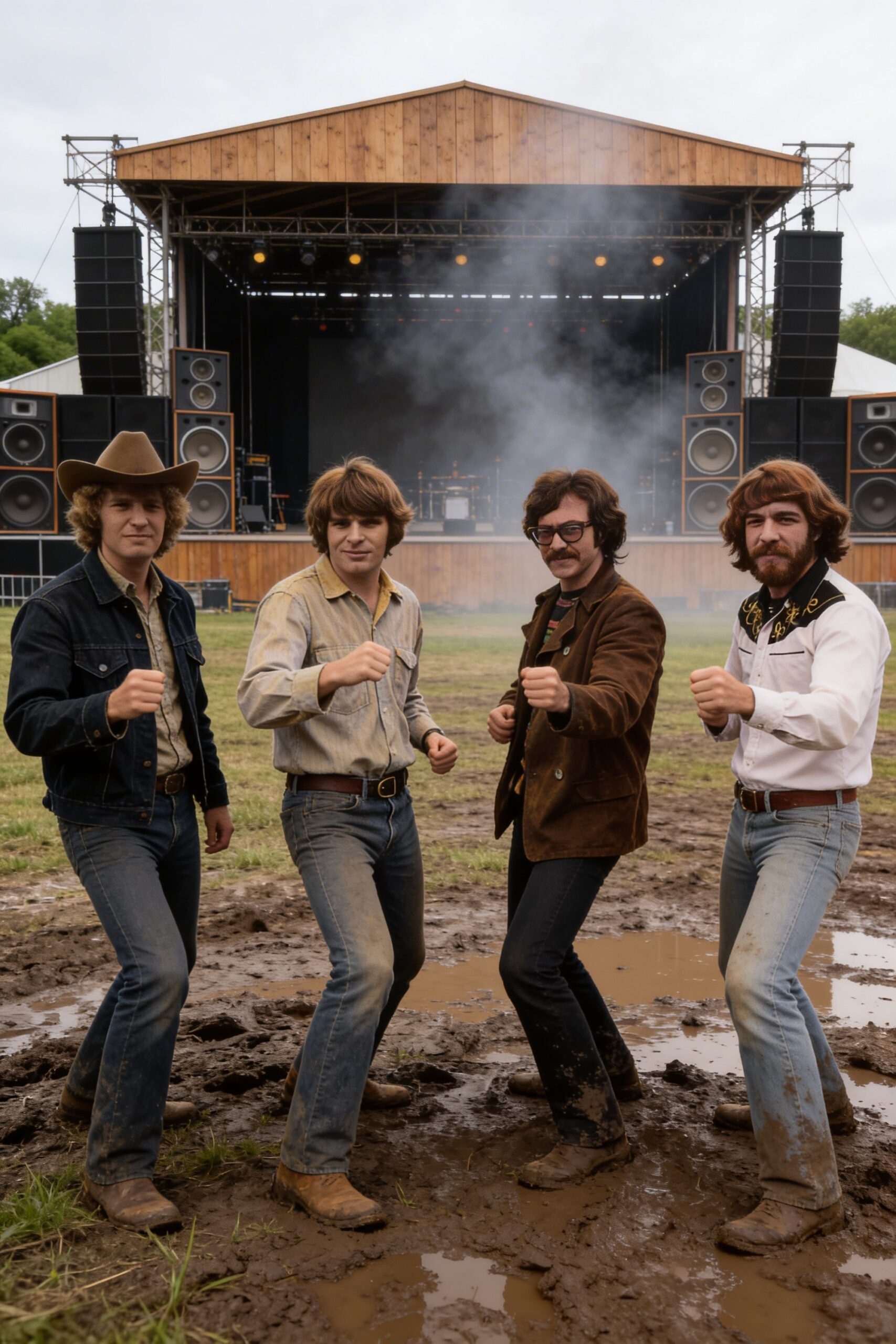
On Pendulum, “Chameleon” caught Creedence Clearwater Revival changing colors without losing their pulse.
Released on Pendulum in December 1970, Creedence Clearwater Revival’s “Chameleon” sits in the quieter part of the band’s story: not as a defining radio single, but as an album deep cut that reveals how restless the group could be when it stepped just outside its most familiar outline. Written by John Fogerty, the track belongs to the band’s sixth studio album, a record made after the enormous run of Cosmo’s Factory and before the original quartet’s final break in shape. In that narrow space, “Chameleon” carries a special charge. It is CCR, unmistakably, but with the colors turned toward soul, horn arrangements, and keyboard texture.
By 1970, the band had already built a world around economy. Their best-known recordings often seemed carved from a few hard materials: Fogerty’s voice, lean guitars, direct rhythm, and songs that made the American South feel vivid even though the musicians came out of the San Francisco Bay Area. That contradiction was part of their power. Creedence did not need elaborate studio architecture to create atmosphere. They found it in a riff, a drum figure, a clipped vocal phrase, a title that sounded like a weather report from somewhere half-real and half-remembered.
Pendulum, however, was not content simply to repeat that formula. The album was the first Creedence LP made entirely of John Fogerty originals, and it brought keyboards and horns further into the sound than many listeners expected from a band so closely associated with guitar-driven swamp rock. The famous entries from the album, “Have You Ever Seen the Rain” and “Hey Tonight”, have long carried much of its public memory. “Chameleon” works differently. It does not try to be the obvious doorway. It stays a little deeper in the room, where the album’s experiments feel less like decoration and more like a shift in temperature.
The soul influence in “Chameleon” is not a costume. It comes through in the way the arrangement moves: the horns punctuating rather than overwhelming, the keyboard presence thickening the groove, the rhythm section keeping everything grounded. CCR’s playing had always depended on discipline, and that discipline remains here. The brass does not turn the track into a revue number; it adds pressure and contrast. The keyboards do not soften the band into polish; they give the song a different kind of body. What might have been a standard Creedence rocker becomes more elastic, more urban in its edges, and more aware of R&B’s clipped urgency.
Fogerty’s vocal is central to that balance. He does not smooth himself into the setting. His voice keeps its grain, its rough bite, its nearly percussive insistence. That friction is what makes the track interesting. A more polished singer might have made “Chameleon” glide; Fogerty makes it lean forward. The soul coloring meets a voice built for warning signs, riverbanks, road dust, and restless motion. Instead of erasing CCR’s identity, the arrangement lets that identity press against a new frame.
The title itself helps explain the feeling without needing to be treated as a grand statement. A chameleon changes color in response to its surroundings, and on Pendulum the band was audibly testing what could change and what had to remain fixed. The beat still lands with Creedence bluntness. The song still has the compact architecture associated with John Fogerty’s writing. But the surrounding color has shifted. Horns and keyboards make the track feel less like a front-porch stomp and more like a band stepping into a room where soul, rock, and studio craft can speak at once.
That matters because Pendulum arrived at a complicated moment in the CCR timeline. It was the last studio album made by the original four-man lineup of John Fogerty, Tom Fogerty, Stu Cook, and Doug Clifford. Tom Fogerty would leave the band in 1971, before the trio recorded Mardi Gras. It would be too easy to hear every unusual sound on Pendulum as an omen, and that kind of hindsight can flatten the music. “Chameleon” is more valuable when heard as evidence of motion rather than prophecy. The band was not simply approaching an ending; it was also trying to expand its language.
Deep cuts often preserve these transitional truths better than hits do. A hit tends to become fixed by repetition, polished by memory until it stands for an era in a simple way. An album track like “Chameleon” keeps more of the workshop around it. You can hear the band’s familiar habits and its curiosity at the same time. You can hear a group known for directness discovering that directness did not have to mean austerity. There was room, even inside CCR’s famously compact style, for horns to answer the vocal, for keyboards to darken the corners, for soul phrasing to pull the rhythm into a slightly different walk.
That is the quiet reward of returning to “Chameleon.” It does not ask to replace the big songs in Creedence Clearwater Revival’s story. It asks to complicate them. It reminds us that even a band celebrated for its clarity was not frozen in one sound. Beneath the swamp-rock image was a working ensemble shaped by blues, country, rock and roll, R&B, and the pressure of constant creation. On this Pendulum deep cut, change does not arrive as a dramatic announcement. It slips into the groove, flashes in the horns, settles into the keys, and leaves the band sounding both familiar and newly alert.
In that sense, “Chameleon” is less a departure than a revealing turn of the head. It shows CCR’s strength not as purity, but as concentration: the ability to absorb another color without losing the line. The song endures in the margins because it catches a great band at work inside uncertainty, still disciplined, still forceful, still willing to let the music change shape before the final note falls.
