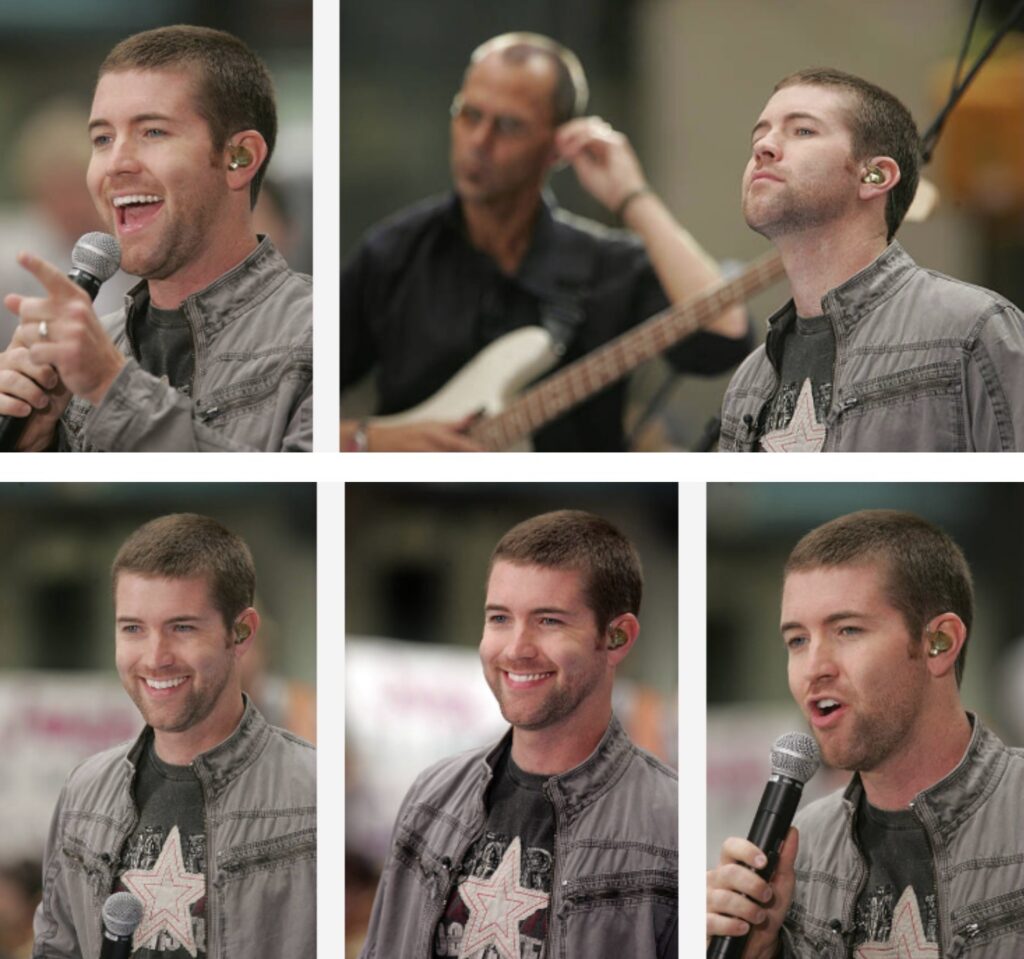
“Two Steppin’ on the Moon” turns a simple dance into a small miracle—proof that when love is close enough, even gravity feels optional.
There’s something wonderfully old-fashioned—almost comforting—about the way Josh Turner approaches romance when he’s at his best. He doesn’t rush it into slogans. He lets it unfold like a slow spin across a worn wooden floor, where the lights are low, the band is steady, and the world outside can wait. “Two Steppin’ on the Moon” belongs to that tradition: a modern country song that feels like it’s been waiting for you in the corner of the room, smiling, patient, sure of itself.
The hard facts place it firmly in Turner’s later chapter, and they matter because they explain the song’s mature calm. “Two Steppin’ on the Moon” appears on his tenth studio album, This Country Music Thing, released August 16, 2024 on MCA Nashville, produced by Turner’s longtime collaborator Kenny Greenberg. The track runs about 3:15–3:16, and it sits as track 7 on most official listings—right in the album’s middle, like a bright window opened between sturdier, earthbound songs.
Then comes the detail that quietly changes the way you hear it: Turner didn’t write it. The song was written by Matt Dragstrem, Chase McGill, and John Pierce—a trio of contemporary Nashville writers who know how to build a hook that feels playful without feeling silly. Knowing that, you can appreciate Turner’s gift as an interpreter again: he has always been the singer who can take a well-made song and give it weight—not heaviness, but meaning.
What does it mean, exactly, to be “two-steppin’ on the moon”? It’s the most charming kind of exaggeration: the idea that dancing with the right person makes you feel lifted, buoyant, a little unreal—in the sweetest possible way. The phrase turns romance into physics: love as levitation, devotion as a new atmosphere. It’s flirtation, yes, but it’s also gratitude—the sense that after enough years on earth, you recognize the rare nights that feel like they don’t belong to ordinary time.
And the story behind the song’s public life is unusually cinematic—almost too perfect, until you realize it actually happened. In late 2024, Turner was invited to NASA’s Mission Control and ended up “serenading astronauts on the International Space Station” with “Two Steppin’ on the Moon.” MCA Nashville’s own release notes specify the performance took place Sunday, October 27, 2024, and the announcement was dated October 30, 2024—a modern country singer standing in Houston, sending a love song upward into actual orbit. His official bio highlights the same remarkable connection: the song “garnered” him the invitation connected to the ISS performance from Mission Control at Johnson Space Center. It’s hard to imagine a more literal fulfillment of a title—one of those moments where pop music’s metaphor briefly becomes real life.
The music video leans into that playful destiny, and its details are part of the song’s mythology now. MCA Nashville notes that Turner premiered the video around the album’s release and that it was spotlighted on billboards in Times Square, with a concept built around moon-themed cameos—friends and legends who’ve sung their own “moon” songs, including Randy Travis, The Gatlin Brothers, John Anderson, and more, plus longtime producer Kenny Greenberg. The effect isn’t gimmick for gimmick’s sake; it’s a wink at country music’s long memory, a reminder that today’s tunes still talk to yesterday’s.
So when you listen now, “Two Steppin’ on the Moon” isn’t only a cute title with a clever hook. It’s a small, modern country fable about how music can lift us—sometimes emotionally, sometimes imaginatively, and in Turner’s case, briefly and unbelievably, almost literally. It carries that nostalgic comfort of a two-step—something familiar to the body—even as it points your eyes upward. And that’s why it lingers: because it honors the oldest truth in country music’s love songs. The world can be heavy, the days can be long, but for one song—three minutes and a little change—someone takes your hand, the band finds the groove, and you remember what it feels like to float.
