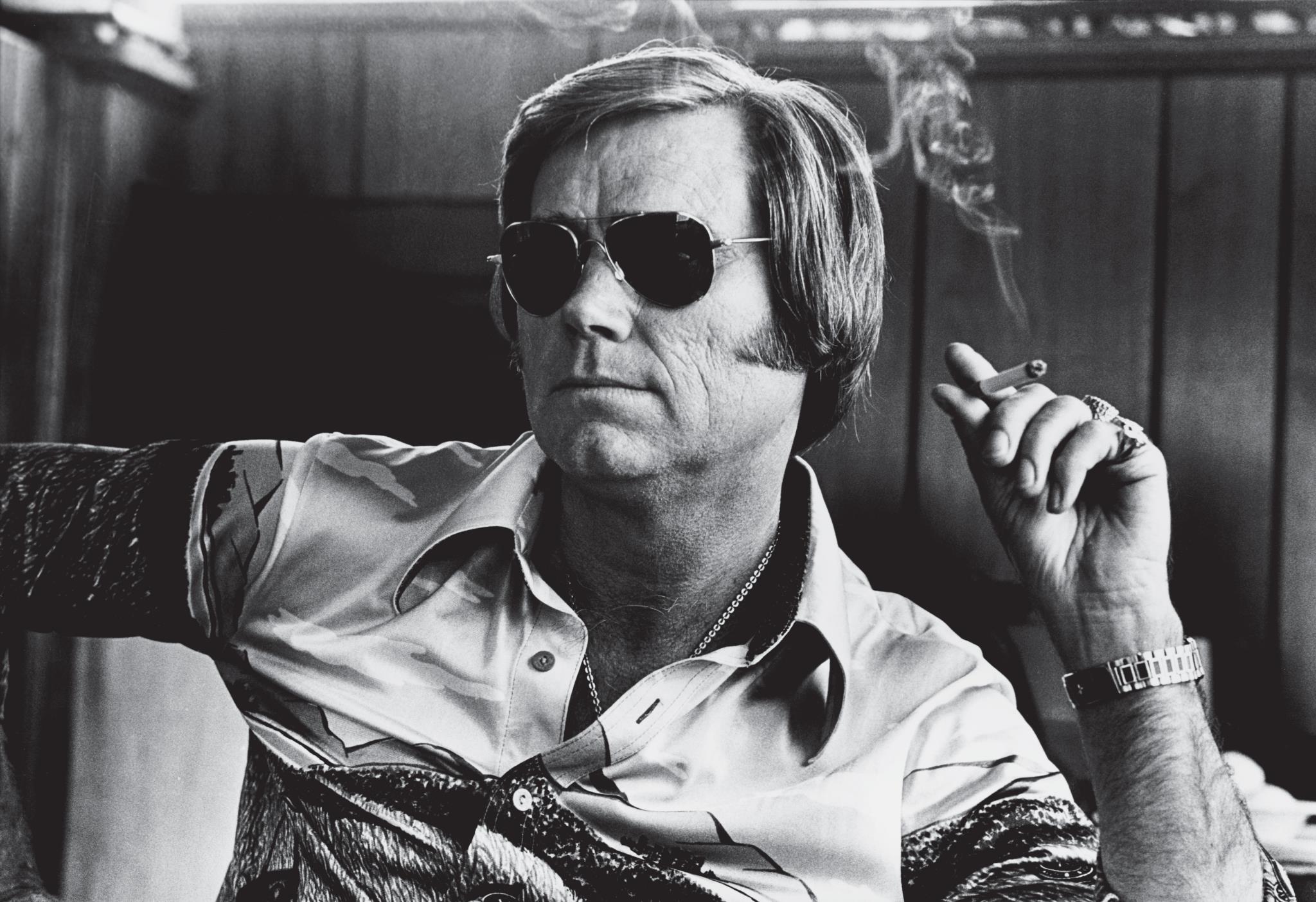
On I Am What I Am, George Jones turned a country death ballad into the vocal that defined his return.
In 1980, George Jones released “He Stopped Loving Her Today” as part of the album I Am What I Am, and the recording quickly became the central performance by which many listeners understood his greatness. Written by Bobby Braddock and Curly Putman, and produced by Billy Sherrill, the song arrived at a moment when Jones’s career needed more than another strong single. It needed a recording that could gather the authority of his voice, the wear of his history, and the discipline of his art into one unmistakable statement.
The premise is stark even by country music standards: a man carries a lost love until death finally ends his devotion. In lesser hands, the story could become melodrama, a song driven by the shock of its final turn. Jones made it something smaller and therefore more devastating. He did not sing it as a grand tragedy unfolding under a spotlight. He sang it as if each line were being discovered reluctantly, with the careful pacing of someone trying not to disturb the truth by touching it too hard.
That restraint is the heart of the performance. Jones had one of country music’s most expressive instruments, capable of bending pitch and time in ways that made ordinary words feel unstable with feeling. On “He Stopped Loving Her Today”, he uses that gift sparingly. He lingers, but he does not overdecorate. He lets certain vowels open just enough to show the ache inside them, then pulls back before the emotion becomes theatrical. The pauses matter almost as much as the notes. They give the song a human pace, the pace of memory returning in fragments rather than in speeches.
Billy Sherrill’s production gives the recording a formal, almost ceremonial frame. The strings, the background voices, and the measured country arrangement all suggest a room prepared for mourning. Yet the record never becomes crowded. Its polish does not erase the grain in Jones’s singing. Instead, the arrangement places his voice against a dignified backdrop, allowing the roughness in his phrasing to feel even more exposed. The contrast between the smooth setting and the wounded vocal center is part of why the song continues to feel so complete.
The spoken passage deepens that effect. In country music, recitation can sometimes draw attention to itself, but here it serves the architecture of the story. Jones moves from singing to speech without breaking the emotional temperature. His voice narrows, becomes plainer, almost documentary. The moment does not explain the song so much as confirm its inevitability. By the time the chorus returns, the title has changed meaning. What first sounded like a statement about heartbreak becomes a final sentence, simple and irreversible.
The album title I Am What I Am also matters in retrospect. Jones was not presenting himself as a newly polished figure detached from the difficulties that had surrounded parts of his life and career. The title suggests acceptance rather than reinvention for its own sake. Within that frame, “He Stopped Loving Her Today” became a song about endurance, but not in the easy inspirational sense. It was endurance carried to its absolute limit. Jones’s vocal did not ask the listener to admire suffering. It asked the listener to notice how quietly suffering can remain faithful to its own shape.
The response was immediate and lasting. The single reached No. 1 on the Billboard country chart and won the Grammy Award for Best Male Country Vocal Performance. It also helped restore Jones’s commercial standing at a time when his reputation as a singer had never been in doubt but his career momentum had become less certain. Awards and chart success explain part of the record’s impact, but they do not explain why the performance feels so definitive. That answer lives in the sound of Jones choosing control when excess was available to him.
Many great singers are remembered for the moments when they soar. Jones is often remembered here for how little he needs to do. A slight delay before a phrase, a softened consonant, a note that seems to bend under the weight of the lyric—these are not displays of technique for their own sake. They are acts of interpretation. He lets the song remain plain enough to be believed. He trusts the listener to feel what he refuses to force.
That is why “He Stopped Loving Her Today” became career-defining rather than merely successful. It gathered the elements associated with George Jones—the ache, the precision, the vulnerability, the country tradition of plainspoken sorrow—and gave them a setting where nothing felt wasted. The performance does not sound like a singer trying to secure his place in history. It sounds like an artist meeting the song that could hold the full weight of his voice. In that meeting, Jones proved that a return does not always announce itself loudly. Sometimes it arrives in a measured breath, a held note, and the courage to let the final word fall exactly where it belongs.
