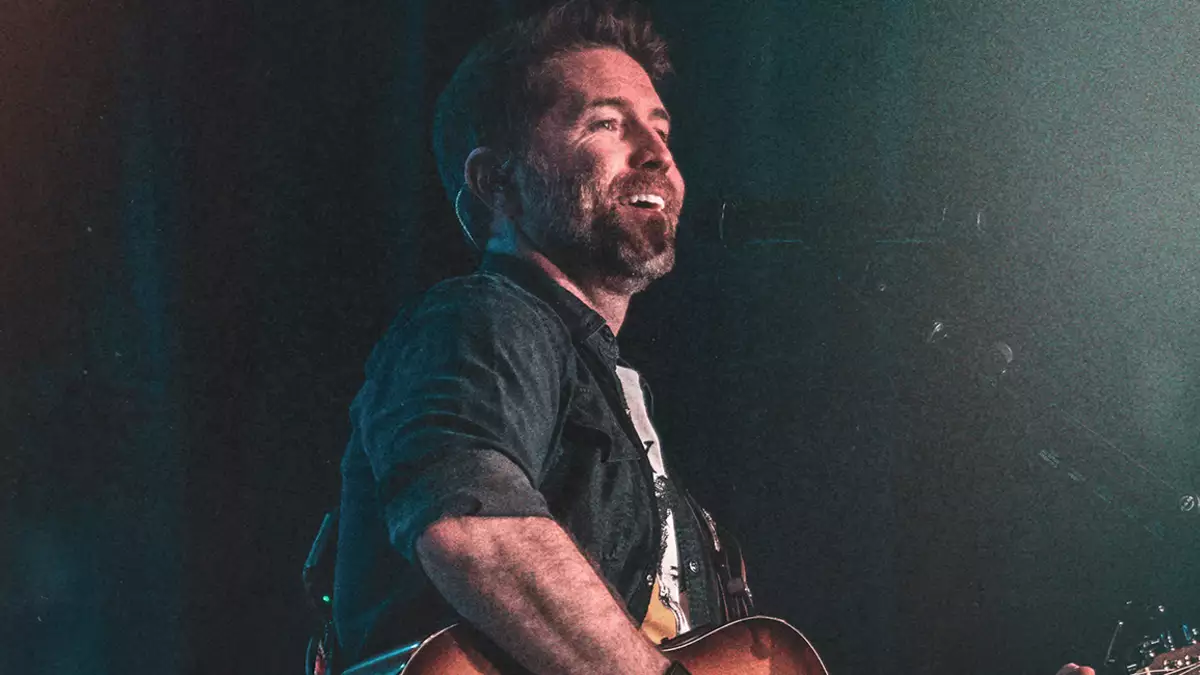
A country vow returned as a quiet act of presence, with Josh Turner carrying the melody and Randy Travis bringing the song home.
In 2020, Josh Turner placed Forever and Ever, Amen near the emotional center of his album Country State of Mind, recording it as a studio duet with Randy Travis. That detail matters because this was not simply a younger singer covering a beloved country standard. It was Turner revisiting one of Travis’s defining songs with Travis himself on the track, after a long period in which the older singer’s public voice had been profoundly altered by his 2013 stroke.
The song already carried a deep country memory. Written by Don Schlitz and Paul Overstreet, Forever and Ever, Amen became one of Travis’s signature recordings after its 1987 release from Always & Forever. Its language is plain almost to the point of nursery rhyme: old men talking, hair turning gray, love promised in measures anyone can understand. Travis’s original made that simplicity feel unforced. His phrasing was firm, warm, and lightly amused, giving the vow the shape of everyday certainty rather than grand theater.
Turner’s 2020 version respects that memory without trying to duplicate it. His own bass-baritone gives the song a different gravity, darker in color and more measured in movement. The arrangement leans into country tradition rather than redesigning the tune: steady rhythm, open space around the vocal, and a sense that the melody knows exactly where it is going. Turner does not oversell the pledge. He sings it as if durability is best proven by calmness, not volume.
The presence of Randy Travis changes the recording’s emotional temperature. Since the severe 2013 stroke that left lasting effects on his speech and singing, Travis’s appearances in song have carried a different meaning. On this duet, he is not asked to recreate the full command of the 1987 record. The performance understands the dignity of limitation. It allows his participation to be brief, carefully placed, and deeply recognizable, so that a familiar title becomes a document of return.
That restraint is what gives the duet its force. Turner’s vocal becomes a kind of shelter for the song, holding the melody with steadiness while Travis’s contribution arrives as an affirmation rather than an ornament. The effect is not a contest between generations. It is closer to a handoff made in full view of the listener: one artist honoring the line of influence that shaped him, the other returning to a lyric that the public had long associated with his name.
Country State of Mind was built around that kind of conversation with the past. Released in 2020, the album found Turner interpreting songs connected to country artists who helped define his musical imagination. In that setting, Forever and Ever, Amen stands apart because the connection is not abstract. Travis was one of the voices that made room for traditional country to breathe in the late 1980s, and Turner’s career has often shown a similar trust in low registers, clear storytelling, and unhurried conviction.
Hearing the song in this later form also changes the lyric. Lines that once sounded like youthful assurance now seem to hold the weight of time, illness, recovery, and continuity. The promise of forever is still written as romance, but the duet lets it widen into something else: loyalty to a song, to a tradition, to a voice that could no longer move through music in the same way but could still be welcomed into it. The word amen becomes less of an ending than a small, steadfast reply.
There is inspiration here, but it is not the loud kind. It comes from the discipline of not forcing a moment to become bigger than it can honestly be. Turner leaves space. Travis enters that space. The old song survives not by being polished into a new monument, but by accepting the marks of time on the people who carry it. In the 2020 studio duet of Forever and Ever, Amen, country music’s past is not frozen behind glass. It breathes, answers softly, and keeps faith with the melody.
