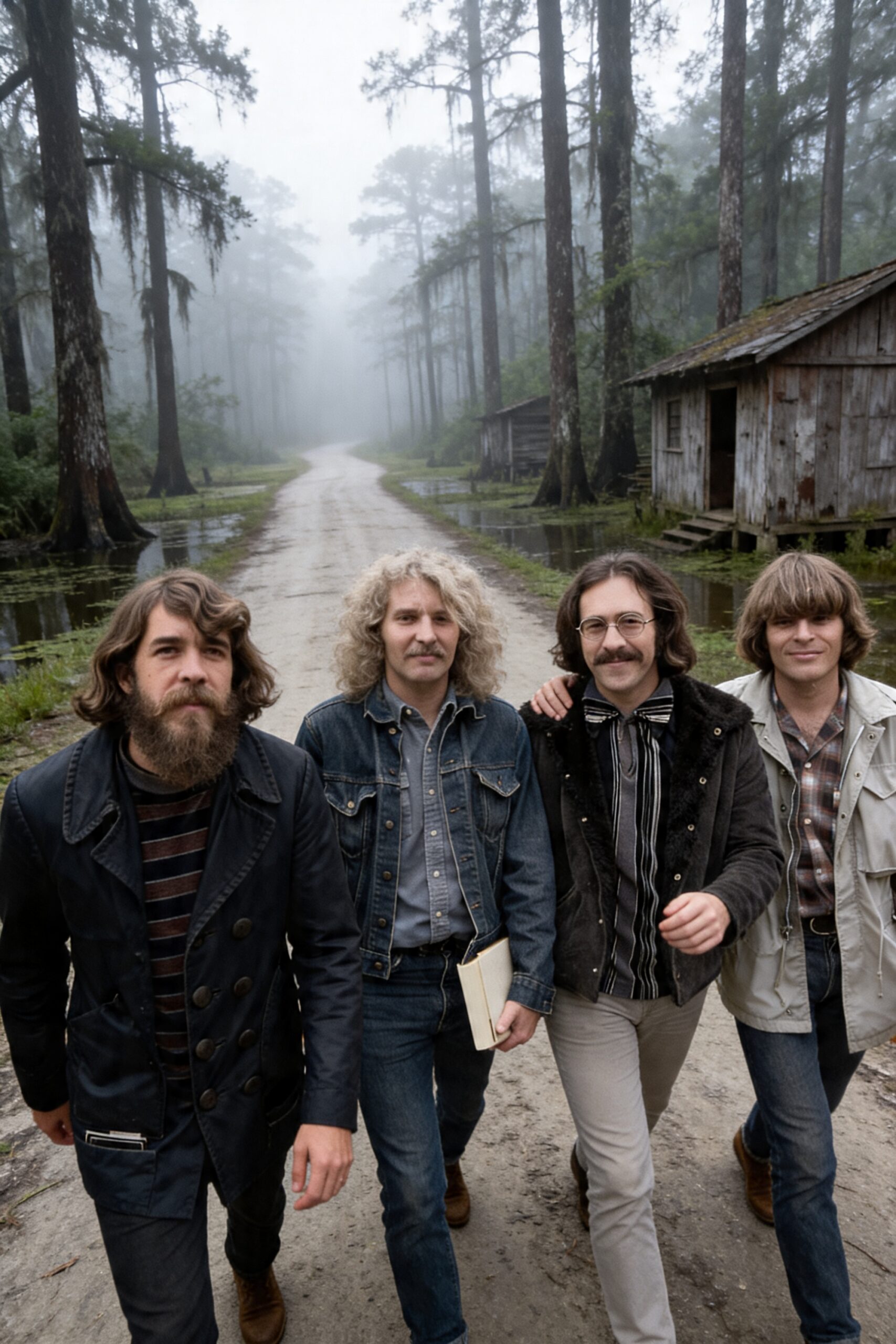
A childhood soda flavor became a river of memory in Creedence Clearwater Revival’s 1969 title track.
In 1969, Creedence Clearwater Revival released Green River as both a single and the title track of the band’s third studio album, Green River. Written by John Fogerty, the song carries one of rock’s most disarming origin stories: Fogerty has explained that the title came from a childhood soda-pop syrup flavor called Green River. What could have remained a small, almost comic detail instead became the doorway into one of Creedence’s most vivid pieces of remembered American landscape.
That origin matters because the song is not really about soda, and it is not simply about a map location either. Fogerty has connected its imagery to childhood memories of water, trees, and outdoor escape in Northern California, including time near Putah Creek. The phrase Green River works like a remembered taste on the tongue: artificial, sweet, bright, and yet capable of unlocking something much older than commerce. It is a title born from a fountain drink that opens into a world of shallow water, night roads, insects, rocks, and the freedom of being young enough to believe a familiar place might last forever.
The record itself wastes no time building that world. The guitar riff arrives with the confidence of something already in motion, clipped and earthy, more muscular than ornate. Doug Clifford keeps the beat steady and dry, Stu Cook anchors the groove without crowding it, and Tom Fogerty helps hold the rhythm section’s plainspoken force in place. Creedence’s sound in this period was famously lean: no grand arrangement, no long instrumental excursion, no studio mist. The band finds atmosphere through pressure, repetition, and tone. The result feels less like a postcard than a memory struck sharply enough to spark.
John Fogerty’s vocal is central to that effect. He does not sing Green River as a dreamy reminiscence. He sings it with urgency, as if the past is not soft but alive, still pulling at him. His voice has the rough grain that made Creedence distinct: Southern in flavor despite the band’s Bay Area roots, country-blues in attack, rock and roll in its insistence. That tension gives the song much of its power. It sounds as if it belongs to a mythic rural South, yet it is filtered through a California childhood and a songwriter’s imagination. The river is both specific and invented, personal and public.
The lyrics move through fragments rather than explanation. They summon water, moonlight, creatures, a road, a tree, a stone skipped across the surface. None of these images needs a detailed backstory. Their force comes from how quickly they appear, like flashes seen from a car window or sensations retrieved from early memory. Fogerty’s writing often works this way: direct language, compact scenes, almost no ornamental excess. In Green River, that economy lets each image carry more weight. The song does not tell listeners what childhood meant; it lets them feel how memory behaves when it returns in pieces.
Placed on the Green River album, the title track helped define the particular strength Creedence Clearwater Revival reached in 1969. The band was moving with extraordinary momentum, following Bayou Country and preceding Willy and the Poor Boys within the same year. Yet Green River does not sound hurried in the careless sense. It sounds distilled. Creedence had learned how to make a record feel immediate without making it feel thin. Every part seems chosen for function: the riff pushes, the drums tighten, the bass turns the ground solid, and the vocal makes the remembered river seem urgent enough to revisit.
The soda-syrup origin gives the song a strange and beautiful human scale. Rock history often prefers dramatic legends: midnight sessions, artistic battles, sudden revelations. Green River begins with something ordinary, a childhood flavor that happened to stay in the mind. That ordinariness is precisely what makes the song generous. It suggests that memory does not always announce itself through grand events. Sometimes it hides in a taste, a name, a local place, a summer sound, or a phrase that waits years before it becomes art.
For Creedence Clearwater Revival, the track also shows how invention and authenticity can coexist without cancelling each other out. The band did not need to be from the bayou to create music that felt wet with river air and rural motion. Fogerty’s gift was not documentary accuracy; it was compression, the ability to take a few true sensations and shape them into something listeners could enter. Green River is not a confession, not a travelogue, not a novelty built around a drink. It is a song about how the past survives by changing form.
That is why the title’s unlikely source still feels important. A soda syrup gave Fogerty a name, but the song gave that name a landscape. In less than three minutes, Creedence Clearwater Revival turned a private childhood association into a shared place of return. The river in the song may not be one fixed body of water for every listener. It may be any place remembered through sound, taste, heat, movement, or distance. The miracle is not that the memory was preserved exactly. It is that music found a way to keep it flowing.
