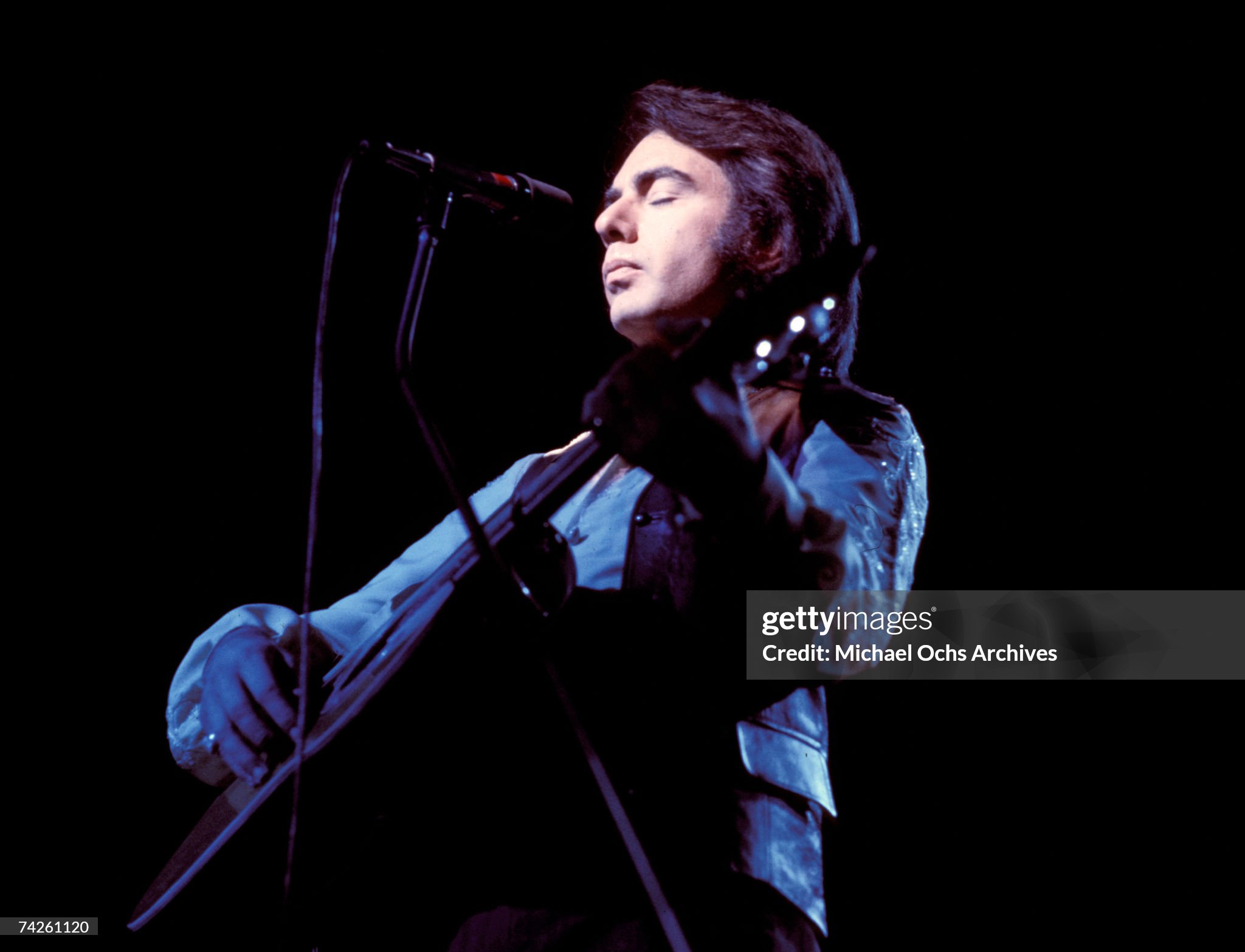
Before the big ballads and arena singalongs, Neil Diamond could make a brief 1967 B-side feel like a private note left under the louder hit.
In 1967, during his early Bang Records period, Neil Diamond released Girl, You’ll Be a Woman Soon as a single connected to his album Just for You. On the original flip side was You’ll Forget, a smaller and less celebrated recording that nonetheless belongs to the same crucial chapter: the moment when Diamond was still emerging from the world of professional songwriting into the sharper light of being a recording artist with his own voice, his own phrasing, and his own emotional weather.
It is easy, with years of hindsight, to let the A-side take up all the room. Girl, You’ll Be a Woman Soon became one of Diamond’s important early songs, a dramatic pop-rock declaration from a young writer who already understood how to make desire sound urgent and theatrical. But B-sides often preserve a different kind of truth. They are not always built to announce a career. Sometimes they show the workshop, the instinct, the shadow tone beside the public statement. You’ll Forget is valuable for that reason. It catches Diamond before the later sweep of Sweet Caroline, before the solemn grandeur of I Am… I Said, before the concert-stage persona became inseparable from the songs. Here, the feeling is more compact, more exposed, and closer to the grain of the era.
The title alone carries a quiet bruise. You’ll Forget does not sound like a plea so much as a prediction, and that gives the song its emotional shape. In early Diamond songs, romantic language often arrives with a strong outline: direct, rhythmic, built for radio, but carrying more ache than the surface suggests. He was already skilled at writing lines that felt immediate without needing to be ornate. The emotional force came from compression. A phrase could sound simple and still open into disappointment, pride, fear, or resignation.
That was one of the signatures of Diamond’s early work. Before his records grew larger in arrangement and reputation, he had a keen understanding of the pop single as a small dramatic room. The late-1960s atmosphere around Bang Records favored songs that moved quickly, hooks that landed clearly, and vocals that did not waste time explaining themselves. Within that frame, Diamond’s voice had a distinctive tension. It was not smooth in the conventional sense, and that was part of its appeal. There was a grain in it, a push from the chest, a sense of a man trying to keep control of feeling rather than simply display it.
He had already made his mark with songs such as Solitary Man and Cherry, Cherry, recordings that helped establish him as more than a songwriter for hire. By the time Just for You appeared, Diamond was building a catalog that mixed youthful confidence with a surprisingly adult awareness of loneliness. That contrast matters when hearing You’ll Forget. The song may not have the cultural footprint of its A-side, but it belongs to the same early portrait: a young artist learning how to turn restlessness, romance, and self-protection into concise pop drama.
There is also something meaningful about the physical idea of the flip side. In 1967, listeners did not encounter every song as an isolated digital object. A single had two faces. The side promoted to radio might carry the obvious claim on attention, but the other side waited for the listener who turned the record over. In that act, a song like You’ll Forget could become a private discovery. It did not have to compete with the whole sweep of Diamond’s future. It simply had to occupy its own few minutes with conviction.
He would go on to become a far bigger figure than any one early B-side could predict, but recordings like this help explain the foundation. The young Neil Diamond was already drawn to emotional contrasts: confidence and insecurity, romance and distance, memory and the fear of being erased. You’ll Forget sits at that intersection. It is not merely a collectible detail attached to Girl, You’ll Be a Woman Soon; it is a glimpse of the emotional vocabulary that Diamond would keep refining for decades.
He had not yet become the full-scale showman audiences would later know. He was still close to the songwriter’s desk, close to the short single, close to the nerve of the line. That is what gives You’ll Forget its lasting interest. It reminds us that careers are not only built from the songs everyone remembers first. Sometimes the quieter side of the record tells us how the voice was learning to carry loss before the spotlight grew wide enough to hold it.
